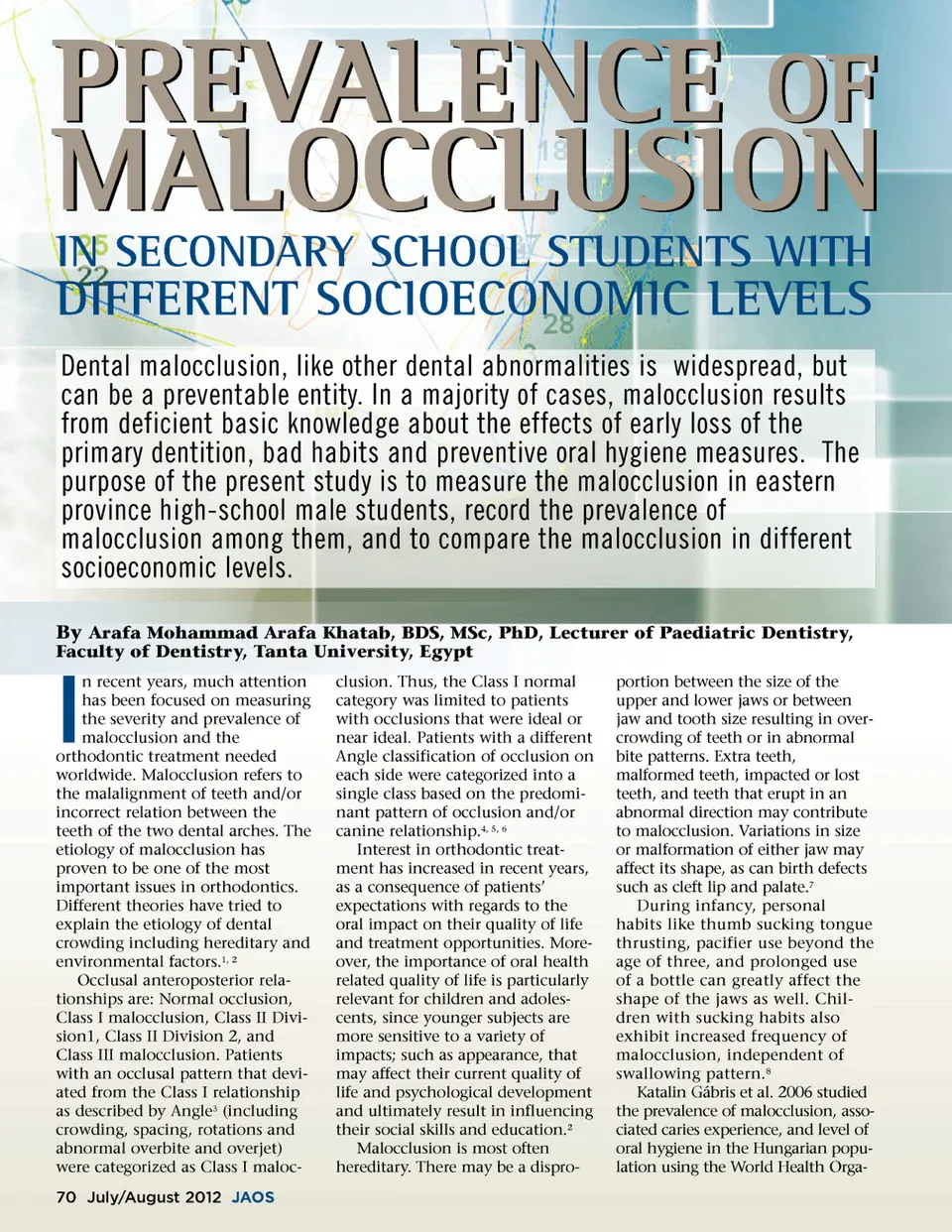
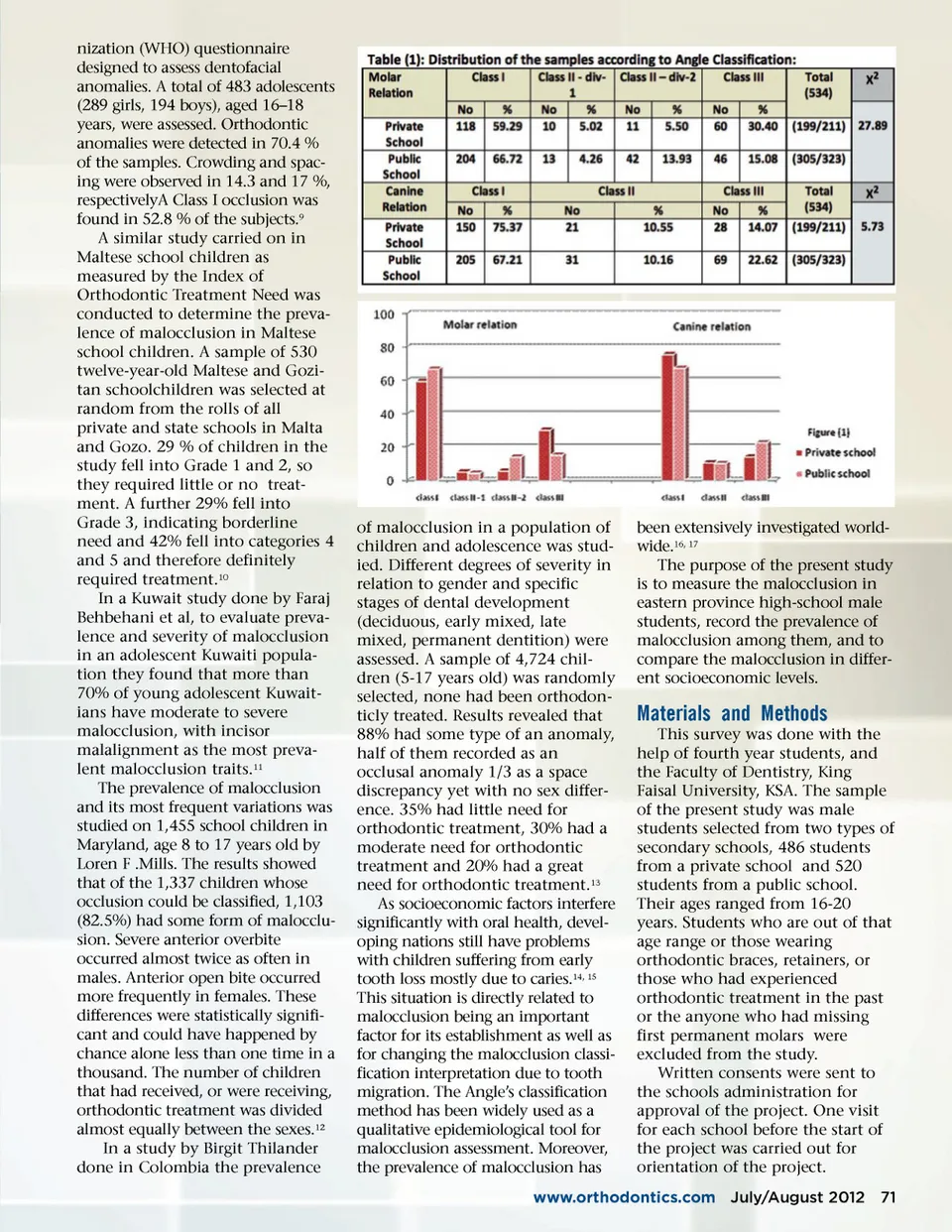
nization (WHO) questionnaire designed to assess dentofacial anomalies. A total of 483 adolescents (289 girls, 194 boys), aged 16–18 years, were assessed. Orthodontic anomalies were detected in 70.4 % of the samples. Crowding and spac-ing were observed in 14.3 and 17 %, respectivelyA Class I occlusion was found in 52.8 % of the subjects. 9 A similar study carried on in Maltese school children as measured by the Index of Orthodontic Treatment Need was conducted to determine the preva-lence of malocclusion in Maltese school children. A sample of 530 twelve-year-old Maltese and Gozi-tan schoolchildren was selected at random from the rolls of all private and state schools in Malta and Gozo. 29 % of children in the study fell into Grade 1 and 2, so they required little or no treat-ment. A further 29% fell into Grade 3, indicating borderline need and 42% fell into categories 4 and 5 and therefore definitely required treatment. 10 In a Kuwait study done by Faraj Behbehani et al, to evaluate preva-lence and severity of malocclusion in an adolescent Kuwaiti popula-tion they found that more than 70% of young adolescent Kuwait-ians have moderate to severe malocclusion, with incisor malalignment as the most preva-lent malocclusion traits. 11 The prevalence of malocclusion and its most frequent variations was studied on 1,455 school children in Maryland, age 8 to 17 years old by Loren F .Mills. The results showed that of the 1,337 children whose occlusion could be classified, 1,103 (82.5%) had some form of malocclu-sion. Severe anterior overbite occurred almost twice as often in males. Anterior open bite occurred more frequently in females. These differences were statistically signifi-cant and could have happened by chance alone less than one time in a thousand. The number of children that had received, or were receiving, orthodontic treatment was divided almost equally between the sexes. 12 In a study by Birgit Thilander done in Colombia the prevalence of malocclusion in a population of children and adolescence was stud-ied. Different degrees of severity in relation to gender and specific stages of dental development (deciduous, early mixed, late mixed, permanent dentition) were assessed. A sample of 4,724 chil-dren (5-17 years old) was randomly selected, none had been orthodon-ticly treated. Results revealed that 88% had some type of an anomaly, half of them recorded as an occlusal anomaly 1/3 as a space discrepancy yet with no sex differ-ence. 35% had little need for orthodontic treatment, 30% had a moderate need for orthodontic treatment and 20% had a great need for orthodontic treatment. 13 As socioeconomic factors interfere significantly with oral health, devel-oping nations still have problems with children suffering from early tooth loss mostly due to caries. 14, 15 This situation is directly related to malocclusion being an important factor for its establishment as well as for changing the malocclusion classi-fication interpretation due to tooth migration. The Angle’s classification method has been widely used as a qualitative epidemiological tool for malocclusion assessment. Moreover, the prevalence of malocclusion has been extensively investigated world-wide. 16, 17 The purpose of the present study is to measure the malocclusion in eastern province high-school male students, record the prevalence of malocclusion among them, and to compare the malocclusion in differ-ent socioeconomic levels. Materials and Methods This survey was done with the help of fourth year students, and the Faculty of Dentistry, King Faisal University, KSA. The sample of the present study was male students selected from two types of secondary schools, 486 students from a private school and 520 students from a public school. Their ages ranged from 16-20 years. Students who are out of that age range or those wearing orthodontic braces, retainers, or those who had experienced orthodontic treatment in the past or the anyone who had missing first permanent molars were excluded from the study. Written consents were sent to the schools administration for approval of the project. One visit for each school before the start of the project was carried out for orientation of the project. www.orthodontics.com July/August 2012 71
Journal of the American Orthodontic Society July-August 2012 Buyer's Guide: Page 71