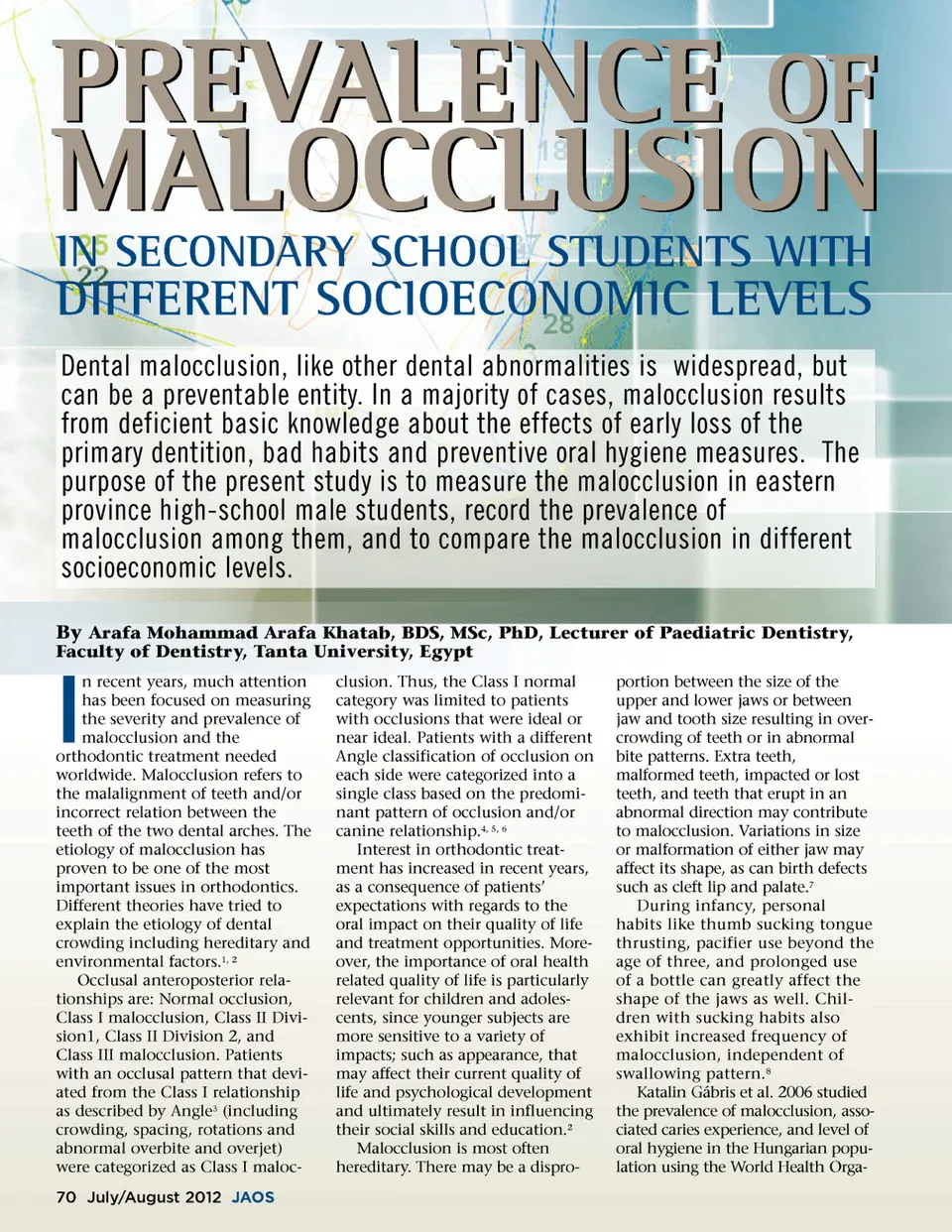
PREVALENCE P REVALENCE OF MALOCCLUSION IN SECONDARY SCHOOL STUDENTS WITH DIFFERENT SOCIOECONOMIC LEVELS Dental malocclusion, like other dental abnormalities is widespread, but can be a preventable entity. In a majority of cases, malocclusion results from deficient basic knowledge about the effects of early loss of the primary dentition, bad habits and preventive oral hygiene measures. The purpose of the present study is to measure the malocclusion in eastern province high-school male students, record the prevalence of malocclusion among them, and to compare the malocclusion in different socioeconomic levels. By Arafa Mohammad Arafa Khatab, BDS, MSc, PhD, Lecturer of Paediatric Dentistry, Faculty of Dentistry, Tanta University, Egypt I n recent years, much attention has been focused on measuring the severity and prevalence of malocclusion and the orthodontic treatment needed worldwide. Malocclusion refers to the malalignment of teeth and/or incorrect relation between the teeth of the two dental arches. The etiology of malocclusion has proven to be one of the most important issues in orthodontics. Different theories have tried to explain the etiology of dental crowding including hereditary and environmental factors. 1, 2 Occlusal anteroposterior rela-tionships are: Normal occlusion, Class I malocclusion, Class II Divi-sion1, Class II Division 2, and Class III malocclusion. Patients with an occlusal pattern that devi-ated from the Class I relationship as described by Angle 3 (including crowding, spacing, rotations and abnormal overbite and overjet) were categorized as Class I maloc-clusion. Thus, the Class I normal category was limited to patients with occlusions that were ideal or near ideal. Patients with a different Angle classification of occlusion on each side were categorized into a single class based on the predomi-nant pattern of occlusion and/or canine relationship. 4, 5, 6 Interest in orthodontic treat-ment has increased in recent years, as a consequence of patients’ expectations with regards to the oral impact on their quality of life and treatment opportunities. More-over, the importance of oral health related quality of life is particularly relevant for children and adoles-cents, since younger subjects are more sensitive to a variety of impacts; such as appearance, that may affect their current quality of life and psychological development and ultimately result in influencing their social skills and education. 2 Malocclusion is most often hereditary. There may be a dispro-portion between the size of the upper and lower jaws or between jaw and tooth size resulting in over-crowding of teeth or in abnormal bite patterns. Extra teeth, malformed teeth, impacted or lost teeth, and teeth that erupt in an abnormal direction may contribute to malocclusion. Variations in size or malformation of either jaw may affect its shape, as can birth defects such as cleft lip and palate. 7 During infancy, personal habits like thumb sucking tongue thrusting, pacifier use beyond the age of three, and prolonged use of a bottle can greatly affect the shape of the jaws as well. Chil-dren with sucking habits also exhibit increased frequency of malocclusion, independent of swallowing pattern. 8 Katalin Gábris et al. 2006 studied the prevalence of malocclusion, asso-ciated caries experience, and level of oral hygiene in the Hungarian popu-lation using the World Health Orga-70 July/August 2012 JAOS
Journal of the American Orthodontic Society July-August 2012 Buyer's Guide: Page 70