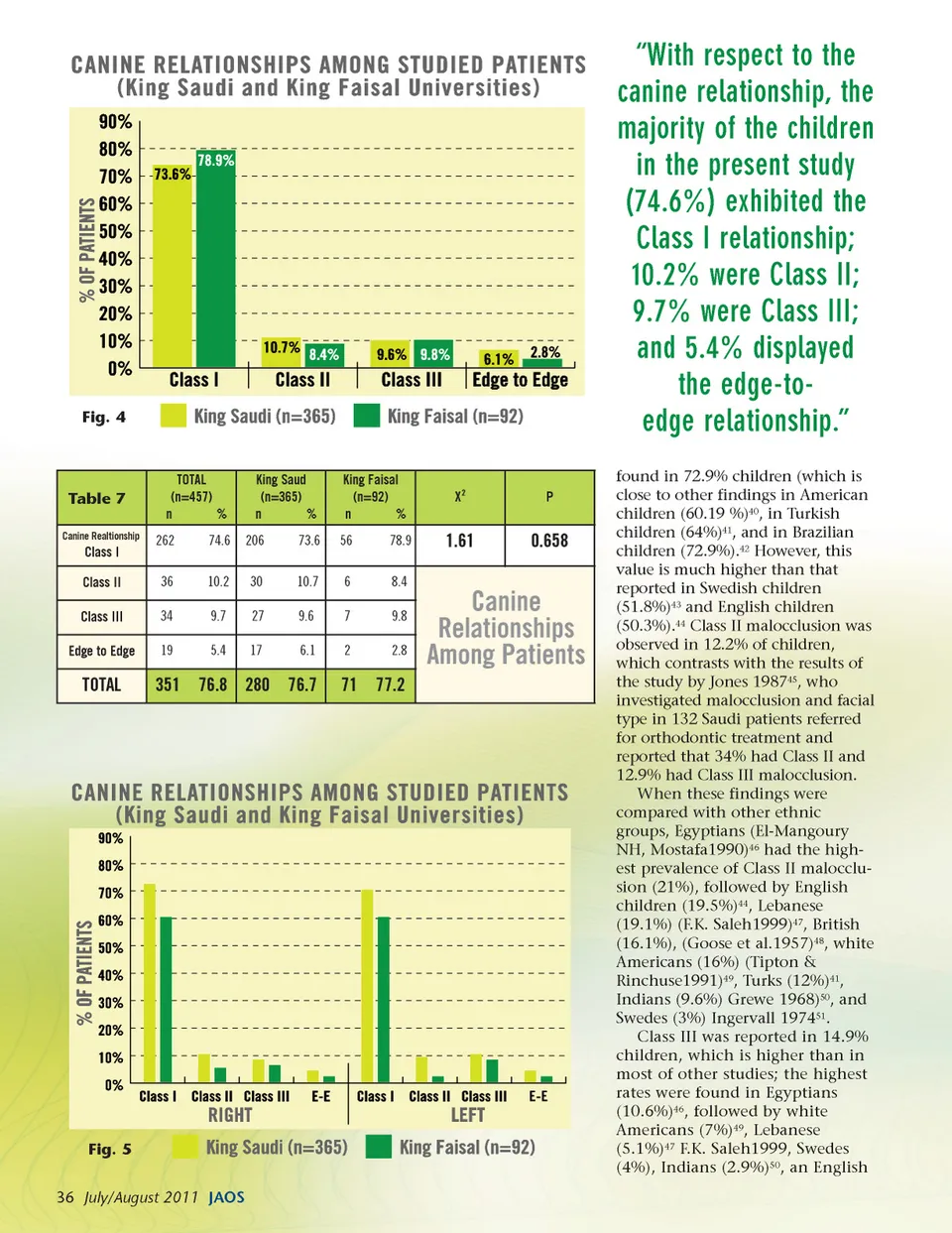
population (2.5%) 44 and Britons (2.9%) 48 . With respect to the canine rela-tionship, the majority of the chil-dren in the present study (74.6%) exhibited the Class I relationship; 10.2% were Class II; 9.7% were Class III; and 5.4% displayed the edge-to-edge relationship. These results are different from those reported by Alhaija & Qudeimat, (2003) 52 in Jordanian children, where 57% were found to display Class I; 29%, Class II; and 3.7%, Class III. The results of Farsi and Salama 21 were 86% canine Class I and 3.3% Class III. Open-bite was noted in 13.6% of the sample (13.7% at King Saud; 13% at King Faisal); these results are higher than those reported by Farsi and Salama (9.2%) 21 but much higher than levels reported in Jorda-nian children, 5.7% of whom had open-bite. 52 We found over-jet (more than 4 mm) in 81% of the children, whereas this occlusion was reported in 24.2% of children by Farsi and Salama. 21 However, these authors defined over-jet as more than 2 mm. Fig. 3 VARIABLES Open-bite Cross-bite TOTAL (n=457) n % 62 46 13.6 10.1 King Saud (n=365) n % 50 29 13.7 7.9 King Faisal (n=92) n % 12 17 13.0 18.5 X 2 Table 8 P 0.03 7.88 0.870 0.005* *Significant at P<0.05 www.orthodontics.com July/August 2011 37
Journal of the American Orthodontic Society July-August 2011-Buyer's Guide: Page 37