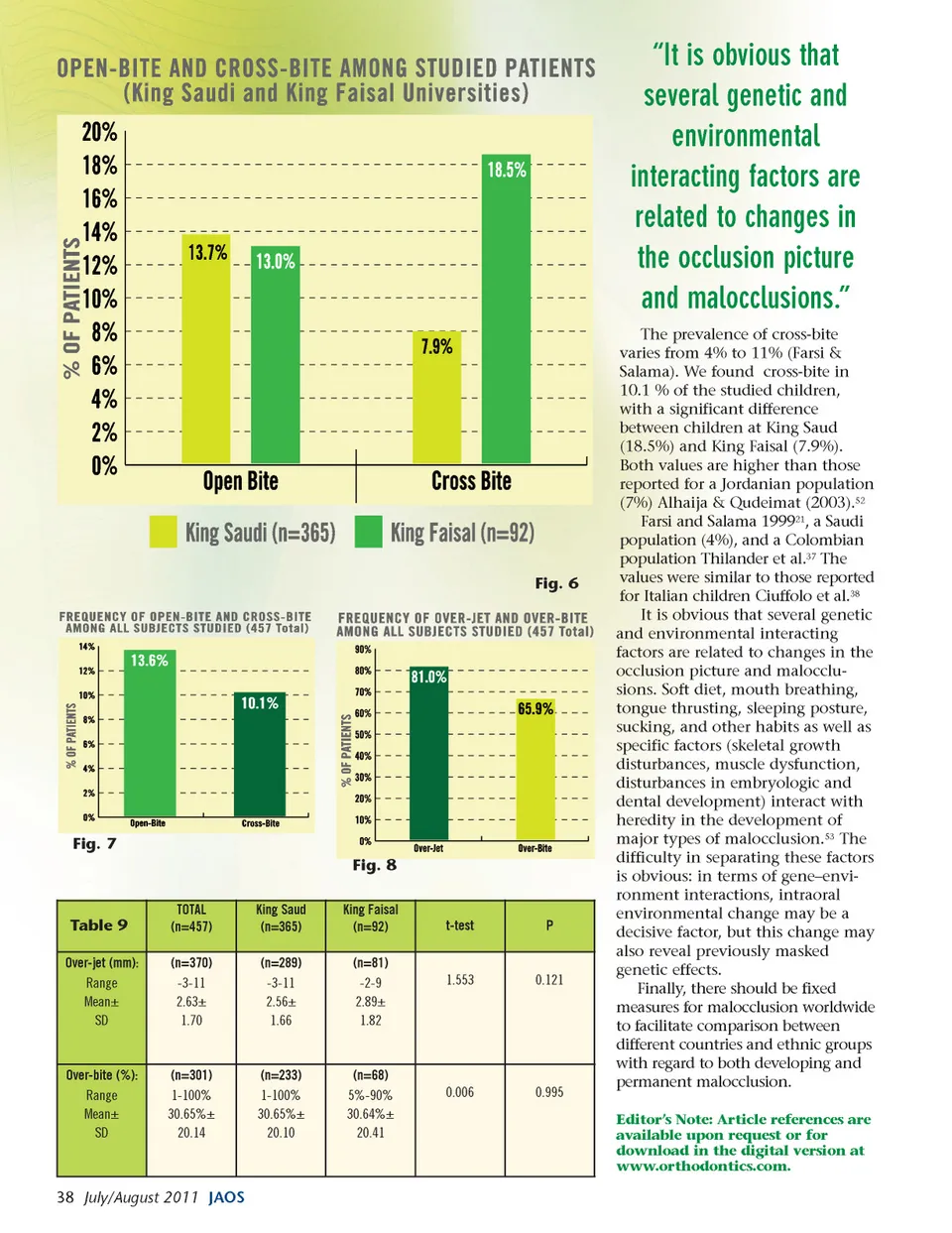
“It is obvious that several genetic and environmental interacting factors are related to changes in the occlusion picture and malocclusions.” The prevalence of cross-bite varies from 4% to 11% (Farsi & Salama). We found cross-bite in 10.1 % of the studied children, with a significant difference between children at King Saud (18.5%) and King Faisal (7.9%). Both values are higher than those reported for a Jordanian population (7%) Alhaija & Qudeimat (2003). 52 Farsi and Salama 1999 21 , a Saudi population (4%), and a Colombian population Thilander et al. 37 The values were similar to those reported for Italian children Ciuffolo et al. 38 It is obvious that several genetic and environmental interacting factors are related to changes in the occlusion picture and malocclu-sions. Soft diet, mouth breathing, tongue thrusting, sleeping posture, sucking, and other habits as well as specific factors (skeletal growth disturbances, muscle dysfunction, disturbances in embryologic and dental development) interact with heredity in the development of major types of malocclusion. 53 The difficulty in separating these factors is obvious: in terms of gene–envi-ronment interactions, intraoral environmental change may be a decisive factor, but this change may also reveal previously masked genetic effects. Finally, there should be fixed measures for malocclusion worldwide to facilitate comparison between different countries and ethnic groups with regard to both developing and permanent malocclusion. Editor’s Note: Article references are available upon request or for download in the digital version at www.orthodontics.com. Fig. 6 Fig. 7 Fig. 8 TOTAL (n=457) (n=370) -3-11 2.63± 1.70 King Saud (n=365) (n=289) -3-11 2.56± 1.66 King Faisal (n=92) (n=81) -2-9 2.89± 1.82 Table 9 Over-jet (mm): Range Mean± SD t-test P 1.553 0.121 Over-bite (%): Range Mean± SD (n=301) 1-100% 30.65%± 20.14 (n=233) 1-100% 30.65%± 20.10 (n=68) 5%-90% 30.64%± 20.41 0.006 0.995 38 July/August 2011 JAOS
Journal of the American Orthodontic Society July-August 2011-Buyer's Guide: Page 38