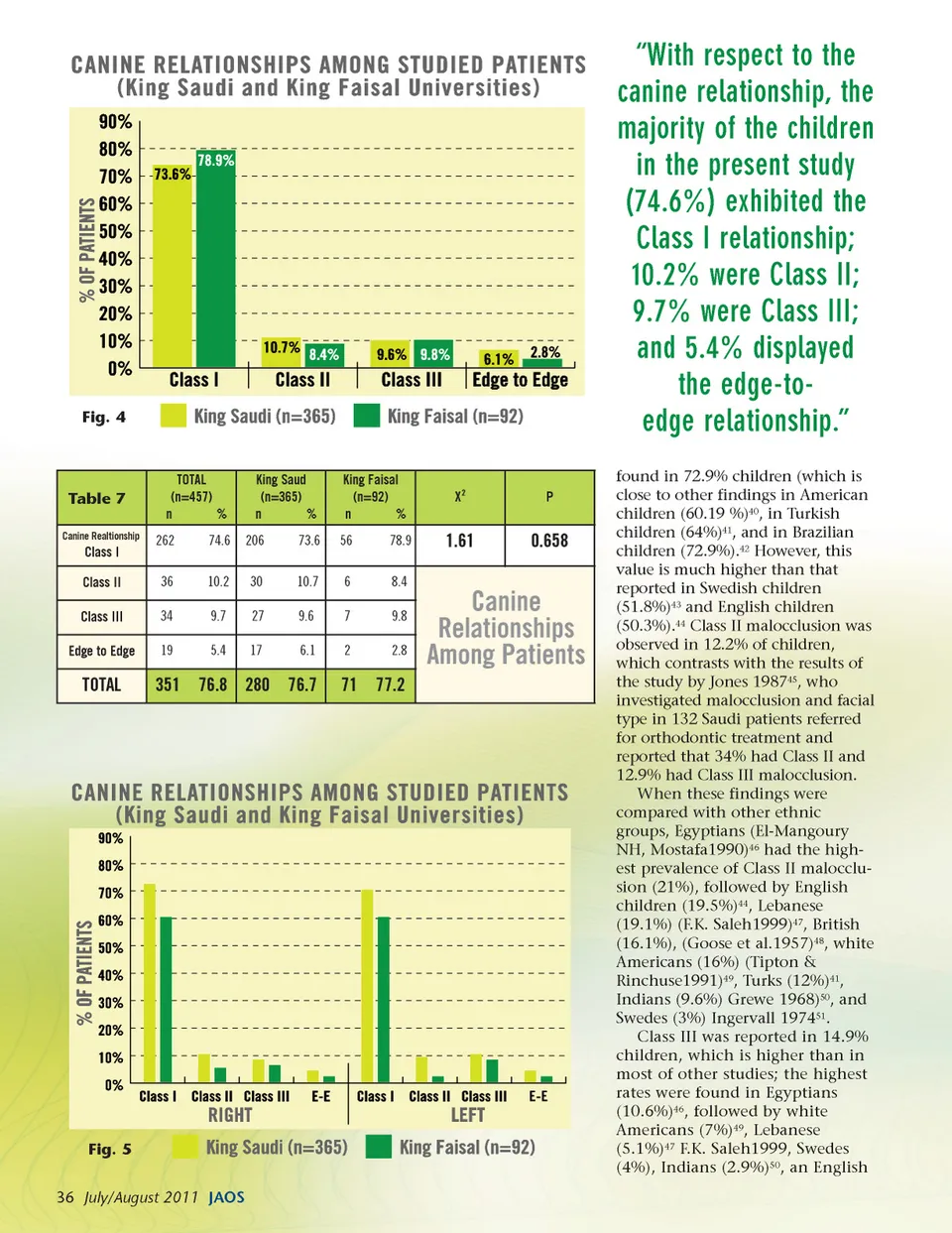
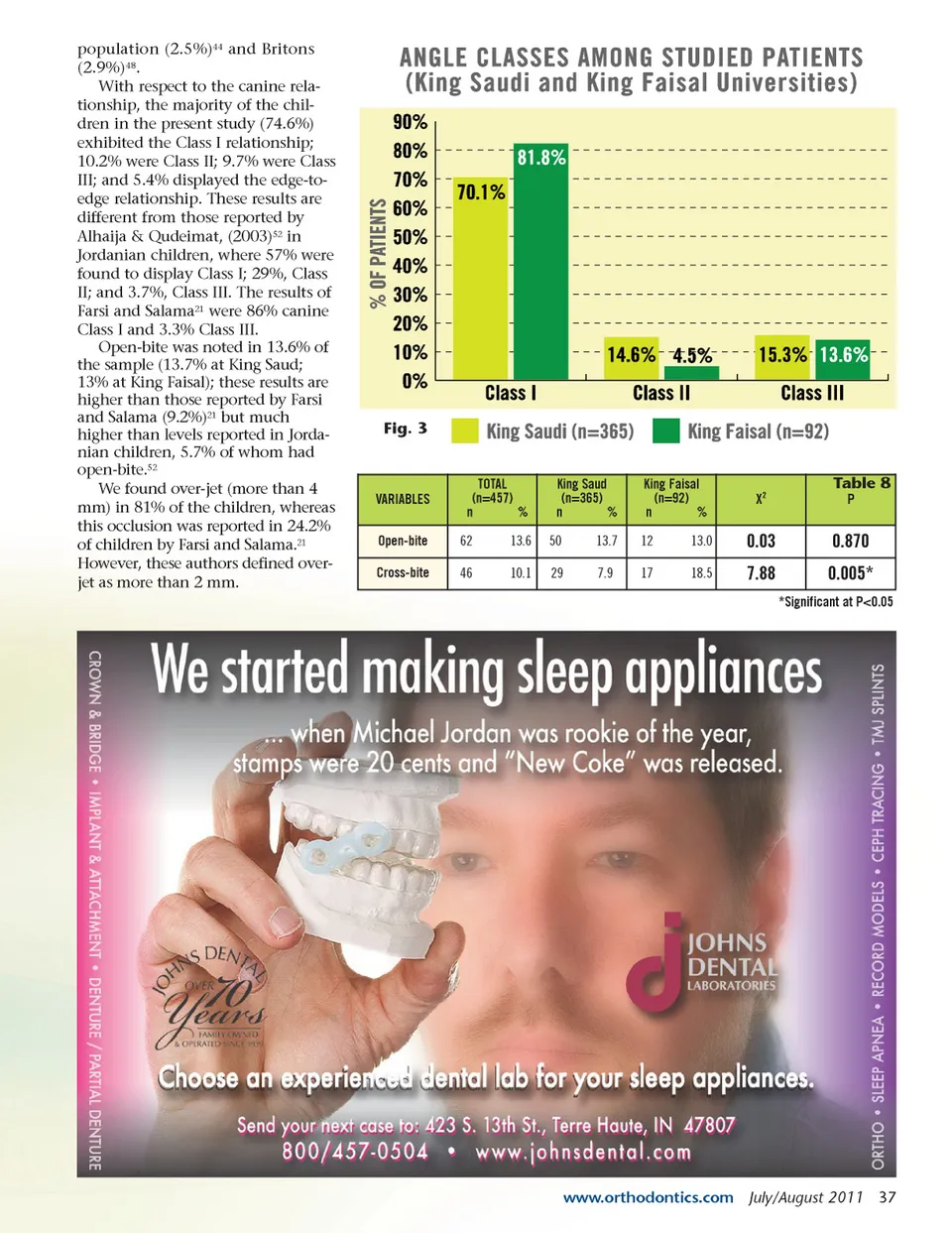
Fig. 4 “With respect to the canine relationship, the majority of the children in the present study (74.6%) exhibited the Class I relationship; 10.2% were Class II; 9.7% were Class III; and 5.4% displayed the edge-to-edge relationship.” TOTAL (n=457) n % 262 36 34 19 74.6 10.2 9.7 5.4 King Saud (n=365) n % 206 30 27 17 73.6 10.7 9.6 6.1 King Faisal (n=92) n % 56 6 7 2 78.9 8.4 9.8 2.8 X 2 P Table 7 Canine Realtionship Class I Class II Class III Edge to Edge 1.61 0.658 Canine Relationships Among Patients TOTAL 351 76.8 280 76.7 71 77.2 E-E Fig. 5 36 July/August 2011 JAOS found in 72.9% children (which is close to other findings in American children (60.19 %) 40 , in Turkish children (64%) 41 , and in Brazilian children (72.9%). 42 However, this value is much higher than that reported in Swedish children (51.8%) 43 and English children (50.3%). 44 Class II malocclusion was observed in 12.2% of children, which contrasts with the results of the study by Jones 1987 45 , who investigated malocclusion and facial type in 132 Saudi patients referred for orthodontic treatment and reported that 34% had Class II and 12.9% had Class III malocclusion. When these findings were compared with other ethnic groups, Egyptians (El-Mangoury NH, Mostafa1990) 46 had the high-est prevalence of Class II malocclu-sion (21%), followed by English children (19.5%) 44 , Lebanese (19.1%) (F.K. Saleh1999) 47 , British (16.1%), (Goose et al.1957) 48 , white Americans (16%) (Tipton & Rinchuse1991) 49 , Turks (12%) 41 , Indians (9.6%) Grewe 1968) 50 , and Swedes (3%) Ingervall 1974 51 . Class III was reported in 14.9% children, which is higher than in most of other studies; the highest rates were found in Egyptians (10.6%) 46 , followed by white Americans (7%) 49 , Lebanese (5.1%) 47 F.K. Saleh1999, Swedes (4%), Indians (2.9%) 50 , an English
Journal of the American Orthodontic Society July-August 2011-Buyer's Guide: Page 36