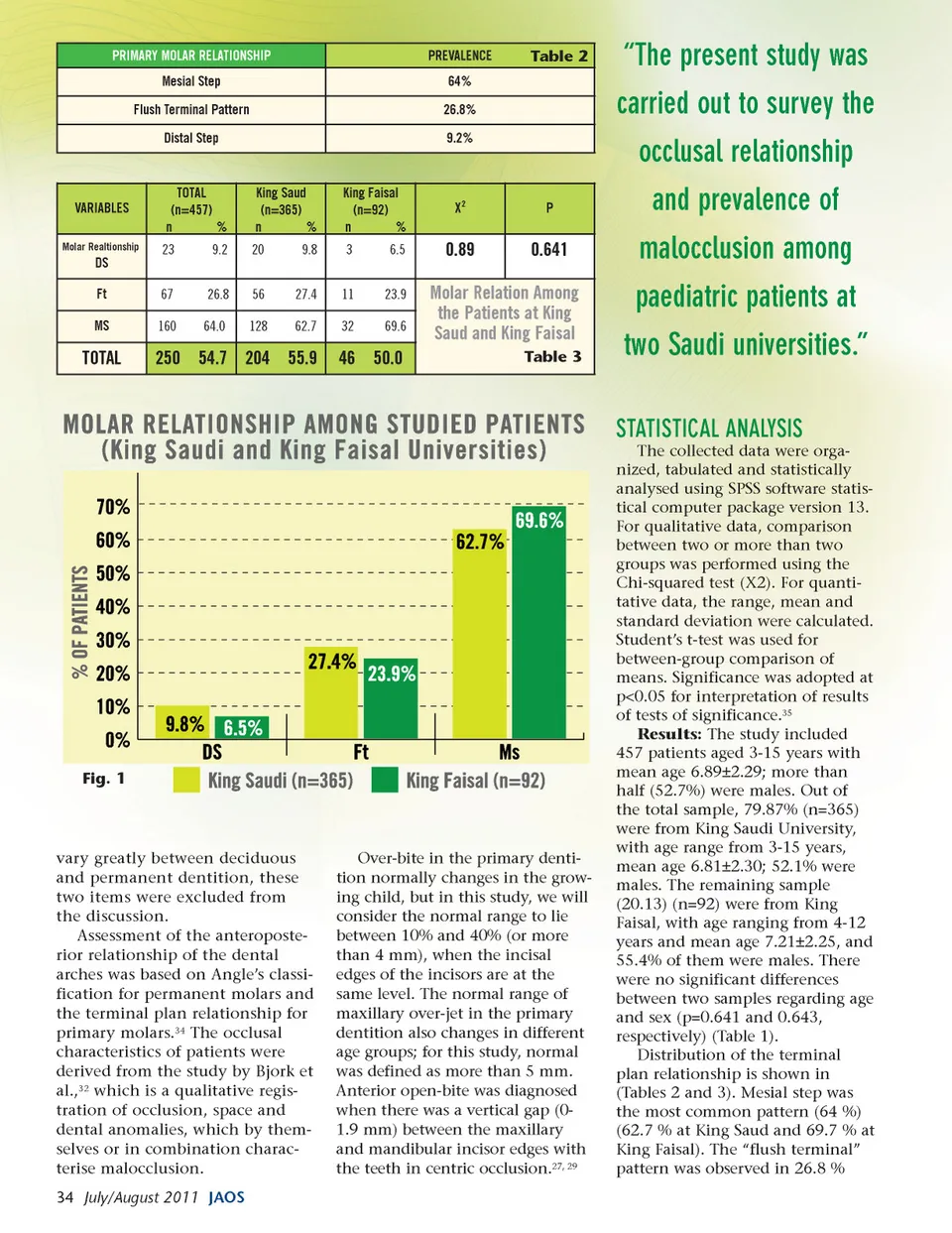
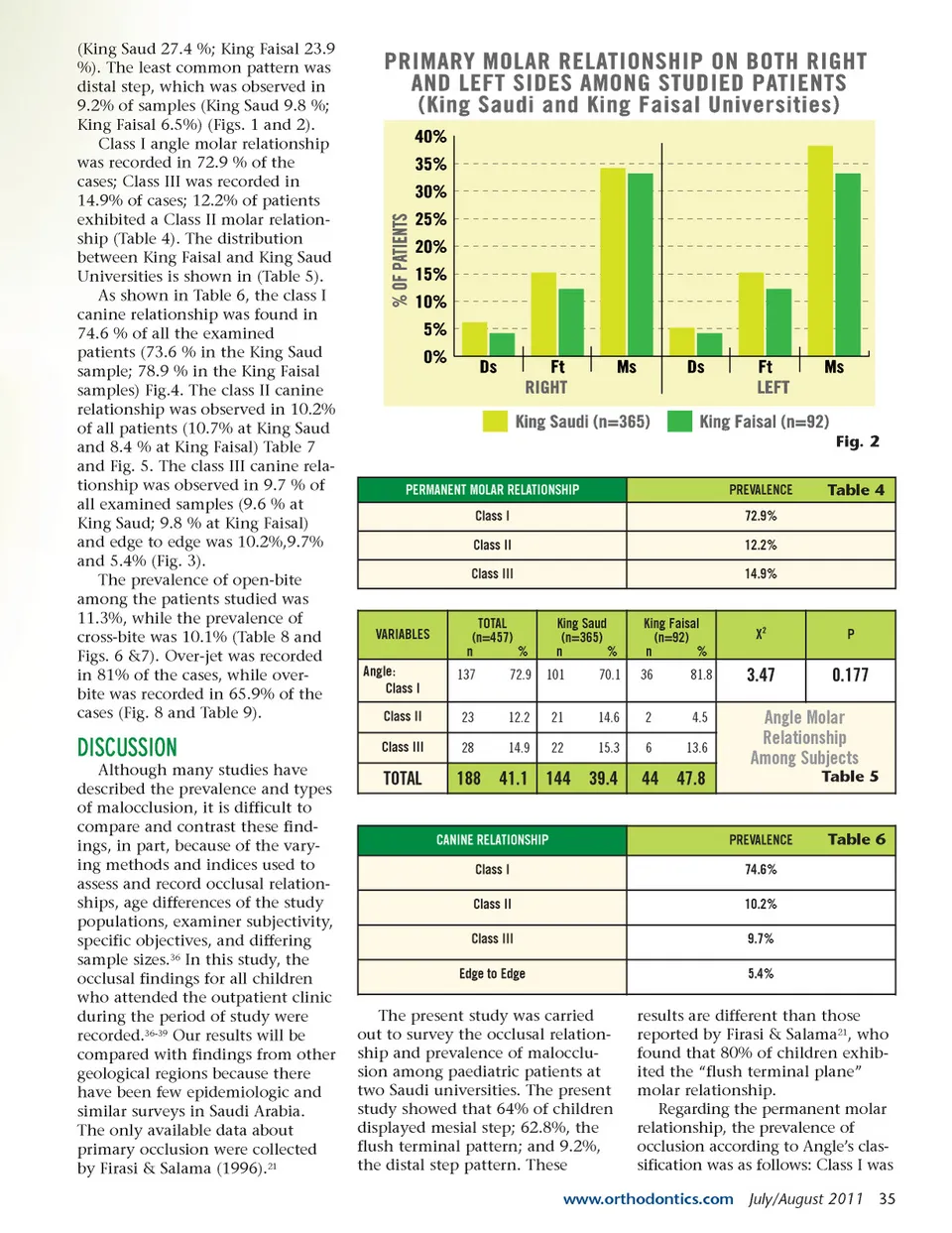
(King Saud 27.4 %; King Faisal 23.9 %). The least common pattern was distal step, which was observed in 9.2% of samples (King Saud 9.8 %; King Faisal 6.5%) (Figs. 1 and 2). Class I angle molar relationship was recorded in 72.9 % of the cases; Class III was recorded in 14.9% of cases; 12.2% of patients exhibited a Class II molar relation-ship (Table 4). The distribution between King Faisal and King Saud Universities is shown in (Table 5). As shown in Table 6, the class I canine relationship was found in 74.6 % of all the examined patients (73.6 % in the King Saud sample; 78.9 % in the King Faisal samples) Fig.4. The class II canine relationship was observed in 10.2% of all patients (10.7% at King Saud and 8.4 % at King Faisal) Table 7 and Fig. 5. The class III canine rela-tionship was observed in 9.7 % of all examined samples (9.6 % at King Saud; 9.8 % at King Faisal) and edge to edge was 10.2%,9.7% and 5.4% (Fig. 3). The prevalence of open-bite among the patients studied was 11.3%, while the prevalence of cross-bite was 10.1% (Table 8 and Figs. 6 &7). Over-jet was recorded in 81% of the cases, while over-bite was recorded in 65.9% of the cases (Fig. 8 and Table 9). Fig. 2 PERMANENT MOLAR RELATIONSHIP Class I Class II Class III PREVALENCE 72.9% 12.2% 14.9% Table 4 VARIABLES Angle: Class I Class II Class III TOTAL (n=457) n % 137 23 28 72.9 12.2 14.9 King Saud (n=365) n % 101 21 22 70.1 14.6 15.3 King Faisal (n=92) n % 36 2 6 81.8 4.5 13.6 X 2 P 3.47 0.177 DISCUSSION Although many studies have described the prevalence and types of malocclusion, it is difficult to compare and contrast these find-ings, in part, because of the vary-ing methods and indices used to assess and record occlusal relation-ships, age differences of the study populations, examiner subjectivity, specific objectives, and differing sample sizes. 36 In this study, the occlusal findings for all children who attended the outpatient clinic during the period of study were recorded. 36-39 Our results will be compared with findings from other geological regions because there have been few epidemiologic and similar surveys in Saudi Arabia. The only available data about primary occlusion were collected by Firasi & Salama (1996). 21 Angle Molar Relationship Among Subjects Table 5 TOTAL 188 41.1 144 39.4 CANINE RELATIONSHIP Class I Class II Class III Edge to Edge 44 47.8 PREVALENCE 74.6% 10.2% 9.7% 5.4% Table 6 The present study was carried out to survey the occlusal relation-ship and prevalence of malocclu-sion among paediatric patients at two Saudi universities. The present study showed that 64% of children displayed mesial step; 62.8%, the flush terminal pattern; and 9.2%, the distal step pattern. These results are different than those reported by Firasi & Salama 21 , who found that 80% of children exhib-ited the “flush terminal plane” molar relationship. Regarding the permanent molar relationship, the prevalence of occlusion according to Angle’s clas-sification was as follows: Class I was www.orthodontics.com July/August 2011 35
Journal of the American Orthodontic Society July-August 2011-Buyer's Guide: Page 35