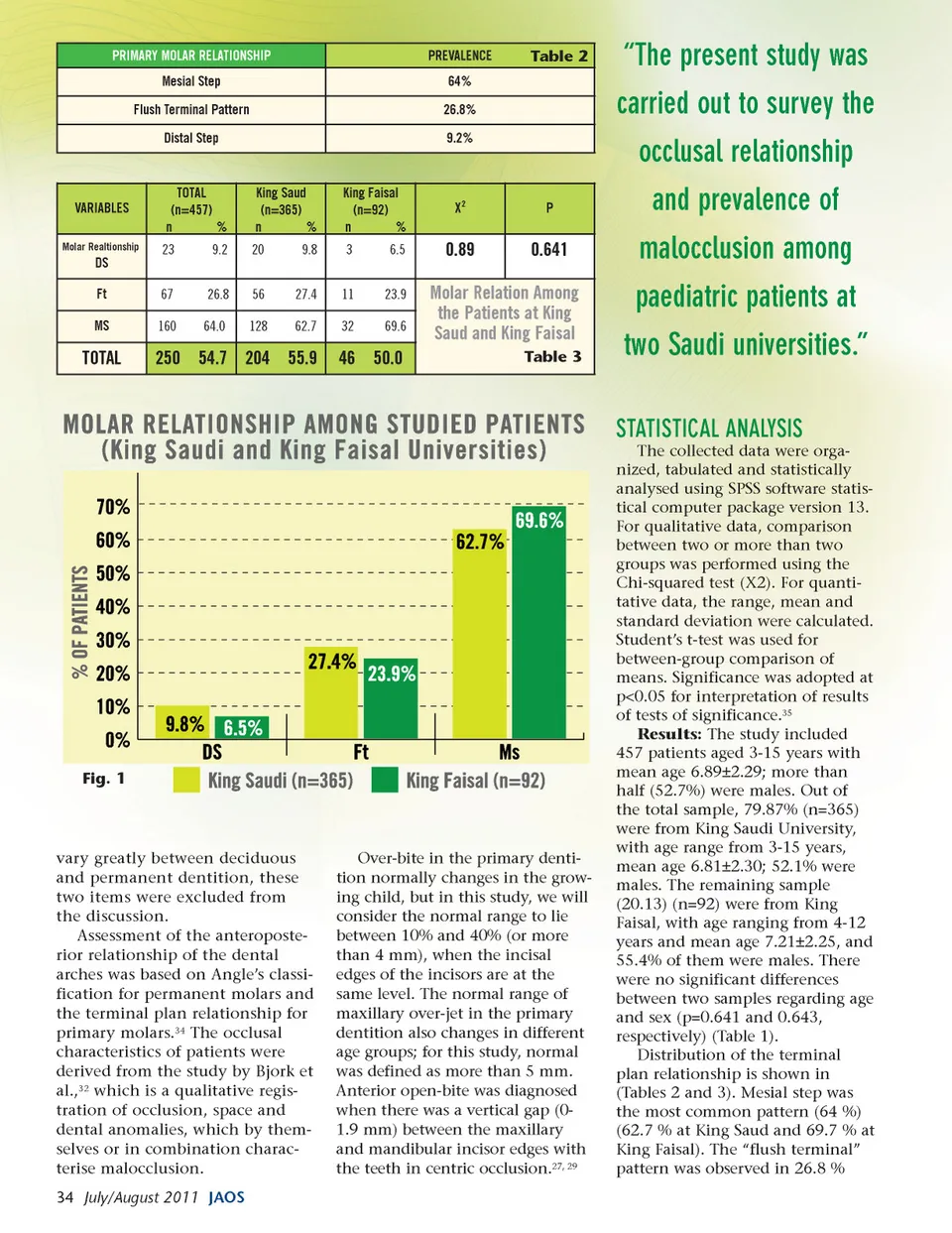
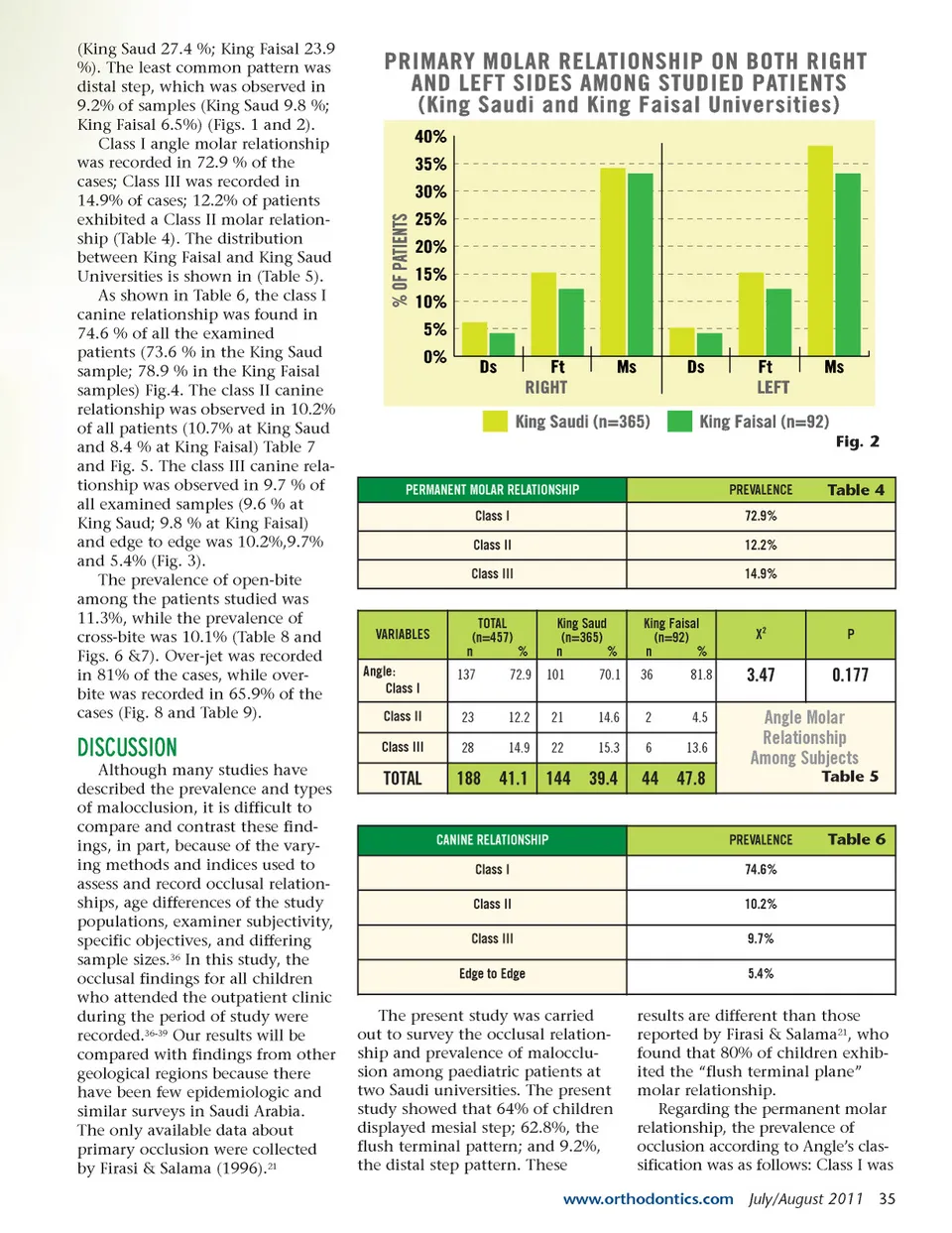
PRIMARY MOLAR RELATIONSHIP Mesial Step Flush Terminal Pattern Distal Step PREVALENCE 64% 26.8% 9.2% Table 2 “The present study was carried out to survey the occlusal relationship and prevalence of malocclusion among paediatric patients at two Saudi universities.” STATISTICAL ANALYSIS The collected data were orga-nized, tabulated and statistically analysed using SPSS software statis-tical computer package version 13. For qualitative data, comparison between two or more than two groups was performed using the Chi-squared test (X2). For quanti-tative data, the range, mean and standard deviation were calculated. Student’s t-test was used for between-group comparison of means. Significance was adopted at p<0.05 for interpretation of results of tests of significance. 35 Results: The study included 457 patients aged 3-15 years with mean age 6.89±2.29; more than half (52.7%) were males. Out of the total sample, 79.87% (n=365) were from King Saudi University, with age range from 3-15 years, mean age 6.81±2.30; 52.1% were males. The remaining sample (20.13) (n=92) were from King Faisal, with age ranging from 4-12 years and mean age 7.21±2.25, and 55.4% of them were males. There were no significant differences between two samples regarding age and sex (p=0.641 and 0.643, respectively) (Table 1). Distribution of the terminal plan relationship is shown in (Tables 2 and 3). Mesial step was the most common pattern (64 %) (62.7 % at King Saud and 69.7 % at King Faisal). The “flush terminal” pattern was observed in 26.8 % VARIABLES Molar Realtionship TOTAL (n=457) n % 23 67 160 9.2 26.8 64.0 King Saud (n=365) n % 20 56 128 9.8 27.4 62.7 King Faisal (n=92) n % 3 11 32 6.5 23.9 69.6 X 2 P DS Ft MS 0.89 0.641 Molar Relation Among the Patients at King Saud and King Faisal Table 3 TOTAL 250 54.7 204 55.9 46 50.0 Fig. 1 vary greatly between deciduous and permanent dentition, these two items were excluded from the discussion. Assessment of the anteroposte-rior relationship of the dental arches was based on Angle’s classi-fication for permanent molars and the terminal plan relationship for primary molars. 34 The occlusal characteristics of patients were derived from the study by Bjork et al., 32 which is a qualitative regis-tration of occlusion, space and dental anomalies, which by them-selves or in combination charac-terise malocclusion. 34 July/August 2011 JAOS Over-bite in the primary denti-tion normally changes in the grow-ing child, but in this study, we will consider the normal range to lie between 10% and 40% (or more than 4 mm), when the incisal edges of the incisors are at the same level. The normal range of maxillary over-jet in the primary dentition also changes in different age groups; for this study, normal was defined as more than 5 mm. Anterior open-bite was diagnosed when there was a vertical gap (0-1.9 mm) between the maxillary and mandibular incisor edges with the teeth in centric occlusion. 27, 29
Journal of the American Orthodontic Society July-August 2011-Buyer's Guide: Page 34