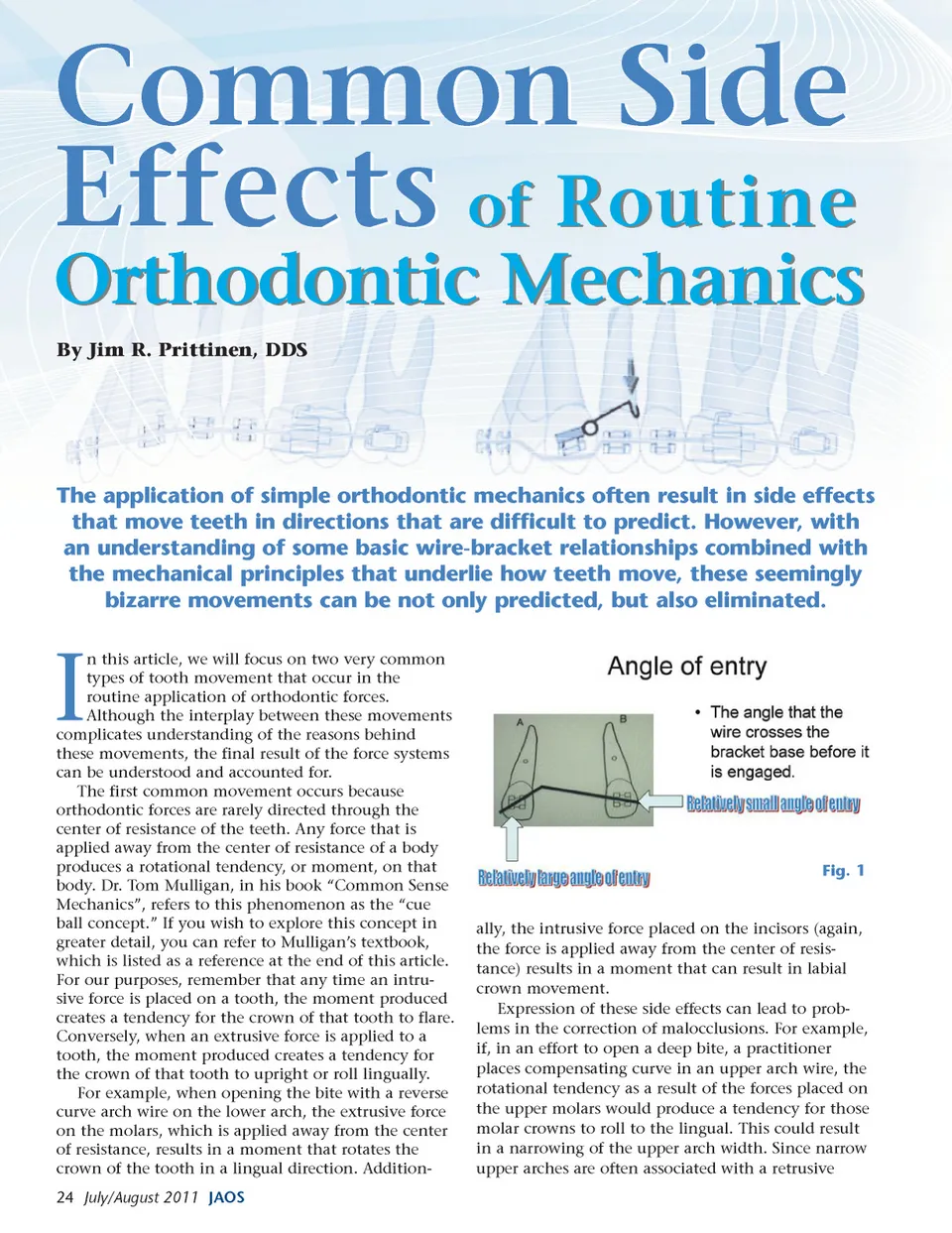
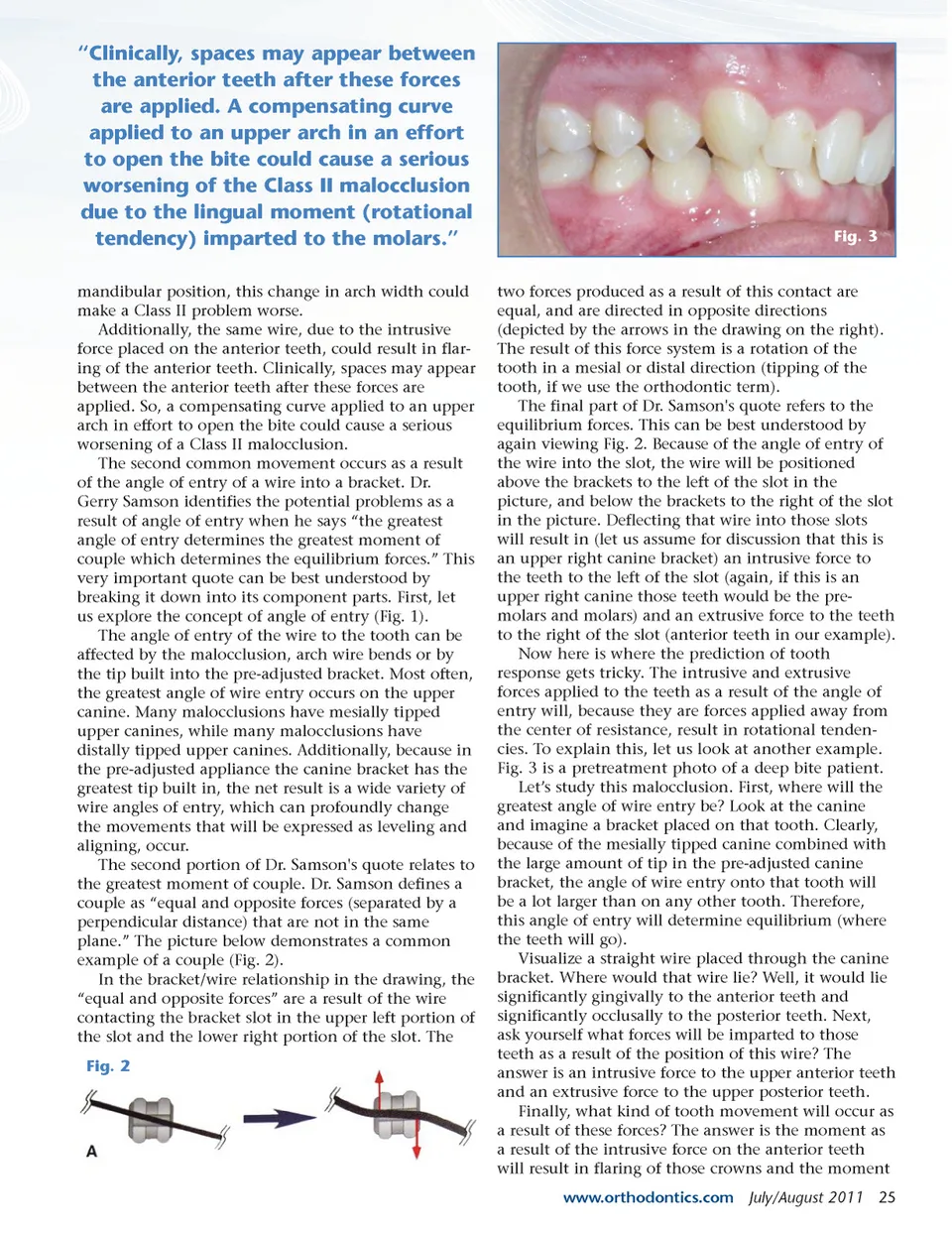
“Clinically, spaces may appear between the anterior teeth after these forces are applied. A compensating curve applied to an upper arch in an effort to open the bite could cause a serious worsening of the Class II malocclusion due to the lingual moment (rotational tendency) imparted to the molars.” mandibular position, this change in arch width could make a Class II problem worse. Additionally, the same wire, due to the intrusive force placed on the anterior teeth, could result in flar-ing of the anterior teeth. Clinically, spaces may appear between the anterior teeth after these forces are applied. So, a compensating curve applied to an upper arch in effort to open the bite could cause a serious worsening of a Class II malocclusion. The second common movement occurs as a result of the angle of entry of a wire into a bracket. Dr. Gerry Samson identifies the potential problems as a result of angle of entry when he says “the greatest angle of entry determines the greatest moment of couple which determines the equilibrium forces.” This very important quote can be best understood by breaking it down into its component parts. First, let us explore the concept of angle of entry (Fig. 1). The angle of entry of the wire to the tooth can be affected by the malocclusion, arch wire bends or by the tip built into the pre-adjusted bracket. Most often, the greatest angle of wire entry occurs on the upper canine. Many malocclusions have mesially tipped upper canines, while many malocclusions have distally tipped upper canines. Additionally, because in the pre-adjusted appliance the canine bracket has the greatest tip built in, the net result is a wide variety of wire angles of entry, which can profoundly change the movements that will be expressed as leveling and aligning, occur. The second portion of Dr. Samson's quote relates to the greatest moment of couple. Dr. Samson defines a couple as “equal and opposite forces (separated by a perpendicular distance) that are not in the same plane.” The picture below demonstrates a common example of a couple (Fig. 2). In the bracket/wire relationship in the drawing, the “equal and opposite forces” are a result of the wire contacting the bracket slot in the upper left portion of the slot and the lower right portion of the slot. The Fig. 2 Fig. 3 two forces produced as a result of this contact are equal, and are directed in opposite directions (depicted by the arrows in the drawing on the right). The result of this force system is a rotation of the tooth in a mesial or distal direction (tipping of the tooth, if we use the orthodontic term). The final part of Dr. Samson's quote refers to the equilibrium forces. This can be best understood by again viewing Fig. 2. Because of the angle of entry of the wire into the slot, the wire will be positioned above the brackets to the left of the slot in the picture, and below the brackets to the right of the slot in the picture. Deflecting that wire into those slots will result in (let us assume for discussion that this is an upper right canine bracket) an intrusive force to the teeth to the left of the slot (again, if this is an upper right canine those teeth would be the pre-molars and molars) and an extrusive force to the teeth to the right of the slot (anterior teeth in our example). Now here is where the prediction of tooth response gets tricky. The intrusive and extrusive forces applied to the teeth as a result of the angle of entry will, because they are forces applied away from the center of resistance, result in rotational tenden-cies. To explain this, let us look at another example. Fig. 3 is a pretreatment photo of a deep bite patient. Let’s study this malocclusion. First, where will the greatest angle of wire entry be? Look at the canine and imagine a bracket placed on that tooth. Clearly, because of the mesially tipped canine combined with the large amount of tip in the pre-adjusted canine bracket, the angle of wire entry onto that tooth will be a lot larger than on any other tooth. Therefore, this angle of entry will determine equilibrium (where the teeth will go). Visualize a straight wire placed through the canine bracket. Where would that wire lie? Well, it would lie significantly gingivally to the anterior teeth and significantly occlusally to the posterior teeth. Next, ask yourself what forces will be imparted to those teeth as a result of the position of this wire? The answer is an intrusive force to the upper anterior teeth and an extrusive force to the upper posterior teeth. Finally, what kind of tooth movement will occur as a result of these forces? The answer is the moment as a result of the intrusive force on the anterior teeth will result in flaring of those crowns and the moment www.orthodontics.com July/August 2011 25
Journal of the American Orthodontic Society July-August 2011-Buyer's Guide: Page 25