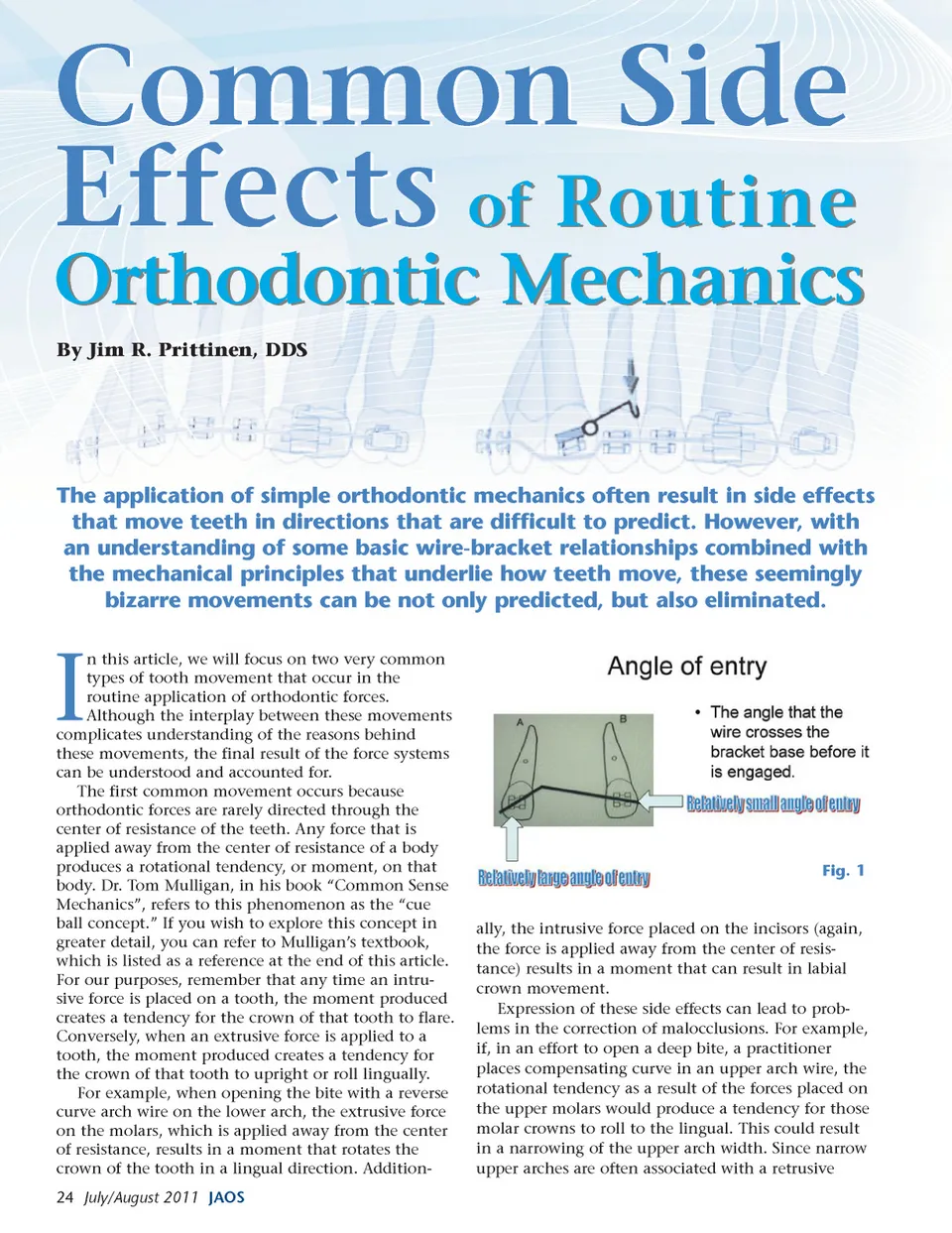
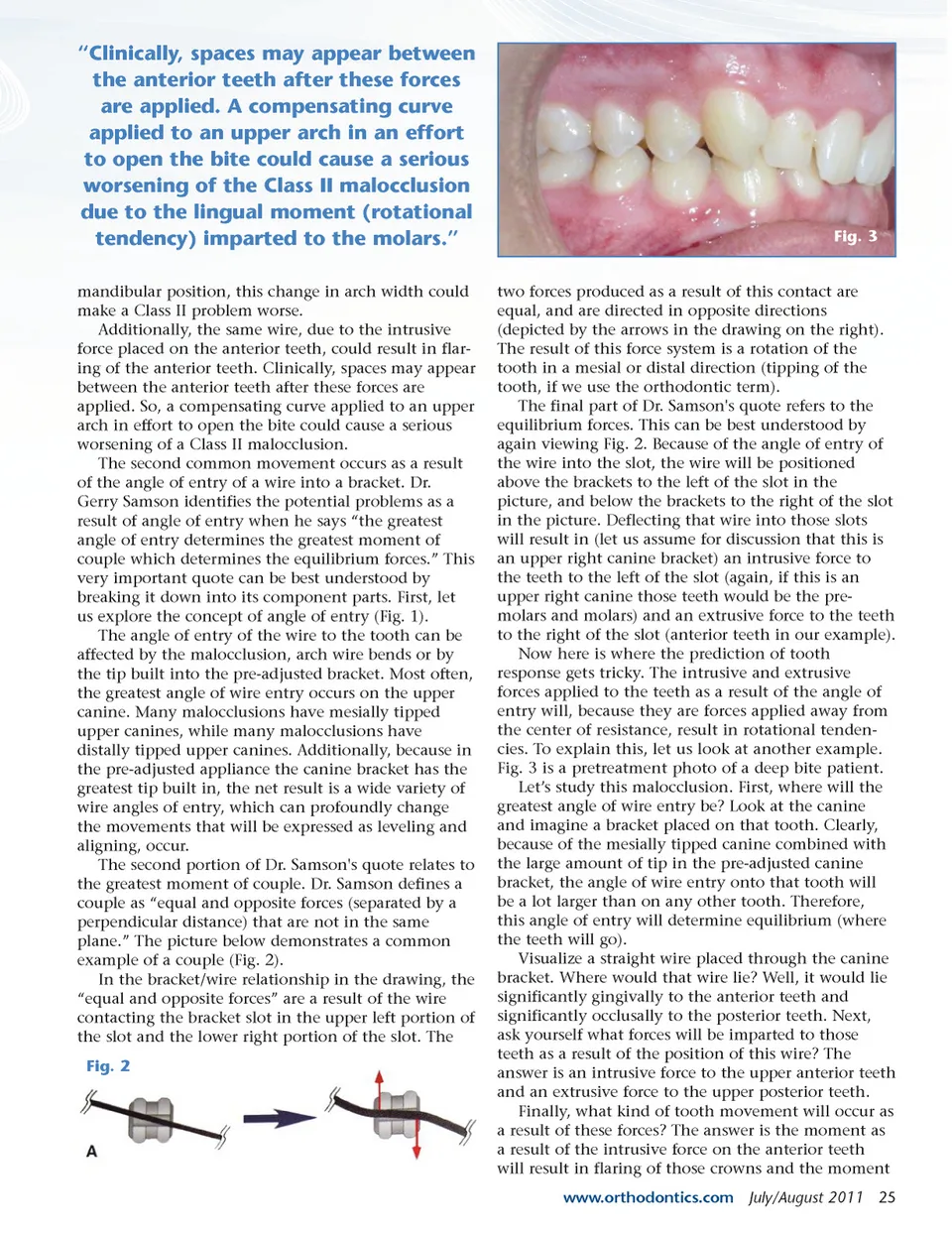
Common Side Effects of Routine By Jim R. Prittinen, DDS Orthodontic Mechanics The application of simple orthodontic mechanics often result in side effects that move teeth in directions that are difficult to predict. However, with an understanding of some basic wire-bracket relationships combined with the mechanical principles that underlie how teeth move, these seemingly bizarre movements can be not only predicted, but also eliminated. I n this article, we will focus on two very common types of tooth movement that occur in the routine application of orthodontic forces. Although the interplay between these movements complicates understanding of the reasons behind these movements, the final result of the force systems can be understood and accounted for. The first common movement occurs because orthodontic forces are rarely directed through the center of resistance of the teeth. Any force that is applied away from the center of resistance of a body produces a rotational tendency, or moment, on that body. Dr. Tom Mulligan, in his book “Common Sense Mechanics”, refers to this phenomenon as the “cue ball concept.” If you wish to explore this concept in greater detail, you can refer to Mulligan’s textbook, which is listed as a reference at the end of this article. For our purposes, remember that any time an intru-sive force is placed on a tooth, the moment produced creates a tendency for the crown of that tooth to flare. Conversely, when an extrusive force is applied to a tooth, the moment produced creates a tendency for the crown of that tooth to upright or roll lingually. For example, when opening the bite with a reverse curve arch wire on the lower arch, the extrusive force on the molars, which is applied away from the center of resistance, results in a moment that rotates the crown of the tooth in a lingual direction. Addition-24 July/August 2011 JAOS Fig. 1 ally, the intrusive force placed on the incisors (again, the force is applied away from the center of resis-tance) results in a moment that can result in labial crown movement. Expression of these side effects can lead to prob-lems in the correction of malocclusions. For example, if, in an effort to open a deep bite, a practitioner places compensating curve in an upper arch wire, the rotational tendency as a result of the forces placed on the upper molars would produce a tendency for those molar crowns to roll to the lingual. This could result in a narrowing of the upper arch width. Since narrow upper arches are often associated with a retrusive
Journal of the American Orthodontic Society July-August 2011-Buyer's Guide: Page 24