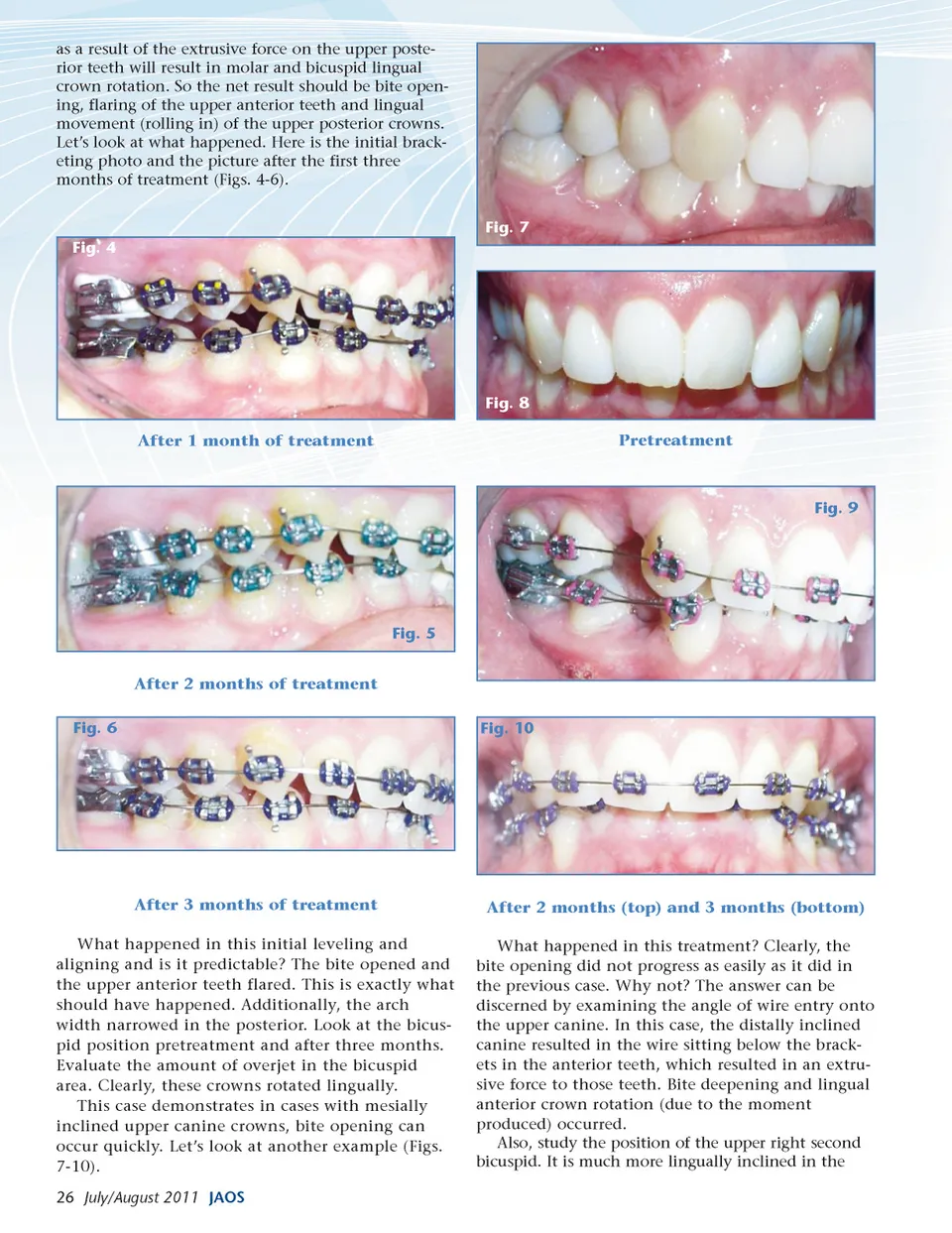
as a result of the extrusive force on the upper poste-rior teeth will result in molar and bicuspid lingual crown rotation. So the net result should be bite open-ing, flaring of the upper anterior teeth and lingual movement (rolling in) of the upper posterior crowns. Let’s look at what happened. Here is the initial brack-eting photo and the picture after the first three months of treatment (Figs. 4-6). Fig. 7 Fig. 4 Fig. 8 After 1 month of treatment Pretreatment Fig. 9 Fig. 5 After 2 months of treatment Fig. 6 Fig. 10 After 3 months of treatment What happened in this initial leveling and aligning and is it predictable? The bite opened and the upper anterior teeth flared. This is exactly what should have happened. Additionally, the arch width narrowed in the posterior. Look at the bicus-pid position pretreatment and after three months. Evaluate the amount of overjet in the bicuspid area. Clearly, these crowns rotated lingually. This case demonstrates in cases with mesially inclined upper canine crowns, bite opening can occur quickly. Let’s look at another example (Figs. 7-10). 26 July/August 2011 JAOS After 2 months (top) and 3 months (bottom) What happened in this treatment? Clearly, the bite opening did not progress as easily as it did in the previous case. Why not? The answer can be discerned by examining the angle of wire entry onto the upper canine. In this case, the distally inclined canine resulted in the wire sitting below the brack-ets in the anterior teeth, which resulted in an extru-sive force to those teeth. Bite deepening and lingual anterior crown rotation (due to the moment produced) occurred. Also, study the position of the upper right second bicuspid. It is much more lingually inclined in the
Journal of the American Orthodontic Society July-August 2011-Buyer's Guide: Page 26