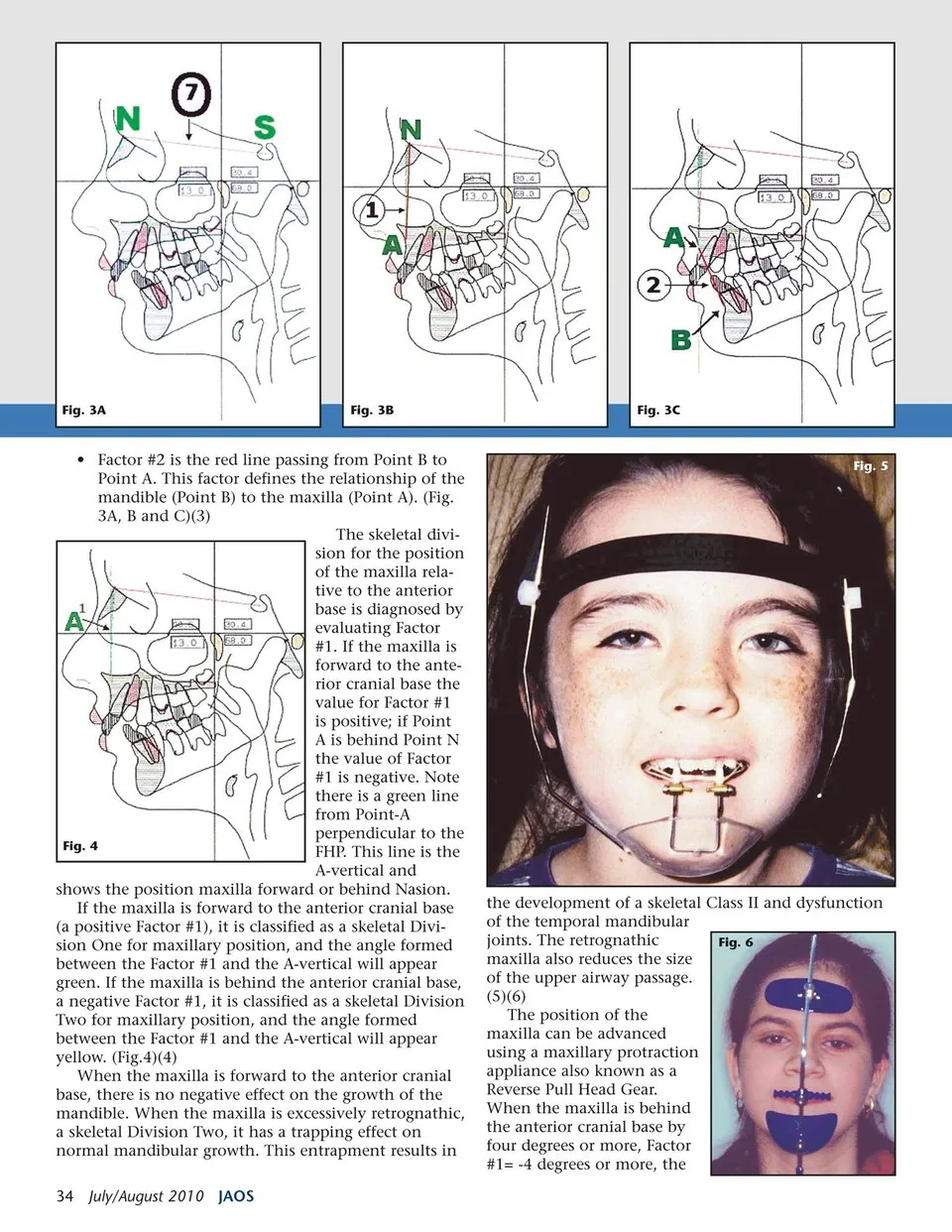
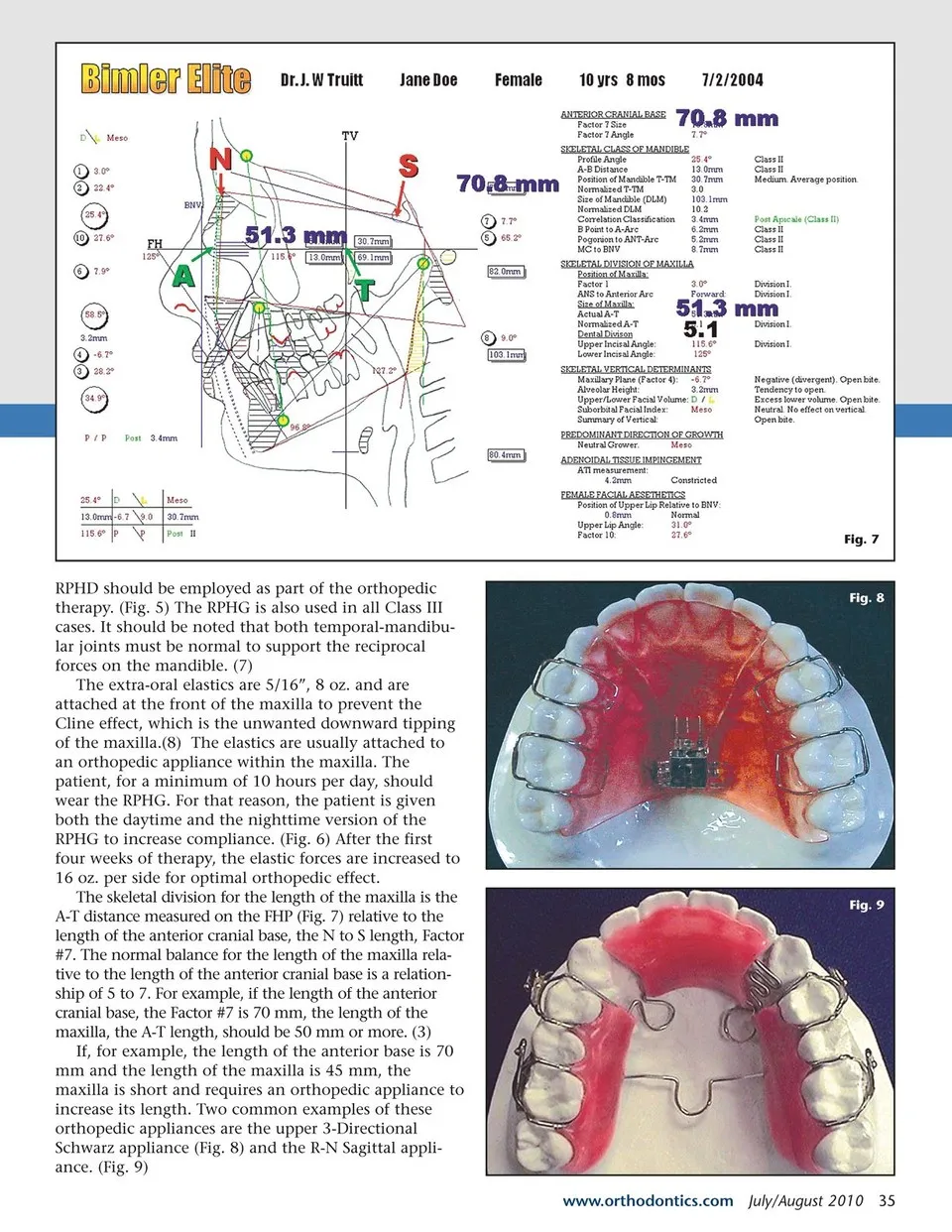
Fig. 7 RPHD should be employed as part of the orthopedic therapy. (Fig. 5) The RPHG is also used in all Class III cases. It should be noted that both temporal-mandibu-lar joints must be normal to support the reciprocal forces on the mandible. (7) The extra-oral elastics are 5/16”, 8 oz. and are attached at the front of the maxilla to prevent the Cline effect, which is the unwanted downward tipping of the maxilla.(8) The elastics are usually attached to an orthopedic appliance within the maxilla. The patient, for a minimum of 10 hours per day, should wear the RPHG. For that reason, the patient is given both the daytime and the nighttime version of the RPHG to increase compliance. (Fig. 6) After the first four weeks of therapy, the elastic forces are increased to 16 oz. per side for optimal orthopedic effect. The skeletal division for the length of the maxilla is the A-T distance measured on the FHP (Fig. 7) relative to the length of the anterior cranial base, the N to S length, Factor #7. The normal balance for the length of the maxilla rela-tive to the length of the anterior cranial base is a relation-ship of 5 to 7. For example, if the length of the anterior cranial base, the Factor #7 is 70 mm, the length of the maxilla, the A-T length, should be 50 mm or more. (3 ) If, for example, the length of the anterior base is 70 mm and the length of the maxilla is 45 mm, the maxilla is short and requires an orthopedic appliance to increase its length. Two common examples of these orthopedic appliances are the upper 3-Directional Schwarz appliance (Fig. 8) and the R-N Sagittal appli-ance. (Fig. 9) Fig. 8 Fig. 9 www.orthodontics.com July/August 2010 35
Journal of the American Orthodontic Society July-August 2010/Buyer's Guide: Page 35