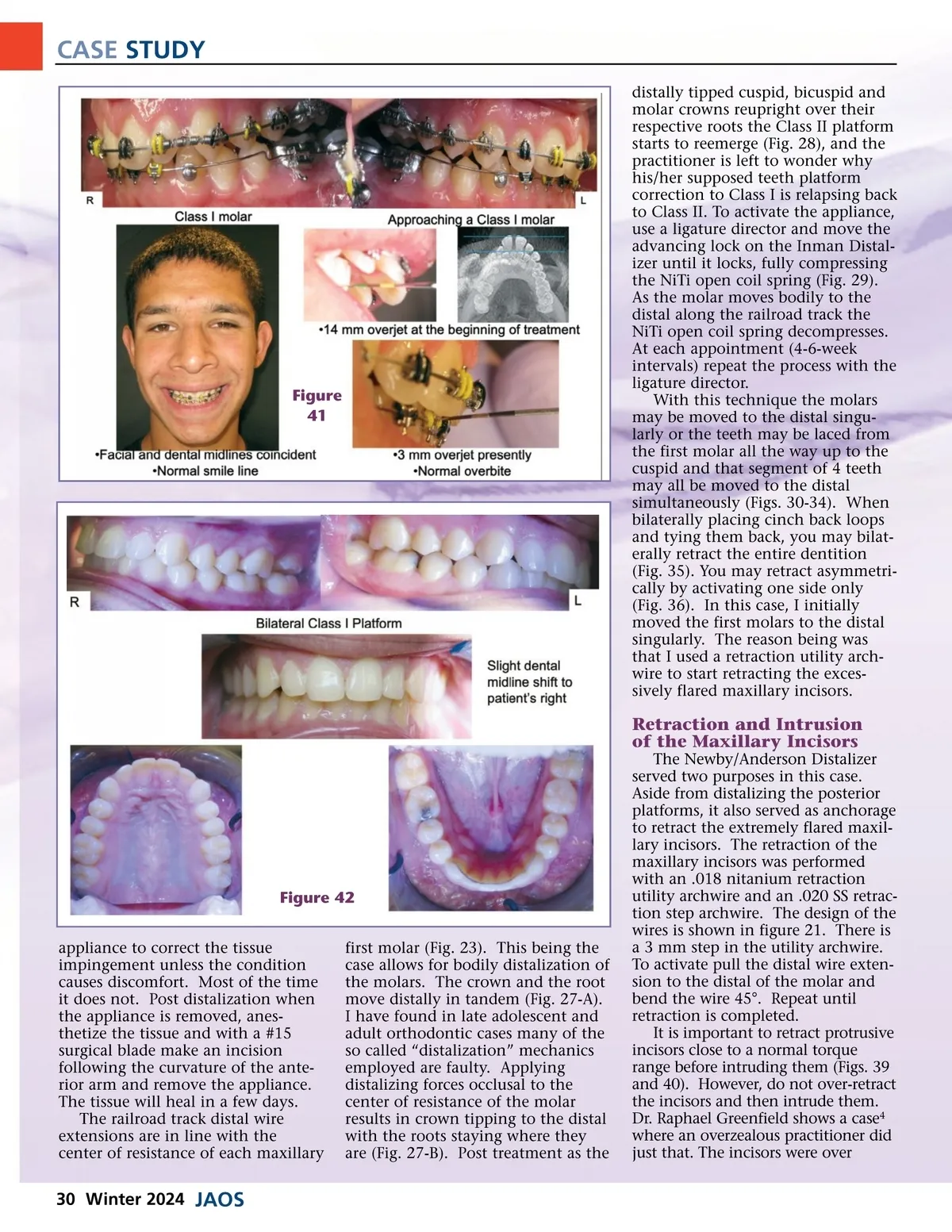
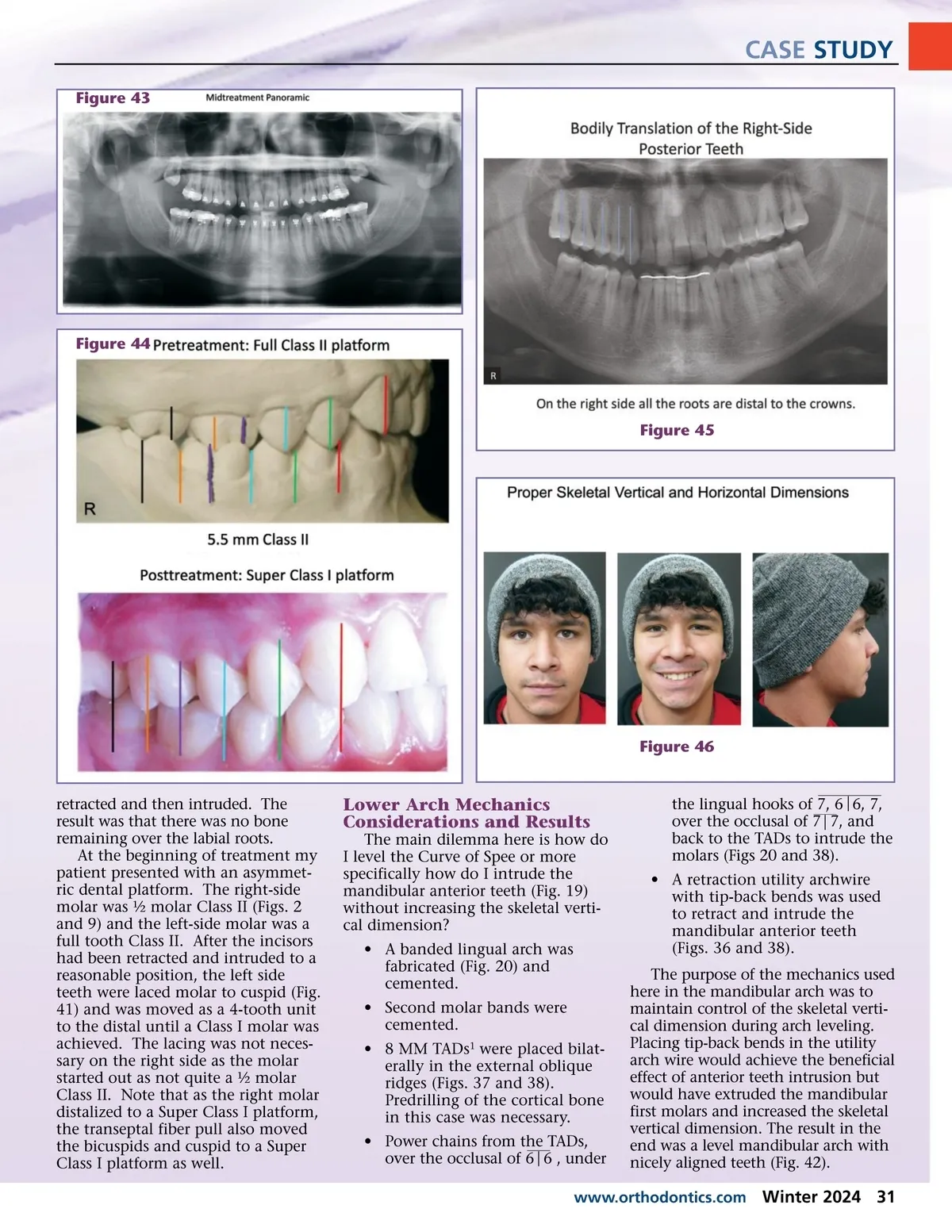
CASE STUDY Figure 43 Figure 44 Figure 45 Figure 46 retracted and then intruded. The result was that there was no bone remaining over the labial roots. At the beginning of treatment my patient presented with an asymmet-ric dental platform. The right-side molar was ½ molar Class II (Figs. 2 and 9) and the left-side molar was a full tooth Class II. After the incisors had been retracted and intruded to a reasonable position, the left side teeth were laced molar to cuspid (Fig. 41) and was moved as a 4-tooth unit to the distal until a Class I molar was achieved. The lacing was not neces-sary on the right side as the molar started out as not quite a ½ molar Class II. Note that as the right molar distalized to a Super Class I platform, the transeptal fiber pull also moved the bicuspids and cuspid to a Super Class I platform as well. Lower Arch Mechanics Considerations and Results The main dilemma here is how do I level the Curve of Spee or more specifically how do I intrude the mandibular anterior teeth (Fig. 19) without increasing the skeletal verti-cal dimension? • A banded lingual arch was fabricated (Fig. 20) and cemented. • Second molar bands were cemented. • 8 MM TADs 1 were placed bilat-erally in the external oblique ridges (Figs. 37 and 38). Predrilling of the cortical bone in this case was necessary. • Power chains from the TADs, over the occlusal of 6 6 , under the lingual hooks of 7, 6 6, 7, over the occlusal of 7 7, and back to the TADs to intrude the molars (Figs 20 and 38). • A retraction utility archwire with tip-back bends was used to retract and intrude the mandibular anterior teeth (Figs. 36 and 38). The purpose of the mechanics used here in the mandibular arch was to maintain control of the skeletal verti-cal dimension during arch leveling. Placing tip-back bends in the utility arch wire would achieve the beneficial effect of anterior teeth intrusion but would have extruded the mandibular first molars and increased the skeletal vertical dimension. The result in the end was a level mandibular arch with nicely aligned teeth (Fig. 42). www.orthodontics.com Winter 2024 31
Journal of the American Orthodontic Society JAOS Winter 2024: Page 31