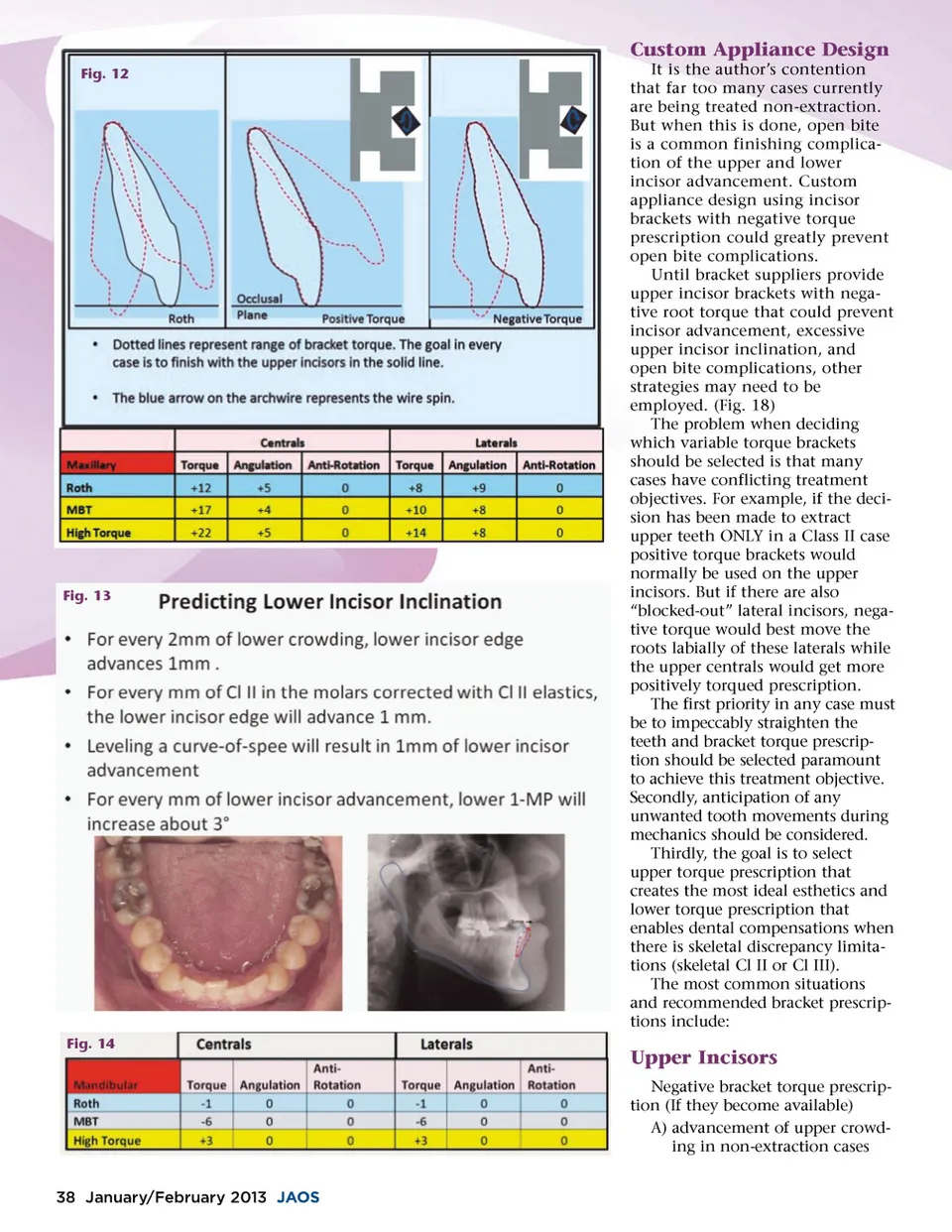
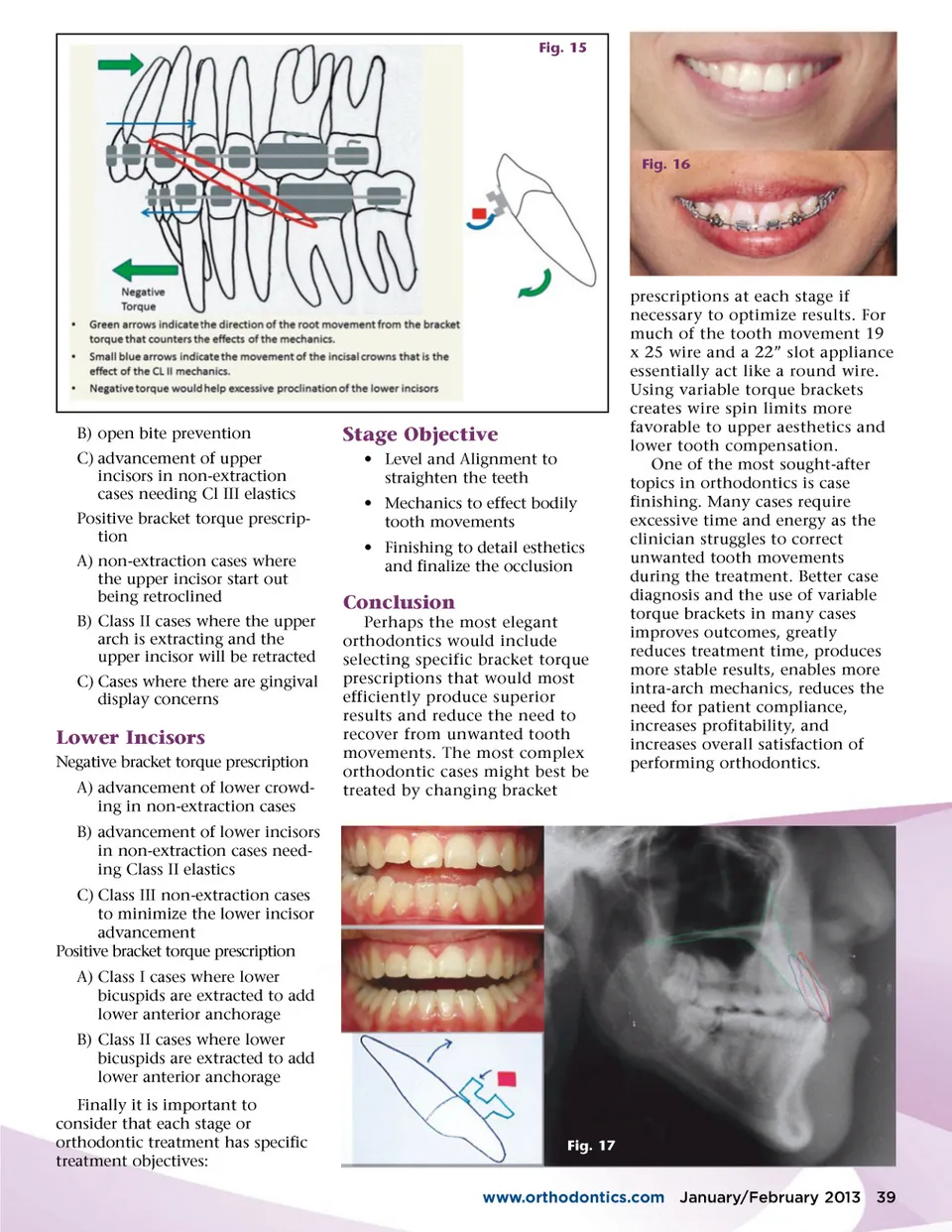
Custom Appliance Design Fig. 12 Fig. 13 It is the author’s contention that far too many cases currently are being treated non-extraction. But when this is done, open bite is a common finishing complica-tion of the upper and lower incisor advancement. Custom appliance design using incisor brackets with negative torque prescription could greatly prevent open bite complications. Until bracket suppliers provide upper incisor brackets with nega-tive root torque that could prevent incisor advancement, excessive upper incisor inclination, and open bite complications, other strategies may need to be employed. (Fig. 18) The problem when deciding which variable torque brackets should be selected is that many cases have conflicting treatment objectives. For example, if the deci-sion has been made to extract upper teeth ONLY in a Class II case positive torque brackets would normally be used on the upper incisors. But if there are also “blocked-out” lateral incisors, nega-tive torque would best move the roots labially of these laterals while the upper centrals would get more positively torqued prescription. The first priority in any case must be to impeccably straighten the teeth and bracket torque prescrip-tion should be selected paramount to achieve this treatment objective. Secondly, anticipation of any unwanted tooth movements during mechanics should be considered. Thirdly, the goal is to select upper torque prescription that creates the most ideal esthetics and lower torque prescription that enables dental compensations when there is skeletal discrepancy limita-tions (skeletal Cl II or Cl III). The most common situations and recommended bracket prescrip-tions include: Fig. 14 Upper Incisors Negative bracket torque prescrip-tion (If they become available) A) advancement of upper crowd-ing in non-extraction cases 38 January/February 2013 JAOS
Journal of the American Orthodontic Society January-February 2013: Page 38