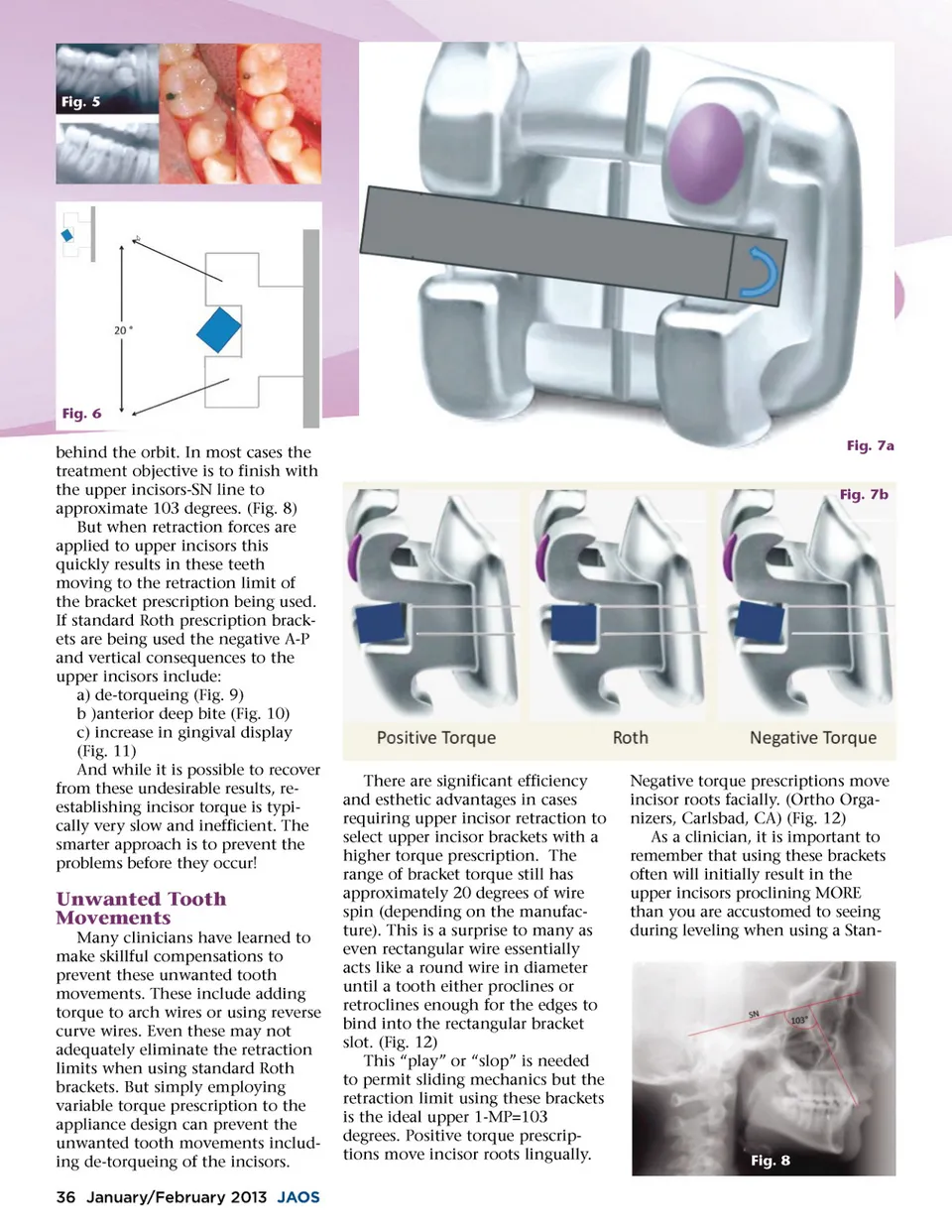
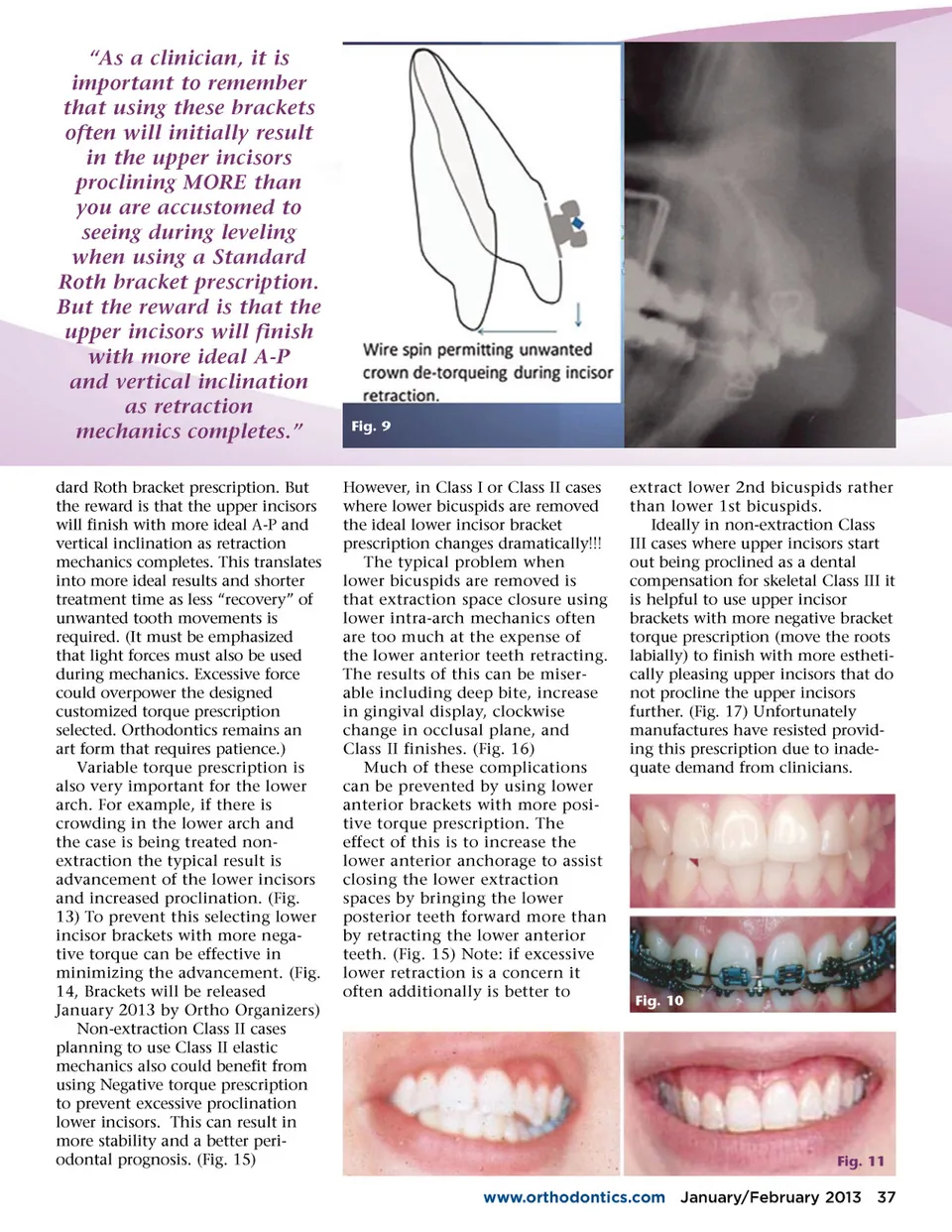
“As a clinician, it is important to remember that using these brackets often will initially result in the upper incisors proclining MORE than you are accustomed to seeing during leveling when using a Standard Roth bracket prescription. But the reward is that the upper incisors will finish with more ideal A-P and vertical inclination as retraction mechanics completes.” dard Roth bracket prescription. But the reward is that the upper incisors will finish with more ideal A-P and vertical inclination as retraction mechanics completes. This translates into more ideal results and shorter treatment time as less “recovery” of unwanted tooth movements is required. (It must be emphasized that light forces must also be used during mechanics. Excessive force could overpower the designed customized torque prescription selected. Orthodontics remains an art form that requires patience.) Variable torque prescription is also very important for the lower arch. For example, if there is crowding in the lower arch and the case is being treated non-extraction the typical result is advancement of the lower incisors and increased proclination. (Fig. 13) To prevent this selecting lower incisor brackets with more nega-tive torque can be effective in minimizing the advancement. (Fig. 14, Brackets will be released January 2013 by Ortho Organizers) Non-extraction Class II cases planning to use Class II elastic mechanics also could benefit from using Negative torque prescription to prevent excessive proclination lower incisors. This can result in more stability and a better peri-odontal prognosis. (Fig. 15) Fig. 9 However, in Class I or Class II cases where lower bicuspids are removed the ideal lower incisor bracket prescription changes dramatically!!! The typical problem when lower bicuspids are removed is that extraction space closure using lower intra-arch mechanics often are too much at the expense of the lower anterior teeth retracting. The results of this can be miser-able including deep bite, increase in gingival display, clockwise change in occlusal plane, and Class II finishes. (Fig. 16) Much of these complications can be prevented by using lower anterior brackets with more posi-tive torque prescription. The effect of this is to increase the lower anterior anchorage to assist closing the lower extraction spaces by bringing the lower posterior teeth forward more than by retracting the lower anterior teeth. (Fig. 15) Note: if excessive lower retraction is a concern it often additionally is better to extract lower 2nd bicuspids rather than lower 1st bicuspids. Ideally in non-extraction Class III cases where upper incisors start out being proclined as a dental compensation for skeletal Class III it is helpful to use upper incisor brackets with more negative bracket torque prescription (move the roots labially) to finish with more estheti-cally pleasing upper incisors that do not procline the upper incisors further. (Fig. 17) Unfortunately manufactures have resisted provid-ing this prescription due to inade-quate demand from clinicians. Fig. 10 Fig. 11 www.orthodontics.com January/February 2013 37
Journal of the American Orthodontic Society January-February 2013: Page 37