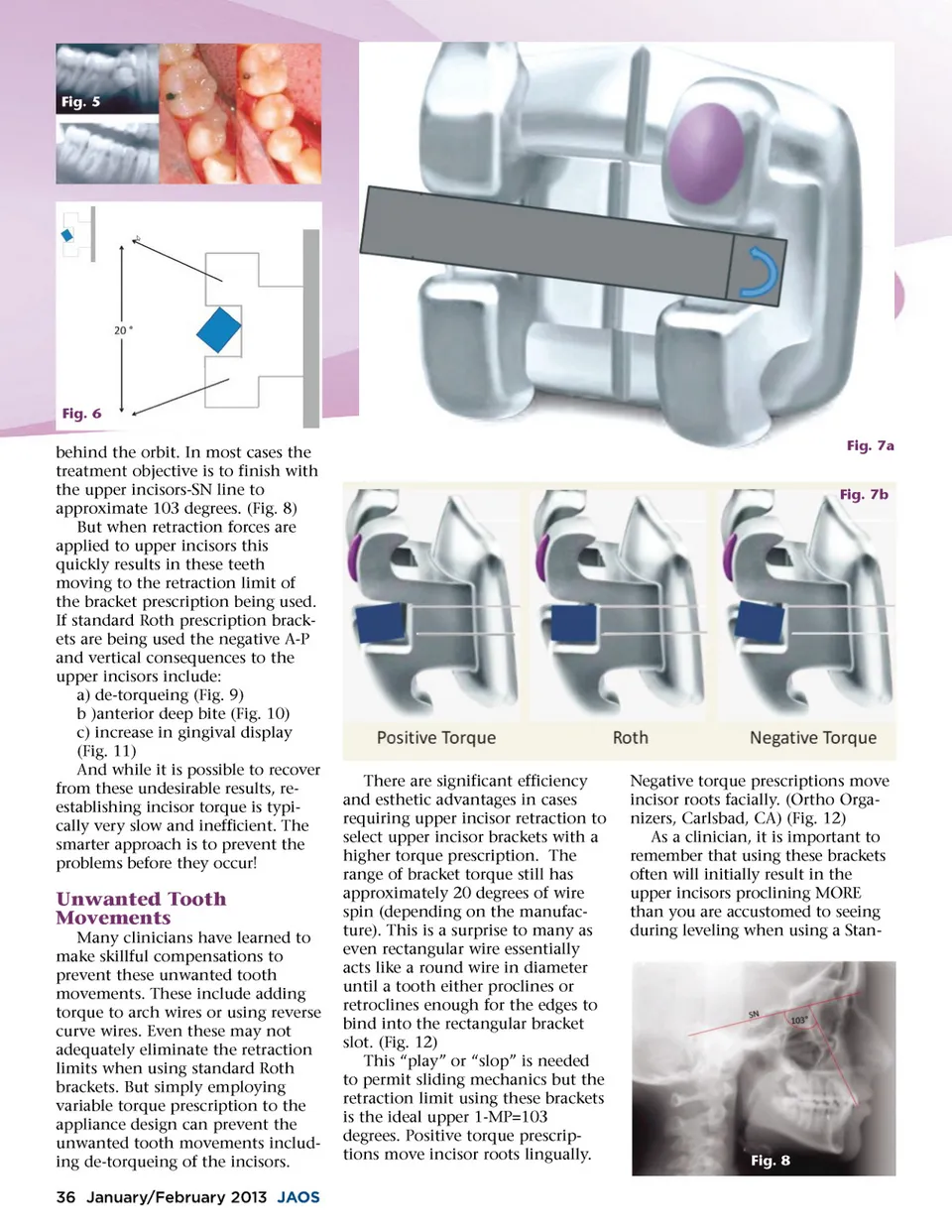
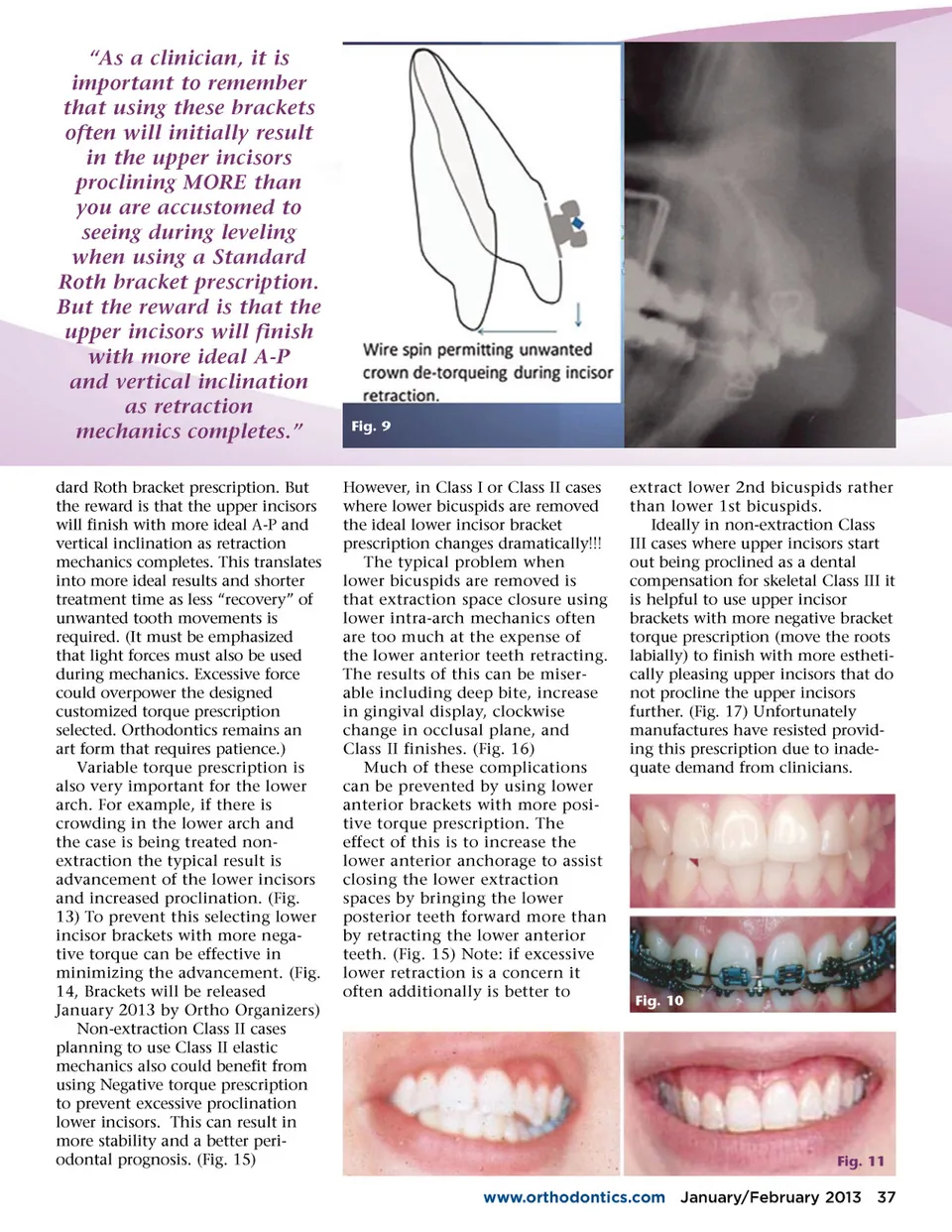
Fig. 5 Fig. 6 behind the orbit. In most cases the treatment objective is to finish with the upper incisors-SN line to approximate 103 degrees. (Fig. 8) But when retraction forces are applied to upper incisors this quickly results in these teeth moving to the retraction limit of the bracket prescription being used. If standard Roth prescription brack-ets are being used the negative A-P and vertical consequences to the upper incisors include: a) de-torqueing (Fig. 9) b )anterior deep bite (Fig. 10) c) increase in gingival display (Fig. 11) And while it is possible to recover from these undesirable results, re-establishing incisor torque is typi-cally very slow and inefficient. The smarter approach is to prevent the problems before they occur! Fig. 7a Fig. 7b Unwanted Tooth Movements Many clinicians have learned to make skillful compensations to prevent these unwanted tooth movements. These include adding torque to arch wires or using reverse curve wires. Even these may not adequately eliminate the retraction limits when using standard Roth brackets. But simply employing variable torque prescription to the appliance design can prevent the unwanted tooth movements includ-ing de-torqueing of the incisors. 36 January/February 2013 JAOS There are significant efficiency and esthetic advantages in cases requiring upper incisor retraction to select upper incisor brackets with a higher torque prescription. The range of bracket torque still has approximately 20 degrees of wire spin (depending on the manufac-ture). This is a surprise to many as even rectangular wire essentially acts like a round wire in diameter until a tooth either proclines or retroclines enough for the edges to bind into the rectangular bracket slot. (Fig. 12) This “play” or “slop” is needed to permit sliding mechanics but the retraction limit using these brackets is the ideal upper 1-MP=103 degrees. Positive torque prescrip-tions move incisor roots lingually. Negative torque prescriptions move incisor roots facially. (Ortho Orga-nizers, Carlsbad, CA) (Fig. 12) As a clinician, it is important to remember that using these brackets often will initially result in the upper incisors proclining MORE than you are accustomed to seeing during leveling when using a Stan-Fig. 8
Journal of the American Orthodontic Society January-February 2013: Page 36