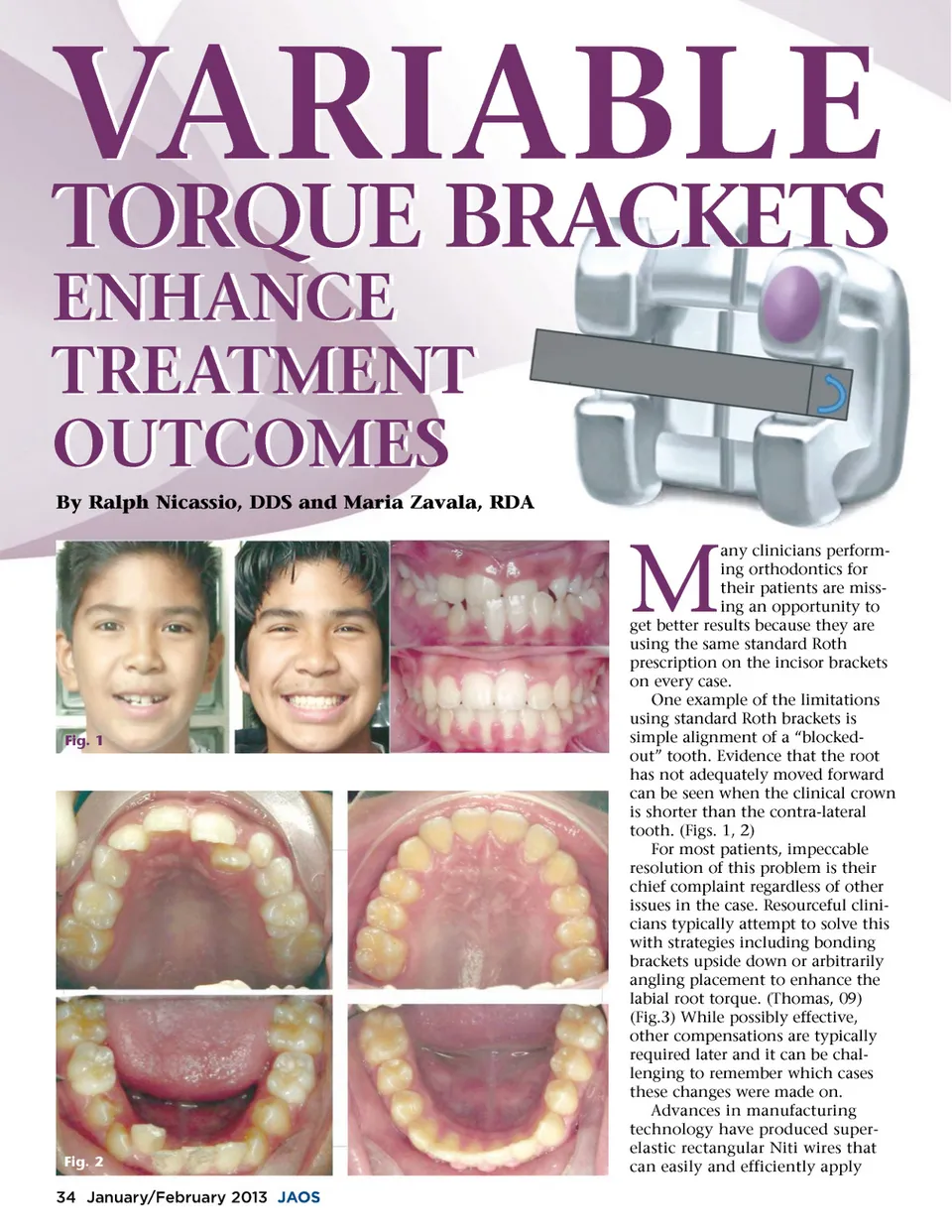
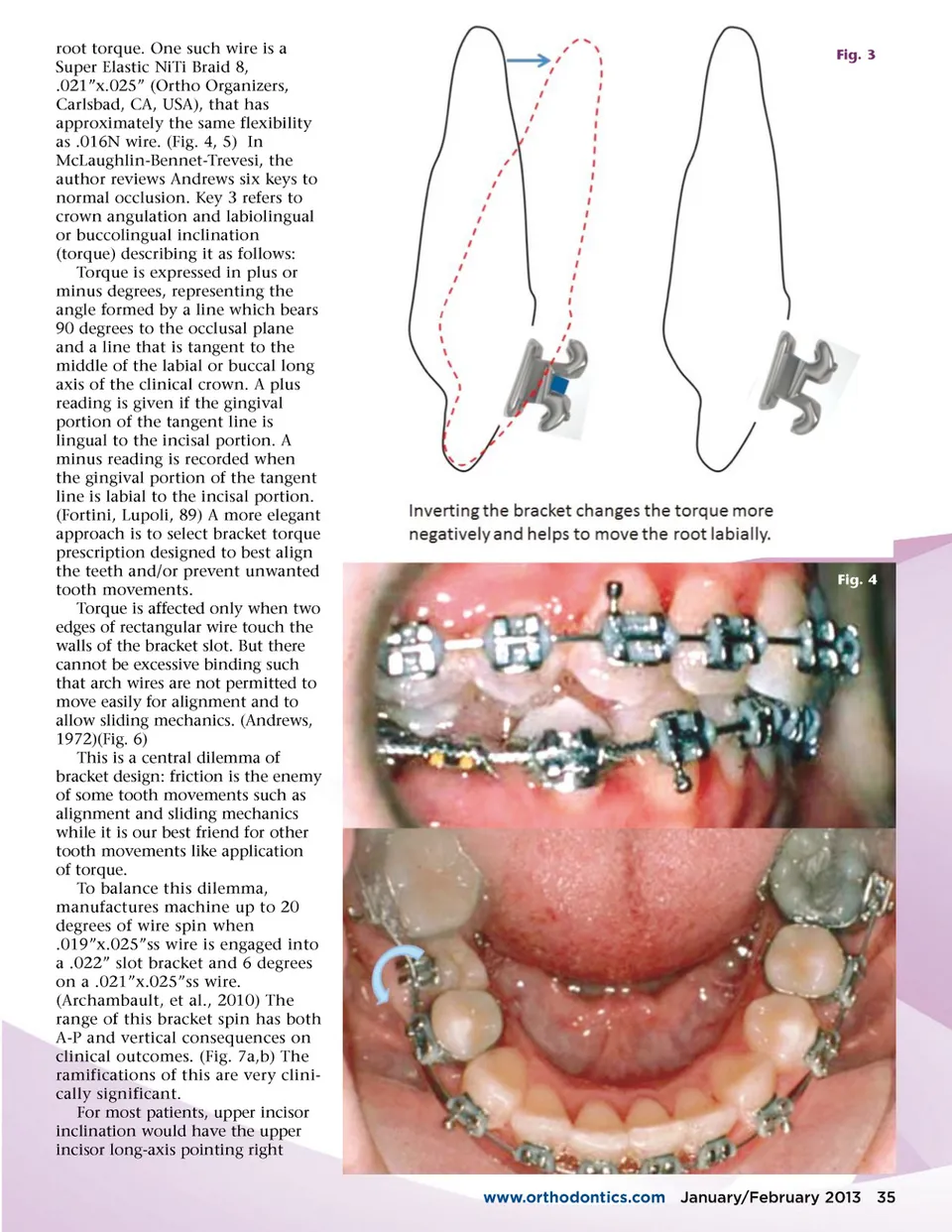
root torque. One such wire is a Super Elastic NiTi Braid 8, .021”x.025” (Ortho Organizers, Carlsbad, CA, USA), that has approximately the same flexibility as .016N wire. (Fig. 4, 5) In McLaughlin-Bennet-Trevesi, the author reviews Andrews six keys to normal occlusion. Key 3 refers to crown angulation and labiolingual or buccolingual inclination (torque) describing it as follows: Torque is expressed in plus or minus degrees, representing the angle formed by a line which bears 90 degrees to the occlusal plane and a line that is tangent to the middle of the labial or buccal long axis of the clinical crown. A plus reading is given if the gingival portion of the tangent line is lingual to the incisal portion. A minus reading is recorded when the gingival portion of the tangent line is labial to the incisal portion. (Fortini, Lupoli, 89) A more elegant approach is to select bracket torque prescription designed to best align the teeth and/or prevent unwanted tooth movements. Torque is affected only when two edges of rectangular wire touch the walls of the bracket slot. But there cannot be excessive binding such that arch wires are not permitted to move easily for alignment and to allow sliding mechanics. (Andrews, 1972)(Fig. 6) This is a central dilemma of bracket design: friction is the enemy of some tooth movements such as alignment and sliding mechanics while it is our best friend for other tooth movements like application of torque. To balance this dilemma, manufactures machine up to 20 degrees of wire spin when .019”x.025”ss wire is engaged into a .022” slot bracket and 6 degrees on a .021”x.025”ss wire. (Archambault, et al., 2010) The range of this bracket spin has both A-P and vertical consequences on clinical outcomes. (Fig. 7a,b) The ramifications of this are very clini-cally significant. For most patients, upper incisor inclination would have the upper incisor long-axis pointing right Fig. 3 Fig. 4 www.orthodontics.com January/February 2013 35
Journal of the American Orthodontic Society January-February 2013: Page 35