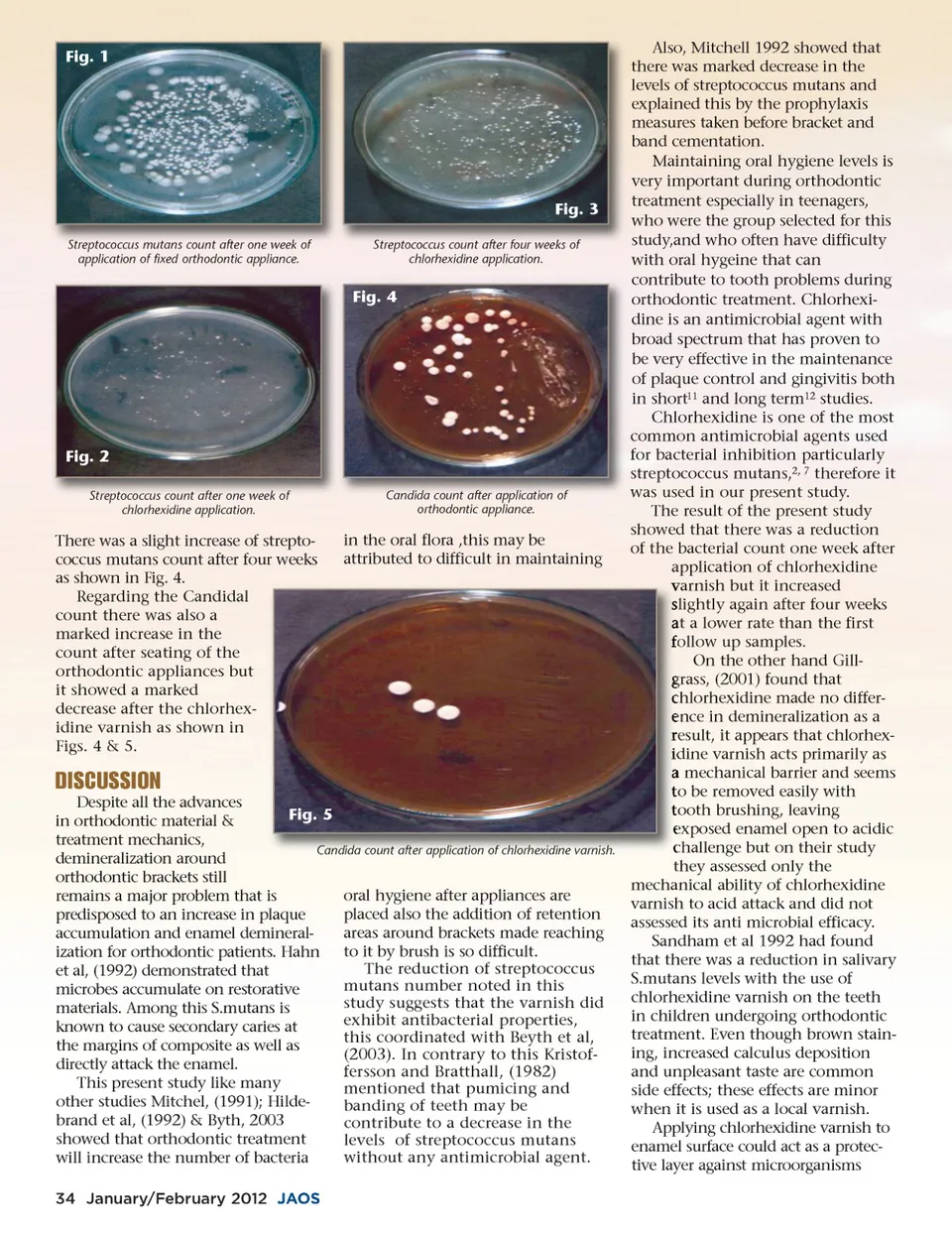
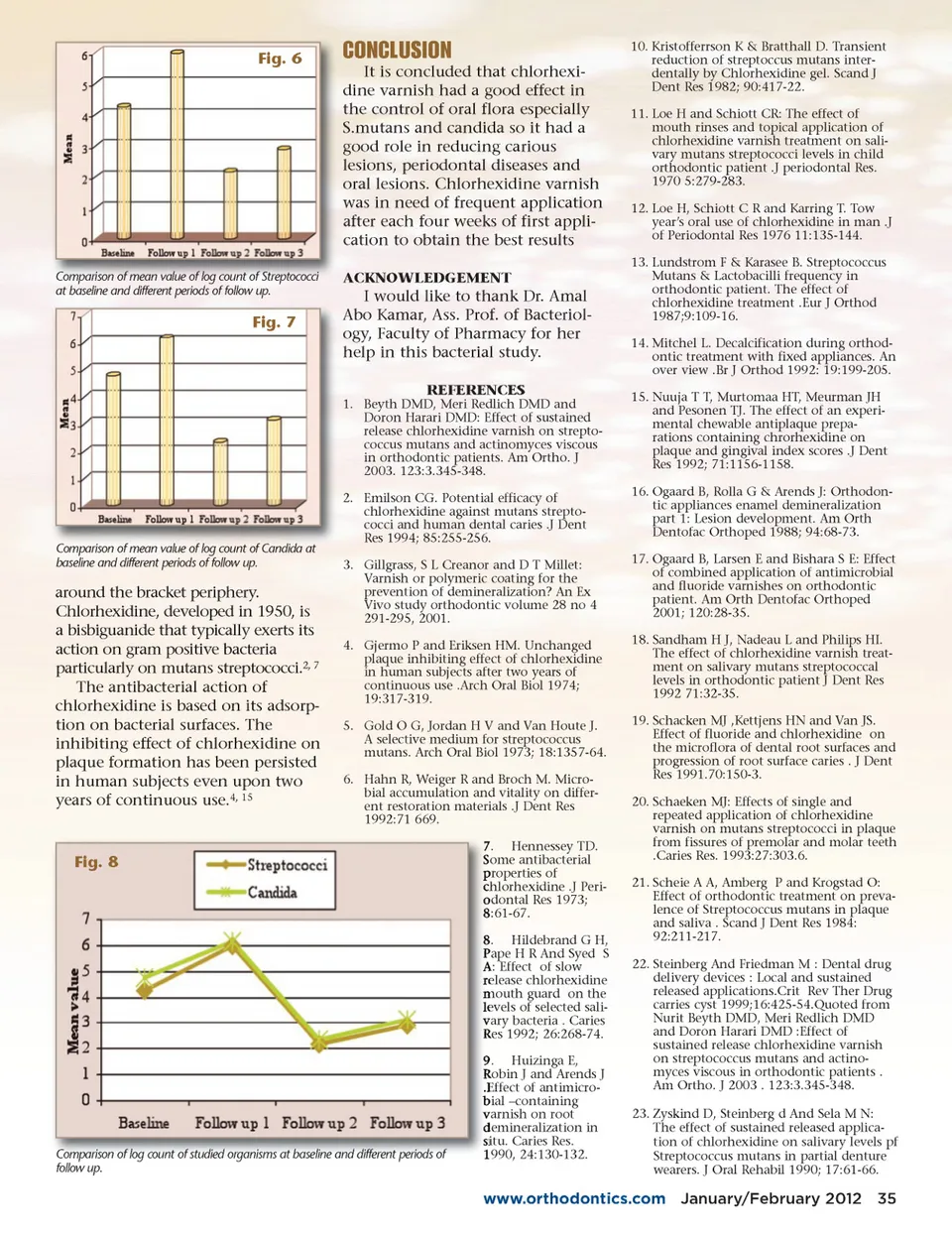
Fig. 6 CONCLUSION It is concluded that chlorhexi-dine varnish had a good effect in the control of oral flora especially S.mutans and candida so it had a good role in reducing carious lesions, periodontal diseases and oral lesions. Chlorhexidine varnish was in need of frequent application after each four weeks of first appli-cation to obtain the best results ACKNOWLEDGEMENT 10. Kristofferrson K & Bratthall D. Transient reduction of streptoccus mutans inter-dentally by Chlorhexidine gel. Scand J Dent Res 1982; 90:417-22. 11. Loe H and Schiott CR: The effect of mouth rinses and topical application of chlorhexidine varnish treatment on sali-vary mutans streptococci levels in child orthodontic patient .J periodontal Res. 1970 5:279-283. 12. Loe H, Schiott C R and Karring T. Tow year’s oral use of chlorhexidine in man .J of Periodontal Res 1976 11:135-144. 13. Lundstrom F & Karasee B. Streptococcus Mutans & Lactobacilli frequency in orthodontic patient. The effect of chlorhexidine treatment .Eur J Orthod 1987;9:109-16. 14. Mitchel L. Decalcification during orthod-ontic treatment with fixed appliances. An over view .Br J Orthod 1992: 19:199-205. 15. Nuuja T T, Murtomaa HT, Meurman JH and Pesonen TJ. The effect of an experi-mental chewable antiplaque prepa-rations containing chrorhexidine on plaque and gingival index scores .J Dent Res 1992; 71:1156-1158. 16. Ogaard B, Rolla G & Arends J: Orthodon-tic appliances enamel demineralization part 1: Lesion development. Am Orth Dentofac Orthoped 1988; 94:68-73. 17. Ogaard B, Larsen E and Bishara S E: Effect of combined application of antimicrobial and fluoride varnishes on orthodontic patient. Am Orth Dentofac Orthoped 2001; 120:28-35. 18. Sandham H J, Nadeau L and Philips HI. The effect of chlorhexidine varnish treat-ment on salivary mutans streptococcal levels in orthodontic patient J Dent Res 1992 71:32-35. 19. Schacken MJ ,Kettjens HN and Van JS. Effect of fluoride and chlorhexidine on the microflora of dental root surfaces and progression of root surface caries . J Dent Res 1991.70:150-3. 20. Schaeken MJ: Effects of single and repeated application of chlorhexidine varnish on mutans streptococci in plaque from fissures of premolar and molar teeth .Caries Res. 1993:27:303.6. 21. Scheie A A, Amberg P and Krogstad O: Effect of orthodontic treatment on preva-lence of Streptococcus mutans in plaque and saliva . Scand J Dent Res 1984: 92:211-217. 22. Steinberg And Friedman M : Dental drug delivery devices : Local and sustained released applications.Crit Rev Ther Drug carries cyst 1999;16:425-54.Quoted from Nurit Beyth DMD, Meri Redlich DMD and Doron Harari DMD :Effect of sustained release chlorhexidine varnish on streptococcus mutans and actino-myces viscous in orthodontic patients . Am Ortho. J 2003 . 123:3.345-348. 23. Zyskind D, Steinberg d And Sela M N: The effect of sustained released applica-tion of chlorhexidine on salivary levels pf Streptococcus mutans in partial denture wearers. J Oral Rehabil 1990; 17:61-66. Comparison of mean value of log count of Streptococci at baseline and different periods of follow up. Fig. 7 I would like to thank Dr. Amal Abo Kamar, Ass. Prof. of Bacteriol-ogy, Faculty of Pharmacy for her help in this bacterial study. REFERENCES 1. Beyth DMD, Meri Redlich DMD and Doron Harari DMD: Effect of sustained release chlorhexidine varnish on strepto-coccus mutans and actinomyces viscous in orthodontic patients. Am Ortho. J 2003. 123:3.345-348. 2. Emilson CG. Potential efficacy of chlorhexidine against mutans strepto-cocci and human dental caries .J Dent Res 1994; 85:255-256. 3. Gillgrass, S L Creanor and D T Millet: Varnish or polymeric coating for the prevention of demineralization? An Ex Vivo study orthodontic volume 28 no 4 291-295, 2001. 4. Gjermo P and Eriksen HM. Unchanged plaque inhibiting effect of chlorhexidine in human subjects after two years of continuous use .Arch Oral Biol 1974; 19:317-319. 5. Gold O G, Jordan H V and Van Houte J. A selective medium for streptococcus mutans. Arch Oral Biol 1973; 18:1357-64. 6. Hahn R, Weiger R and Broch M. Micro-bial accumulation and vitality on differ-ent restoration materials .J Dent Res 1992:71 669. 7. Hennessey TD. Some antibacterial properties of chlorhexidine .J Peri-odontal Res 1973; 8:61-67. 8. Hildebrand G H, Pape H R And Syed S A: Effect of slow release chlorhexidine mouth guard on the levels of selected sali-vary bacteria . Caries Res 1992; 26:268-74. 9. Huizinga E, Robin J and Arends J .Effect of antimicro-bial –containing varnish on root demineralization in situ. Caries Res. 1990, 24:130-132. Comparison of mean value of log count of Candida at baseline and different periods of follow up. around the bracket periphery. Chlorhexidine, developed in 1950, is a bisbiguanide that typically exerts its action on gram positive bacteria particularly on mutans streptococci. 2, 7 The antibacterial action of chlorhexidine is based on its adsorp-tion on bacterial surfaces. The inhibiting effect of chlorhexidine on plaque formation has been persisted in human subjects even upon two years of continuous use. 4, 15 Fig. 8 Comparison of log count of studied organisms at baseline and different periods of follow up. www.orthodontics.com January/February 2012 35
Journal of the American Orthodontic Society January-February 2012: Page 35