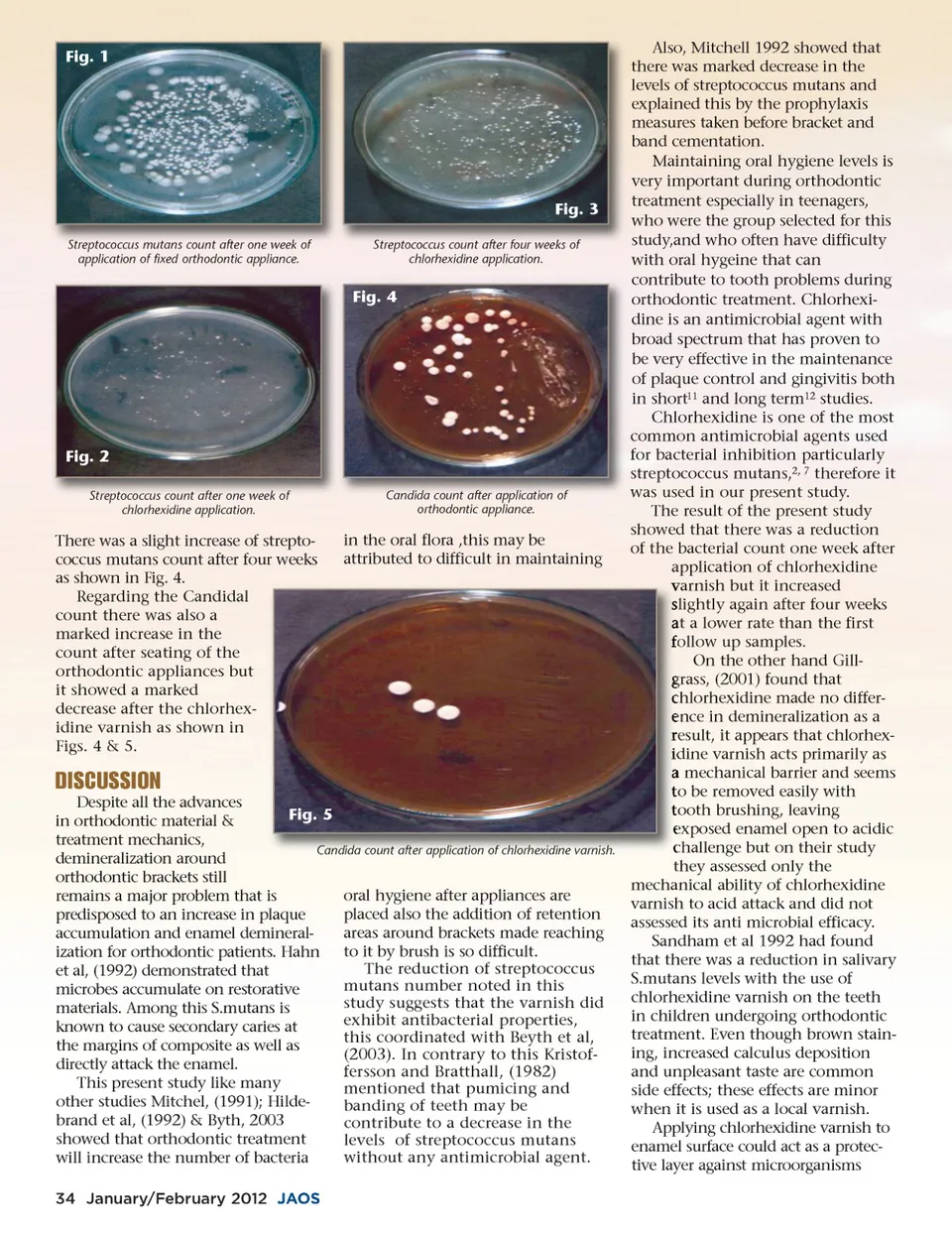
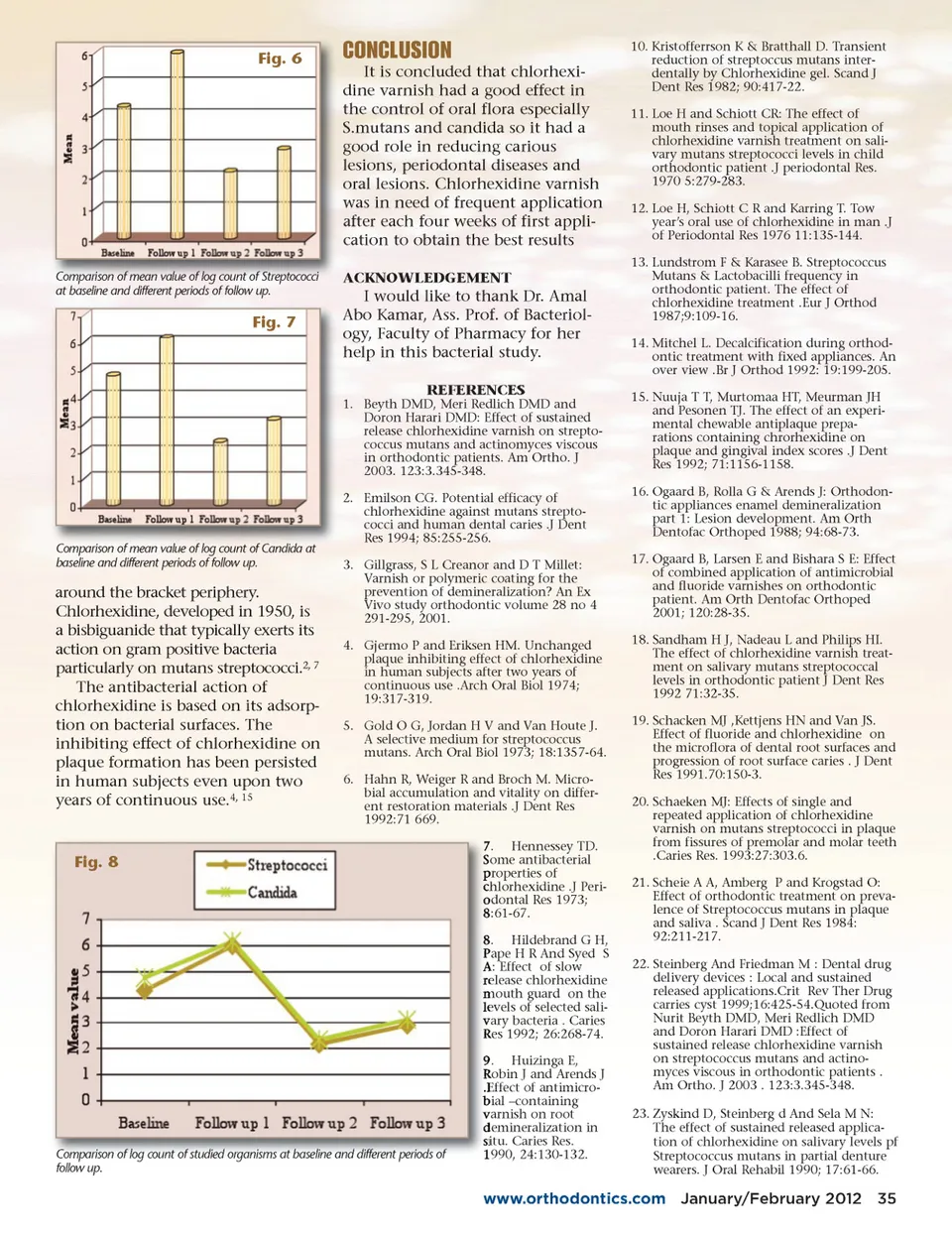
Fig. 1 Fig. 3 Streptococcus mutans count after one week of application of fixed orthodontic appliance. Streptococcus count after four weeks of chlorhexidine application. Fig. 4 Fig. 2 Streptococcus count after one week of chlorhexidine application. Candida count after application of orthodontic appliance. There was a slight increase of strepto-coccus mutans count after four weeks as shown in Fig. 4. Regarding the Candidal count there was also a marked increase in the count after seating of the orthodontic appliances but it showed a marked decrease after the chlorhex-idine varnish as shown in Figs. 4 & 5. in the oral flora ,this may be attributed to difficult in maintaining DISCUSSION Despite all the advances Fig. 5 in orthodontic material & treatment mechanics, Candida count after application of chlorhexidine varnish. demineralization around orthodontic brackets still oral hygiene after appliances are remains a major problem that is placed also the addition of retention predisposed to an increase in plaque areas around brackets made reaching accumulation and enamel demineral-ization for orthodontic patients. Hahn to it by brush is so difficult. The reduction of streptococcus et al, (1992) demonstrated that mutans number noted in this microbes accumulate on restorative study suggests that the varnish did materials. Among this S.mutans is exhibit antibacterial properties, known to cause secondary caries at this coordinated with Beyth et al, the margins of composite as well as (2003). In contrary to this Kristof-directly attack the enamel. fersson and Bratthall, (1982) This present study like many mentioned that pumicing and other studies Mitchel, (1991); Hilde-banding of teeth may be brand et al, (1992) & Byth, 2003 contribute to a decrease in the showed that orthodontic treatment levels of streptococcus mutans without any antimicrobial agent. will increase the number of bacteria 34 January/February 2012 JAOS Also, Mitchell 1992 showed that there was marked decrease in the levels of streptococcus mutans and explained this by the prophylaxis measures taken before bracket and band cementation. Maintaining oral hygiene levels is very important during orthodontic treatment especially in teenagers, who were the group selected for this study,and who often have difficulty with oral hygeine that can contribute to tooth problems during orthodontic treatment. Chlorhexi-dine is an antimicrobial agent with broad spectrum that has proven to be very effective in the maintenance of plaque control and gingivitis both in short 11 and long term 12 studies. Chlorhexidine is one of the most common antimicrobial agents used for bacterial inhibition particularly streptococcus mutans, 2, 7 therefore it was used in our present study. The result of the present study showed that there was a reduction of the bacterial count one week after application of chlorhexidine varnish but it increased slightly again after four weeks at a lower rate than the first follow up samples. On the other hand Gill-grass, (2001) found that chlorhexidine made no differ-ence in demineralization as a result, it appears that chlorhex-idine varnish acts primarily as a mechanical barrier and seems to be removed easily with tooth brushing, leaving exposed enamel open to acidic challenge but on their study they assessed only the mechanical ability of chlorhexidine varnish to acid attack and did not assessed its anti microbial efficacy. Sandham et al 1992 had found that there was a reduction in salivary S.mutans levels with the use of chlorhexidine varnish on the teeth in children undergoing orthodontic treatment. Even though brown stain-ing, increased calculus deposition and unpleasant taste are common side effects; these effects are minor when it is used as a local varnish. Applying chlorhexidine varnish to enamel surface could act as a protec-tive layer against microorganisms
Journal of the American Orthodontic Society January-February 2012: Page 34