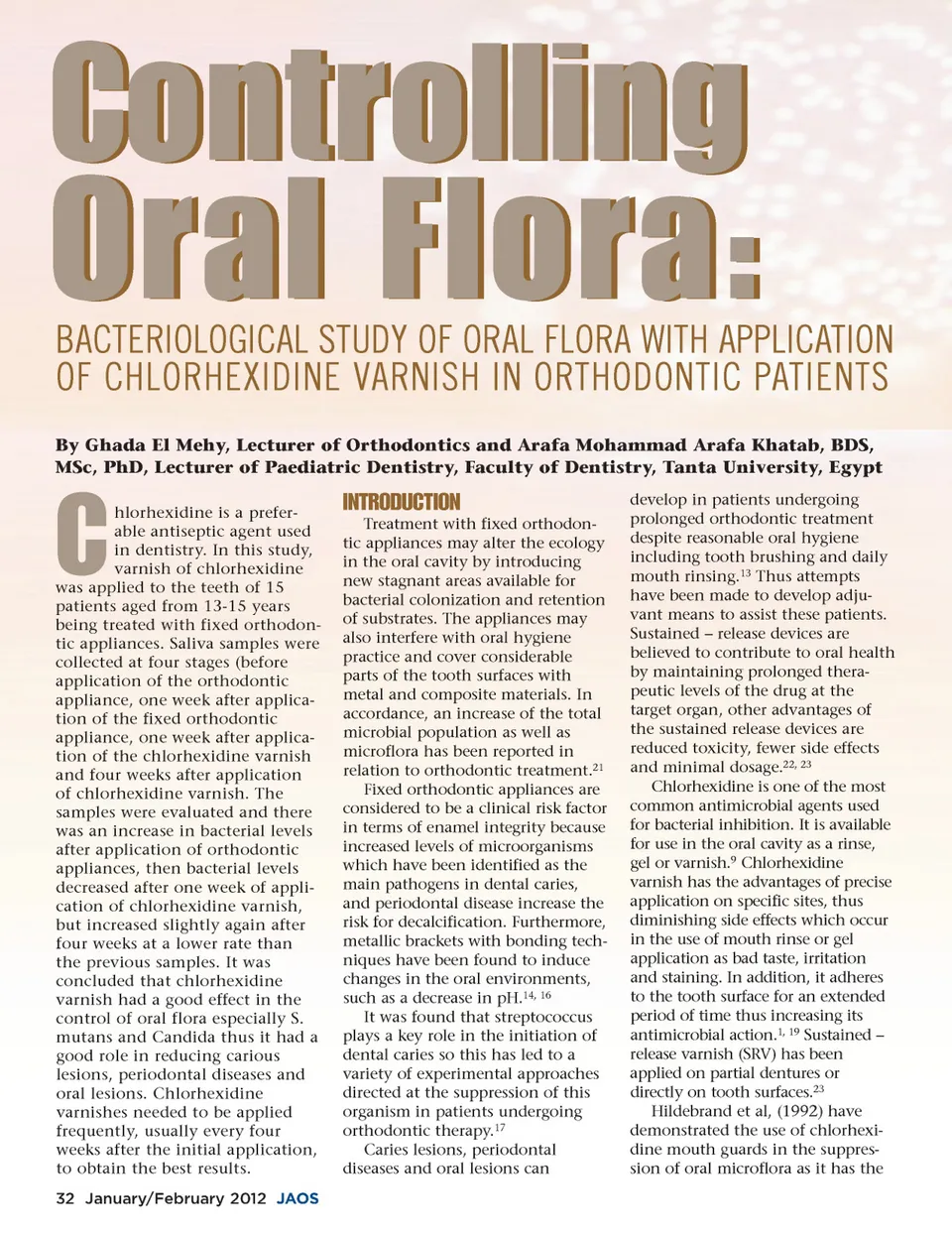
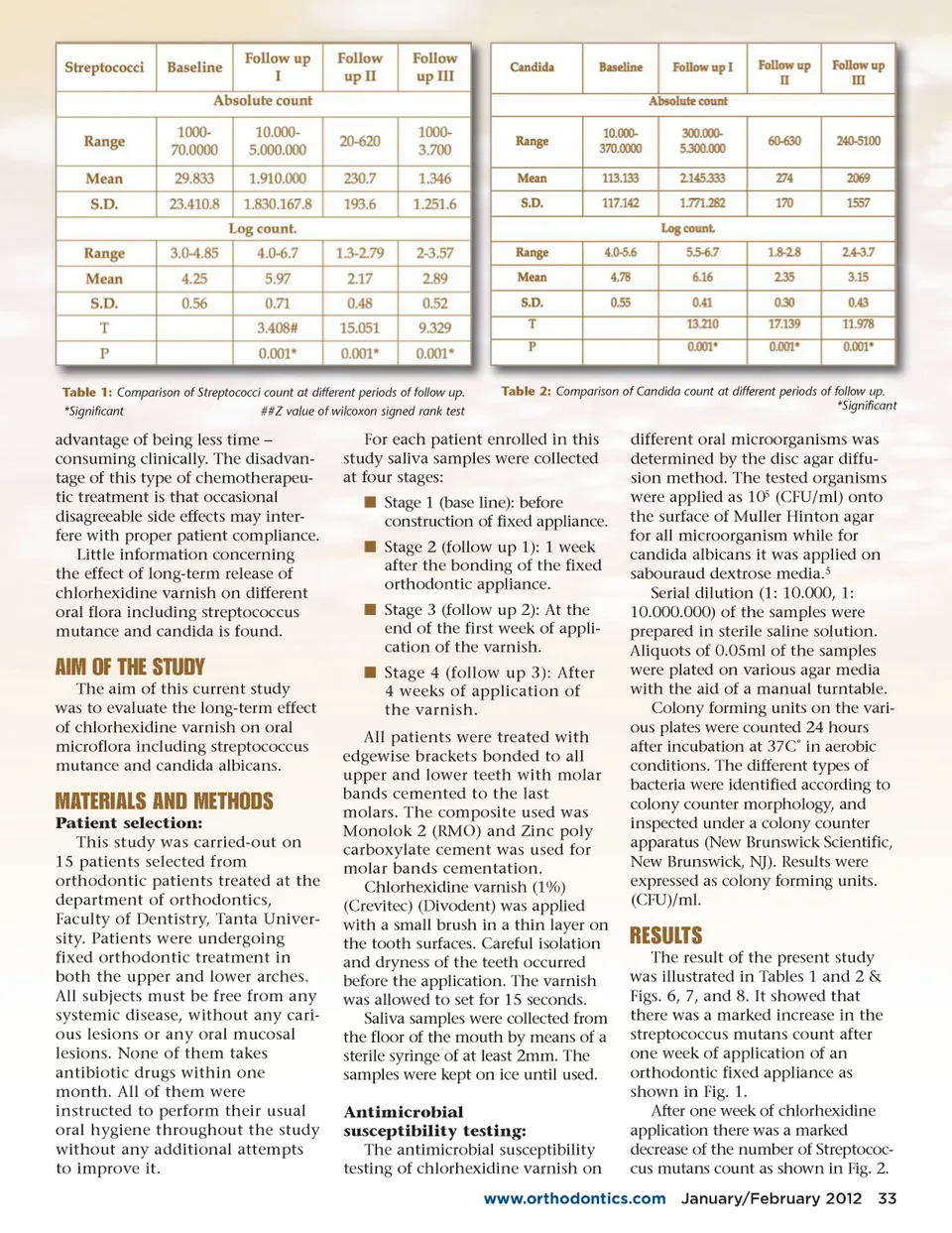
Table 1: Comparison of Streptococci count at different periods of follow up. *Significant ##Z value of wilcoxon signed rank test Table 2: Comparison of Candida count at different periods of follow up. *Significant advantage of being less time – consuming clinically. The disadvan-tage of this type of chemotherapeu-tic treatment is that occasional disagreeable side effects may inter-fere with proper patient compliance. Little information concerning the effect of long-term release of chlorhexidine varnish on different oral flora including streptococcus mutance and candida is found. For each patient enrolled in this study saliva samples were collected at four stages: Stage 1 (base line): before construction of fixed appliance. Stage 2 (follow up 1): 1 week after the bonding of the fixed orthodontic appliance. Stage 3 (follow up 2): At the end of the first week of appli-cation of the varnish. AIM OF THE STUDY The aim of this current study was to evaluate the long-term effect of chlorhexidine varnish on oral microflora including streptococcus mutance and candida albicans. Stage 4 (follow up 3): After 4 weeks of application of the varnish. All patients were treated with edgewise brackets bonded to all upper and lower teeth with molar bands cemented to the last molars. The composite used was Monolok 2 (RMO) and Zinc poly carboxylate cement was used for molar bands cementation. Chlorhexidine varnish (1%) (Crevitec) (Divodent) was applied with a small brush in a thin layer on the tooth surfaces. Careful isolation and dryness of the teeth occurred before the application. The varnish was allowed to set for 15 seconds. Saliva samples were collected from the floor of the mouth by means of a sterile syringe of at least 2mm. The samples were kept on ice until used. Antimicrobial susceptibility testing: The antimicrobial susceptibility testing of chlorhexidine varnish on MATERIALS AND METHODS Patient selection: This study was carried-out on 15 patients selected from orthodontic patients treated at the department of orthodontics, Faculty of Dentistry, Tanta Univer-sity. Patients were undergoing fixed orthodontic treatment in both the upper and lower arches. All subjects must be free from any systemic disease, without any cari-ous lesions or any oral mucosal lesions. None of them takes antibiotic drugs within one month. All of them were instructed to perform their usual oral hygiene throughout the study without any additional attempts to improve it. different oral microorganisms was determined by the disc agar diffu-sion method. The tested organisms were applied as 10 5 (CFU/ml) onto the surface of Muller Hinton agar for all microorganism while for candida albicans it was applied on sabouraud dextrose media. 5 Serial dilution (1: 10.000, 1: 10.000.000) of the samples were prepared in sterile saline solution. Aliquots of 0.05ml of the samples were plated on various agar media with the aid of a manual turntable. Colony forming units on the vari-ous plates were counted 24 hours after incubation at 37C˚ in aerobic conditions. The different types of bacteria were identified according to colony counter morphology, and inspected under a colony counter apparatus (New Brunswick Scientific, New Brunswick, NJ). Results were expressed as colony forming units. (CFU)/ml. RESULTS The result of the present study was illustrated in Tables 1 and 2 & Figs. 6, 7, and 8. It showed that there was a marked increase in the streptococcus mutans count after one week of application of an orthodontic fixed appliance as shown in Fig. 1. After one week of chlorhexidine application there was a marked decrease of the number of Streptococ-cus mutans count as shown in Fig. 2. www.orthodontics.com January/February 2012 33
Journal of the American Orthodontic Society January-February 2012: Page 33