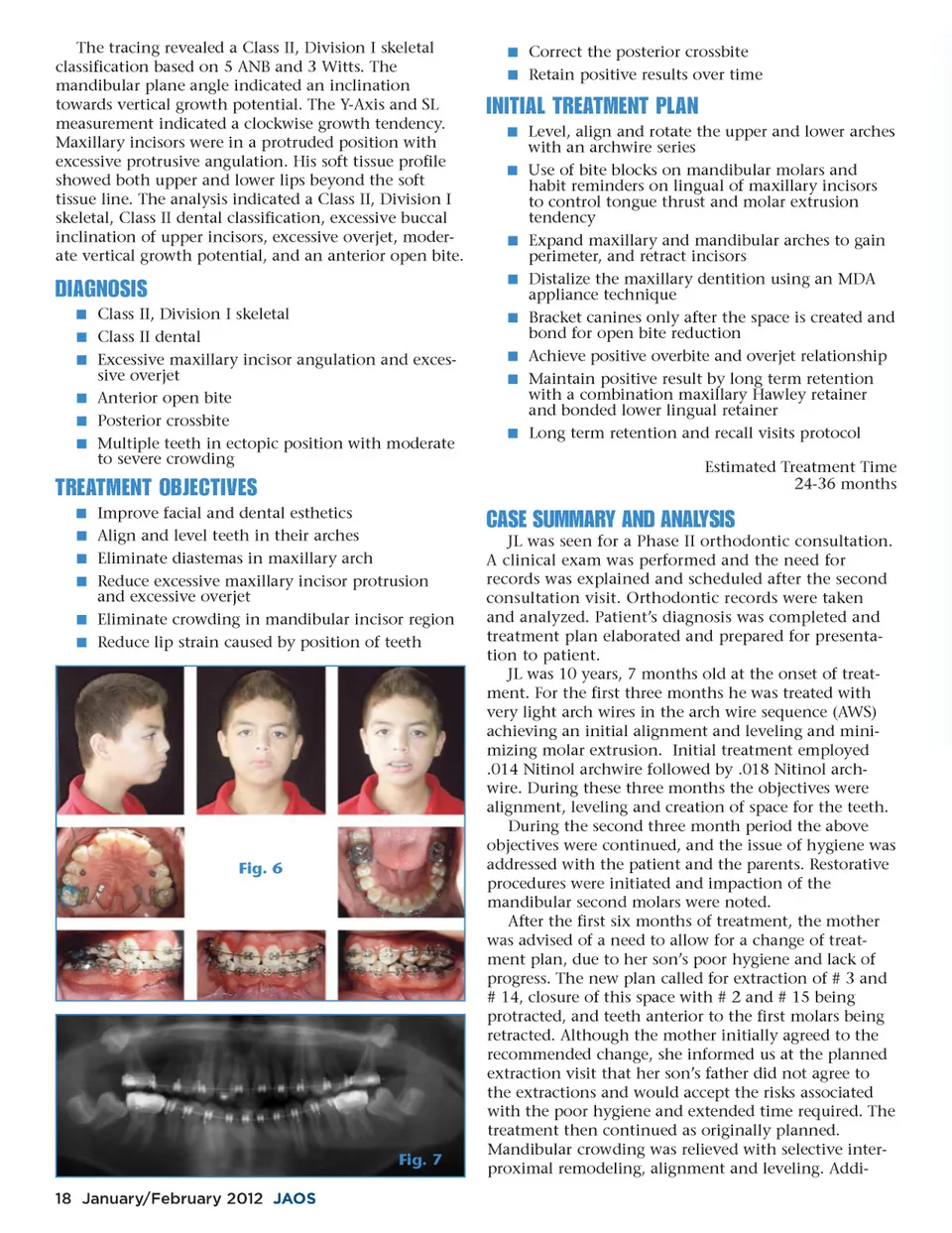
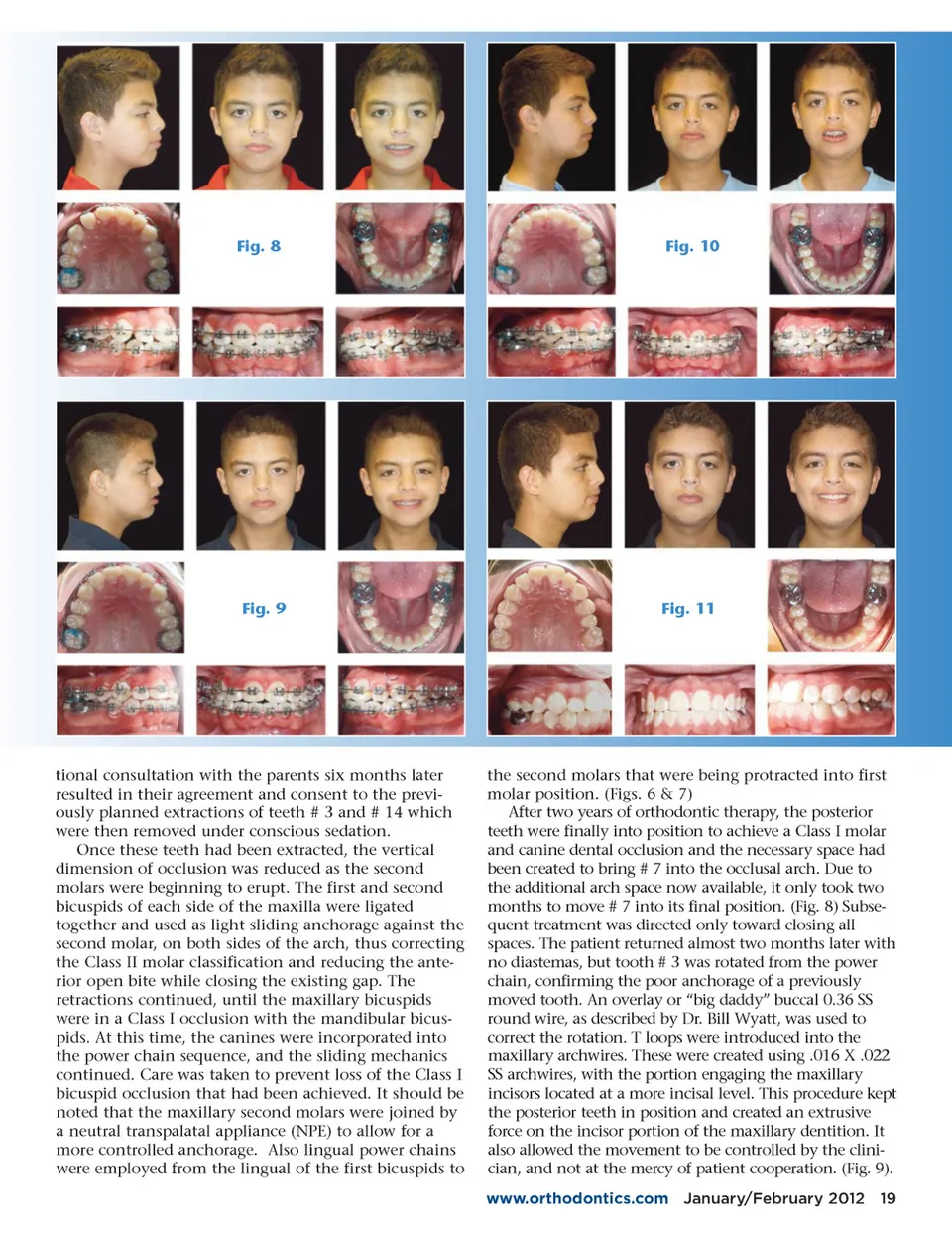
The tracing revealed a Class II, Division I skeletal classification based on 5 ANB and 3 Witts. The mandibular plane angle indicated an inclination towards vertical growth potential. The Y-Axis and SL measurement indicated a clockwise growth tendency. Maxillary incisors were in a protruded position with excessive protrusive angulation. His soft tissue profile showed both upper and lower lips beyond the soft tissue line. The analysis indicated a Class II, Division I skeletal, Class II dental classification, excessive buccal inclination of upper incisors, excessive overjet, moder-ate vertical growth potential, and an anterior open bite. Correct the posterior crossbite Retain positive results over time INITIAL TREATMENT PLAN Level, align and rotate the upper and lower arches with an archwire series Use of bite blocks on mandibular molars and habit reminders on lingual of maxillary incisors to control tongue thrust and molar extrusion tendency Expand maxillary and mandibular arches to gain perimeter, and retract incisors Distalize the maxillary dentition using an MDA appliance technique Bracket canines only after the space is created and bond for open bite reduction Achieve positive overbite and overjet relationship Maintain positive result by long term retention with a combination maxillary Hawley retainer and bonded lower lingual retainer Long term retention and recall visits protocol Estimated Treatment Time 24-36 months DIAGNOSIS Class II, Division I skeletal Class II dental Excessive maxillary incisor angulation and exces-sive overjet Anterior open bite Posterior crossbite Multiple teeth in ectopic position with moderate to severe crowding TREATMENT OBJECTIVES Improve facial and dental esthetics Align and level teeth in their arches Eliminate diastemas in maxillary arch Reduce excessive maxillary incisor protrusion and excessive overjet Eliminate crowding in mandibular incisor region Reduce lip strain caused by position of teeth CASE SUMMARY AND ANALYSIS JL was seen for a Phase II orthodontic consultation. A clinical exam was performed and the need for records was explained and scheduled after the second consultation visit. Orthodontic records were taken and analyzed. Patient’s diagnosis was completed and treatment plan elaborated and prepared for presenta-tion to patient. JL was 10 years, 7 months old at the onset of treat-ment. For the first three months he was treated with very light arch wires in the arch wire sequence (AWS) achieving an initial alignment and leveling and mini-mizing molar extrusion. Initial treatment employed .014 Nitinol archwire followed by .018 Nitinol arch-wire. During these three months the objectives were alignment, leveling and creation of space for the teeth. During the second three month period the above objectives were continued, and the issue of hygiene was addressed with the patient and the parents. Restorative procedures were initiated and impaction of the mandibular second molars were noted. After the first six months of treatment, the mother was advised of a need to allow for a change of treat-ment plan, due to her son’s poor hygiene and lack of progress. The new plan called for extraction of # 3 and # 14, closure of this space with # 2 and # 15 being protracted, and teeth anterior to the first molars being retracted. Although the mother initially agreed to the recommended change, she informed us at the planned extraction visit that her son’s father did not agree to the extractions and would accept the risks associated with the poor hygiene and extended time required. The treatment then continued as originally planned. Mandibular crowding was relieved with selective inter-proximal remodeling, alignment and leveling. Addi-Fig. 6 Fig. 7 18 January/February 2012 JAOS
Journal of the American Orthodontic Society January-February 2012: Page 18