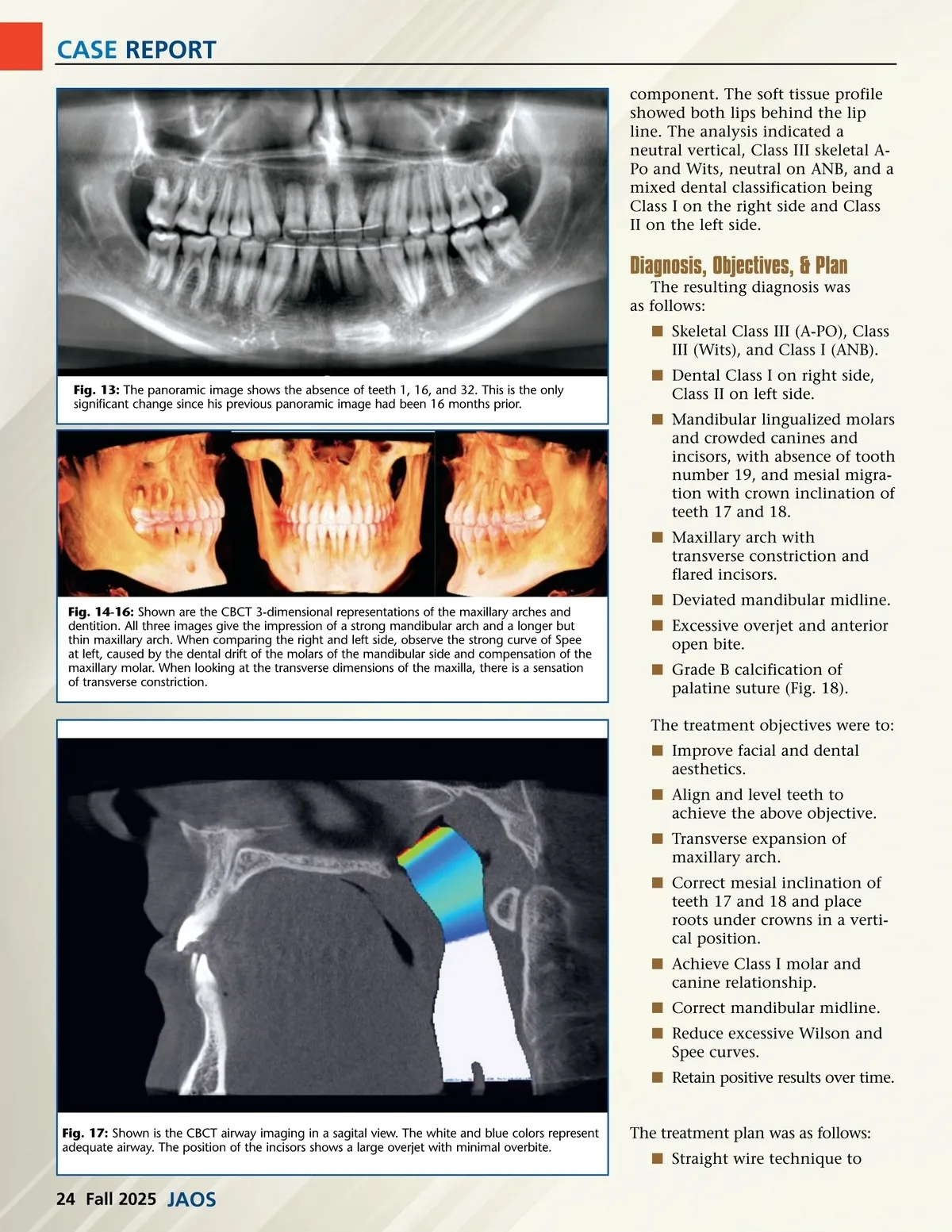
CASE REPORT Fig. 18: Shown is the axial view of the palatal suture. As the suture line can be observed in almost all of its trajectory, it can be classified as a grade B2. This increases the possibility of expansion of this suture with a traditional RME appliance. Fig. 19: The coronal view depicts the relationship between the maxillary and mandibular arches. If the mandibular teeth were uprighted, the patient would end in crossbite, unless the maxillary arch was expanded. Fig. 20: Images taken during treatment show the maxillary arch being expanded and posterior teeth intruded using a cemented and bonded appliance. Simultaneously, a buccal archwire creates alignment and leveling. The mandibular arch was treated with archwire sequence therapy with the intention of aligning and leveling the arches and correcting root torque of teeth 17 and 18 to properly replace the missing tooth. The frontal image shows a diastema created by the palatal expansion, and the lateral views show how the alignments improve the Class II initially observed on the left side. create space and align and level both arches. í Expand maxillary arch while intruding molars to eliminate anterior open bite. (Expan-sion and intrusion would be driven by a custom designed appliance.) í Reduce excessive overjet by expanding maxillary arch and improving arch shape. í Use interproximal proximal reduction as needed to correct the mandibular midline and positioning. í Inter-arch elastics used as needed to achieve a Class I dental occlusion. í Maintain positive results by long-term retention using bonded maxillary and mandibular fixed lingual and palatal retainers and Essix retainers. í Implement long-term reten-tion and hygiene re-care visits protocol. The estimated treatment time was 24 months, average for compre-hensive treatment. Case Summary & Analysis At 24 years 9 months, the patient reviewed the dental and orthodontic findings, diagnosis, and treatment options with the treating doctor. He was given options of (1) no treatment, (2) treatment with no expansion or intrusion, and (3) treatment with Fig. 21: Shown is the custom-made appliance based on a one arm expander. The flat portion of the screw allows for tongue pressure without causing a painful groove. The horizontal arms extend from the second molar to the first bicuspid. The anterior extension is bonded to the lingual surface of the first bicuspids to create a stronger hold when expanding and reducing the buccal tip of these teeth. Two TADs are placed between the second bicuspids and first molars on the palatal surface, and a vertical vector of intrusion force is created with the power chains and tongue pressure on the transverse bar. www.orthodontics.com Fall 2025 25
Journal of the American Orthodontic Society Fall 2025: Page 25