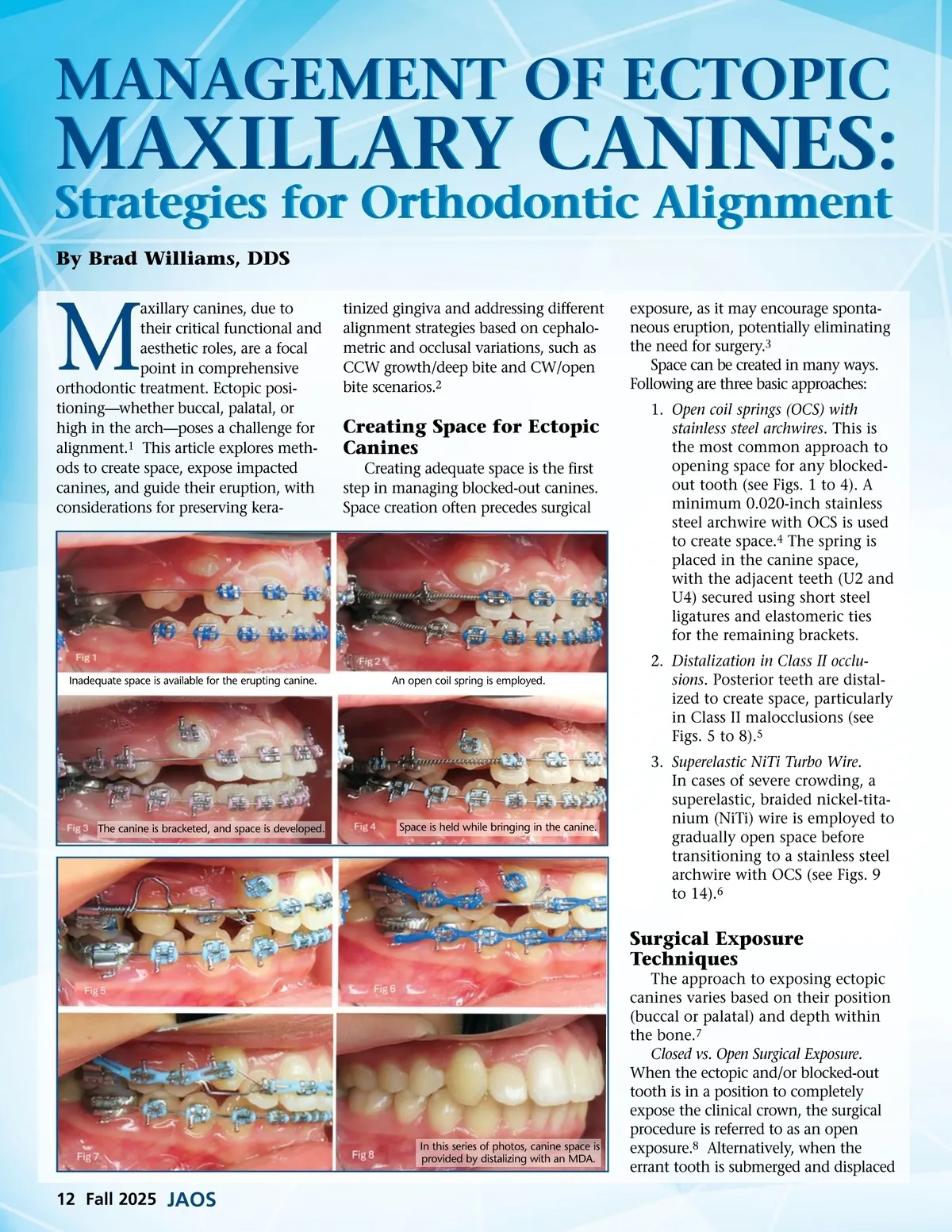
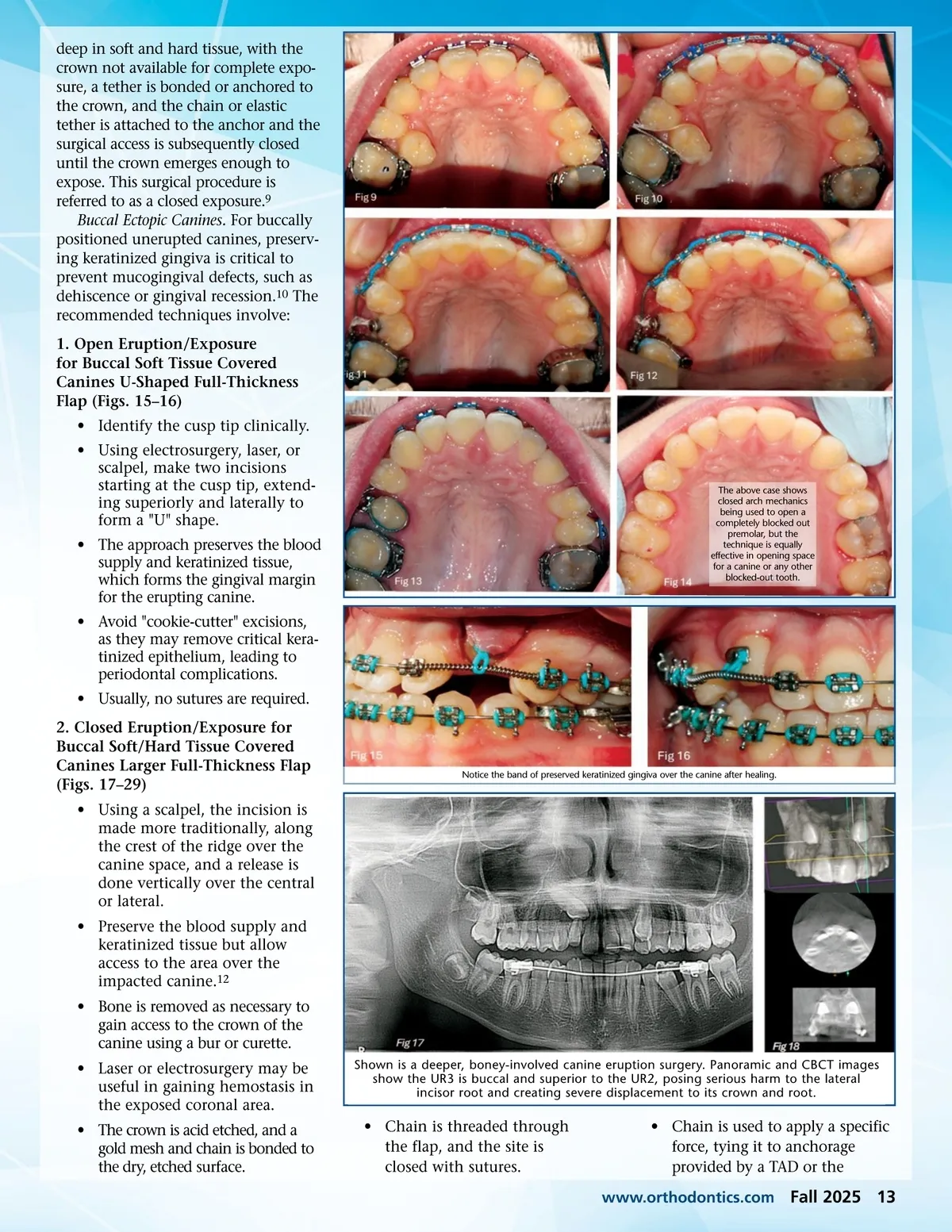
MANAGEMENT OF ECTOPIC MAXILLARY CANINES: Strategies for Orthodontic Alignment By Brad Williams, DDS M axillary canines, due to their critical functional and aesthetic roles, are a focal point in comprehensive orthodontic treatment. Ectopic posi-tioning—whether buccal, palatal, or high in the arch—poses a challenge for alignment. 1 This article explores meth-ods to create space, expose impacted canines, and guide their eruption, with considerations for preserving kera-tinized gingiva and addressing different alignment strategies based on cephalo-metric and occlusal variations, such as CCW growth/deep bite and CW/open bite scenarios. 2 exposure, as it may encourage sponta-neous eruption, potentially eliminating the need for surgery. 3 Space can be created in many ways. Following are three basic approaches: 1. Open coil springs (OCS) with stainless steel archwires. This is the most common approach to opening space for any blocked-out tooth (see Figs. 1 to 4). A minimum 0.020-inch stainless steel archwire with OCS is used to create space. 4 The spring is placed in the canine space, with the adjacent teeth (U2 and U4) secured using short steel ligatures and elastomeric ties for the remaining brackets. 2. Distalization in Class II occlu-sions. Posterior teeth are distal-ized to create space, particularly in Class II malocclusions (see Figs. 5 to 8). 5 3. Superelastic NiTi Turbo Wire. In cases of severe crowding, a superelastic, braided nickel-tita-nium (NiTi) wire is employed to gradually open space before transitioning to a stainless steel archwire with OCS (see Figs. 9 to 14). 6 Creating Space for Ectopic Canines Creating adequate space is the first step in managing blocked-out canines. Space creation often precedes surgical Inadequate space is available for the erupting canine. An open coil spring is employed. The canine is bracketed, and space is developed. Space is held while bringing in the canine. Surgical Exposure Techniques The approach to exposing ectopic canines varies based on their position (buccal or palatal) and depth within the bone. 7 Closed vs. Open Surgical Exposure. When the ectopic and/or blocked-out tooth is in a position to completely expose the clinical crown, the surgical procedure is referred to as an open exposure. 8 Alternatively, when the errant tooth is submerged and displaced In this series of photos, canine space is provided by distalizing with an MDA. 12 Fall 2025 JAOS
Journal of the American Orthodontic Society Fall 2025: Page 12