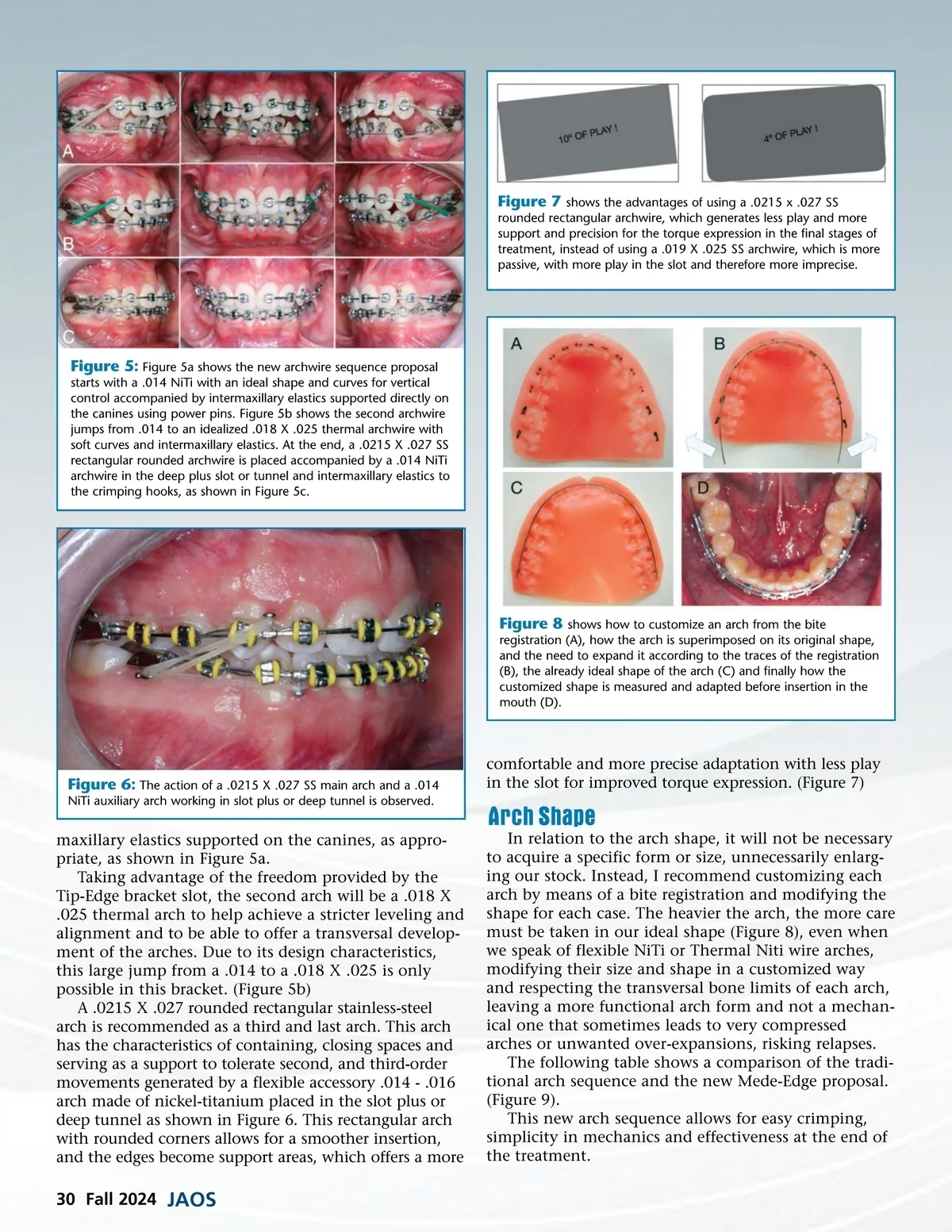
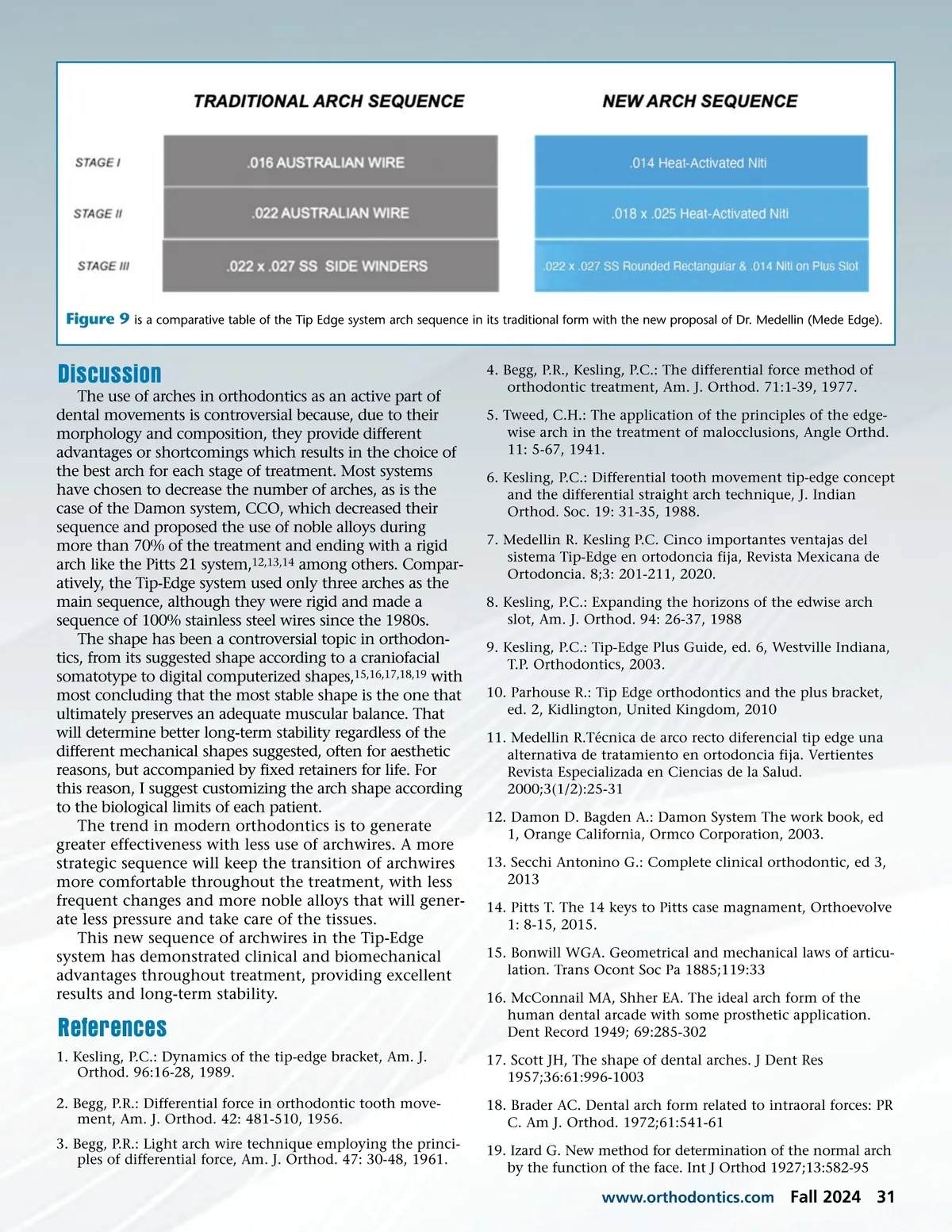
Figure 7 shows the advantages of using a .0215 x .027 SS rounded rectangular archwire, which generates less play and more support and precision for the torque expression in the final stages of treatment, instead of using a .019 X .025 SS archwire, which is more passive, with more play in the slot and therefore more imprecise. Figure 5: Figure 5a shows the new archwire sequence proposal starts with a .014 NiTi with an ideal shape and curves for vertical control accompanied by intermaxillary elastics supported directly on the canines using power pins. Figure 5b shows the second archwire jumps from .014 to an idealized .018 X .025 thermal archwire with soft curves and intermaxillary elastics. At the end, a .0215 X .027 SS rectangular rounded archwire is placed accompanied by a .014 NiTi archwire in the deep plus slot or tunnel and intermaxillary elastics to the crimping hooks, as shown in Figure 5c. Figure 8 shows how to customize an arch from the bite registration (A), how the arch is superimposed on its original shape, and the need to expand it according to the traces of the registration (B), the already ideal shape of the arch (C) and finally how the customized shape is measured and adapted before insertion in the mouth (D). Figure 6: The action of a .0215 X .027 SS main arch and a .014 NiTi auxiliary arch working in slot plus or deep tunnel is observed. comfortable and more precise adaptation with less play in the slot for improved torque expression. (Figure 7) Arch Shape In relation to the arch shape, it will not be necessary to acquire a specific form or size, unnecessarily enlarg-ing our stock. Instead, I recommend customizing each arch by means of a bite registration and modifying the shape for each case. The heavier the arch, the more care must be taken in our ideal shape (Figure 8), even when we speak of flexible NiTi or Thermal Niti wire arches, modifying their size and shape in a customized way and respecting the transversal bone limits of each arch, leaving a more functional arch form and not a mechan-ical one that sometimes leads to very compressed arches or unwanted over-expansions, risking relapses. The following table shows a comparison of the tradi-tional arch sequence and the new Mede-Edge proposal. (Figure 9). This new arch sequence allows for easy crimping, simplicity in mechanics and effectiveness at the end of the treatment. maxillary elastics supported on the canines, as appro-priate, as shown in Figure 5a. Taking advantage of the freedom provided by the Tip-Edge bracket slot, the second arch will be a .018 X .025 thermal arch to help achieve a stricter leveling and alignment and to be able to offer a transversal develop-ment of the arches. Due to its design characteristics, this large jump from a .014 to a .018 X .025 is only possible in this bracket. (Figure 5b) A .0215 X .027 rounded rectangular stainless-steel arch is recommended as a third and last arch. This arch has the characteristics of containing, closing spaces and serving as a support to tolerate second, and third-order movements generated by a flexible accessory .014 -.016 arch made of nickel-titanium placed in the slot plus or deep tunnel as shown in Figure 6. This rectangular arch with rounded corners allows for a smoother insertion, and the edges become support areas, which offers a more 30 Fall 2024 JAOS
Journal of the American Orthodontic Society Fall 2024: Page 30