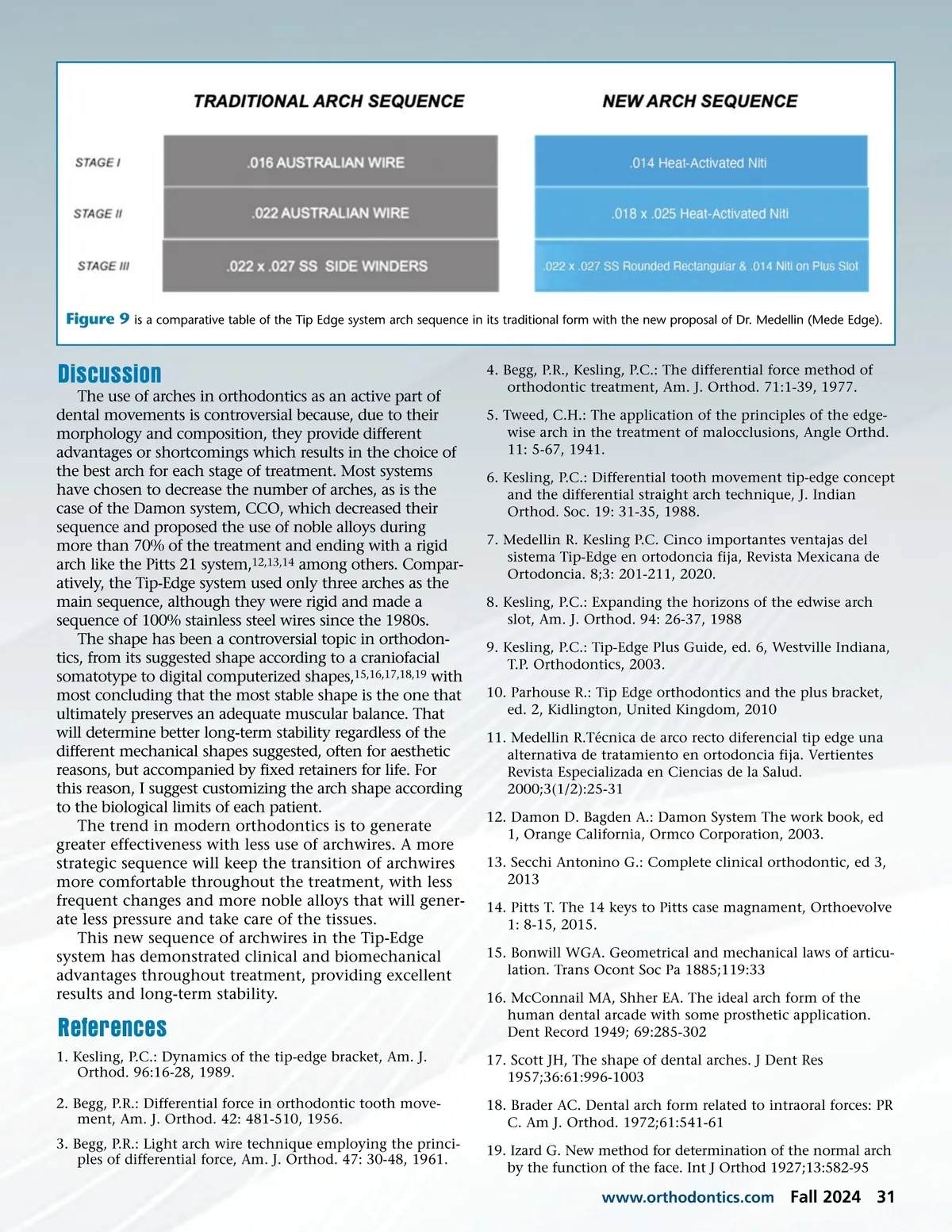
Figure 9 is a comparative table of the Tip Edge system arch sequence in its traditional form with the new proposal of Dr. Medellin (Mede Edge). Discussion The use of arches in orthodontics as an active part of dental movements is controversial because, due to their morphology and composition, they provide different advantages or shortcomings which results in the choice of the best arch for each stage of treatment. Most systems have chosen to decrease the number of arches, as is the case of the Damon system, CCO, which decreased their sequence and proposed the use of noble alloys during more than 70% of the treatment and ending with a rigid arch like the Pitts 21 system, 12,13,14 among others. Compar-atively, the Tip-Edge system used only three arches as the main sequence, although they were rigid and made a sequence of 100% stainless steel wires since the 1980s. The shape has been a controversial topic in orthodon-tics, from its suggested shape according to a craniofacial somatotype to digital computerized shapes, 15,16,17,18,19 with most concluding that the most stable shape is the one that ultimately preserves an adequate muscular balance. That will determine better long-term stability regardless of the different mechanical shapes suggested, often for aesthetic reasons, but accompanied by fixed retainers for life. For this reason, I suggest customizing the arch shape according to the biological limits of each patient. The trend in modern orthodontics is to generate greater effectiveness with less use of archwires. A more strategic sequence will keep the transition of archwires more comfortable throughout the treatment, with less frequent changes and more noble alloys that will gener-ate less pressure and take care of the tissues. This new sequence of archwires in the Tip-Edge system has demonstrated clinical and biomechanical advantages throughout treatment, providing excellent results and long-term stability. 4. Begg, P.R., Kesling, P.C.: The differential force method of orthodontic treatment, Am. J. Orthod. 71:1-39, 1977. 5. Tweed, C.H.: The application of the principles of the edge-wise arch in the treatment of malocclusions, Angle Orthd. 11: 5-67, 1941. 6. Kesling, P.C.: Differential tooth movement tip-edge concept and the differential straight arch technique, J. Indian Orthod. Soc. 19: 31-35, 1988. 7. Medellin R. Kesling P.C. Cinco importantes ventajas del sistema Tip-Edge en ortodoncia fija, Revista Mexicana de Ortodoncia. 8;3: 201-211, 2020. 8. Kesling, P.C.: Expanding the horizons of the edwise arch slot, Am. J. Orthod. 94: 26-37, 1988 9. Kesling, P.C.: Tip-Edge Plus Guide, ed. 6, Westville Indiana, T.P. Orthodontics, 2003. 10. Parhouse R.: Tip Edge orthodontics and the plus bracket, ed. 2, Kidlington, United Kingdom, 2010 11. Medellin R.Técnica de arco recto diferencial tip edge una alternativa de tratamiento en ortodoncia fija. Vertientes Revista Especializada en Ciencias de la Salud. 2000;3(1/2):25-31 12. Damon D. Bagden A.: Damon System The work book, ed 1, Orange California, Ormco Corporation, 2003. 13. Secchi Antonino G.: Complete clinical orthodontic, ed 3, 2013 14. Pitts T. The 14 keys to Pitts case magnament, Orthoevolve 1: 8-15, 2015. 15. Bonwill WGA. Geometrical and mechanical laws of articu-lation. Trans Ocont Soc Pa 1885;119:33 16. McConnail MA, Shher EA. The ideal arch form of the human dental arcade with some prosthetic application. Dent Record 1949; 69:285-302 17. Scott JH, The shape of dental arches. J Dent Res 1957;36:61:996-1003 18. Brader AC. Dental arch form related to intraoral forces: PR C. Am J. Orthod. 1972;61:541-61 19. Izard G. New method for determination of the normal arch by the function of the face. Int J Orthod 1927;13:582-95 References 1. Kesling, P.C.: Dynamics of the tip-edge bracket, Am. J. Orthod. 96:16-28, 1989. 2. Begg, P.R.: Differential force in orthodontic tooth move-ment, Am. J. Orthod. 42: 481-510, 1956. 3. Begg, P.R.: Light arch wire technique employing the princi-ples of differential force, Am. J. Orthod. 47: 30-48, 1961. www.orthodontics.com Fall 2024 31
Journal of the American Orthodontic Society Fall 2024: Page 31