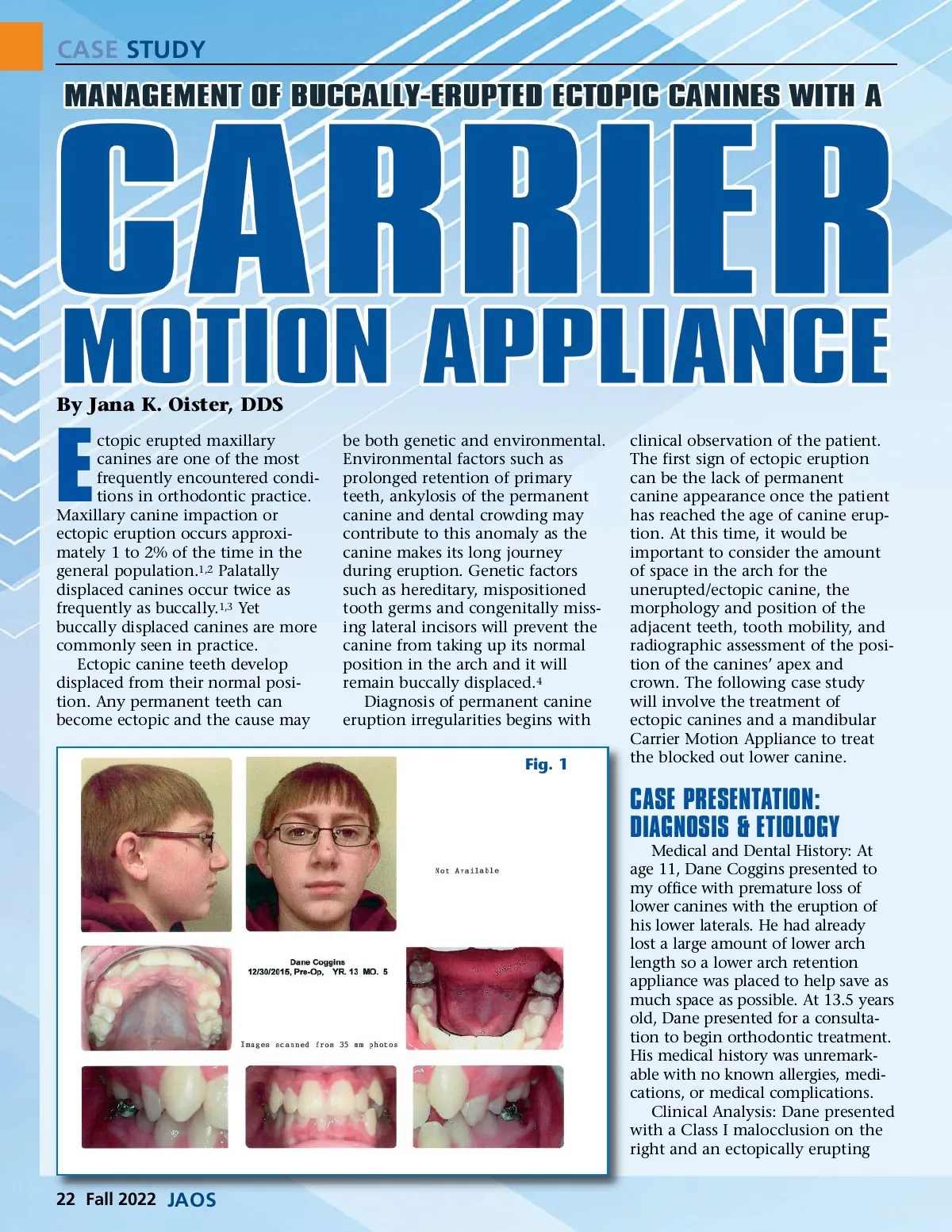
CASE STUDY By Jana K. Oister, DDS E ctopic erupted maxillary canines are one of the most frequently encountered condi-tions in orthodontic practice. Maxillary canine impaction or ectopic eruption occurs approxi-mately 1 to 2% of the time in the general population. 1,2 Palatally displaced canines occur twice as frequently as buccally. 1,3 Yet buccally displaced canines are more commonly seen in practice. Ectopic canine teeth develop displaced from their normal posi-tion. Any permanent teeth can become ectopic and the cause may be both genetic and environmental. Environmental factors such as prolonged retention of primary teeth, ankylosis of the permanent canine and dental crowding may contribute to this anomaly as the canine makes its long journey during eruption. Genetic factors such as hereditary, mispositioned tooth germs and congenitally miss-ing lateral incisors will prevent the canine from taking up its normal position in the arch and it will remain buccally displaced. 4 Diagnosis of permanent canine eruption irregularities begins with Fig. 1 clinical observation of the patient. The first sign of ectopic eruption can be the lack of permanent canine appearance once the patient has reached the age of canine erup-tion. At this time, it would be important to consider the amount of space in the arch for the unerupted/ectopic canine, the morphology and position of the adjacent teeth, tooth mobility, and radiographic assessment of the posi-tion of the canines’ apex and crown. The following case study will involve the treatment of ectopic canines and a mandibular Carrier Motion Appliance to treat the blocked out lower canine. CASE PRESENTATION: DIAGNOSIS & ETIOLOGY Medical and Dental History: At age 11, Dane Coggins presented to my office with premature loss of lower canines with the eruption of his lower laterals. He had already lost a large amount of lower arch length so a lower arch retention appliance was placed to help save as much space as possible. At 13.5 years old, Dane presented for a consulta-tion to begin orthodontic treatment. His medical history was unremark-able with no known allergies, medi-cations, or medical complications. Clinical Analysis: Dane presented with a Class I malocclusion on the right and an ectopically erupting 22 Fall 2022 JAOS
Journal of the American Orthodontic Society Fall 2022: Page 22