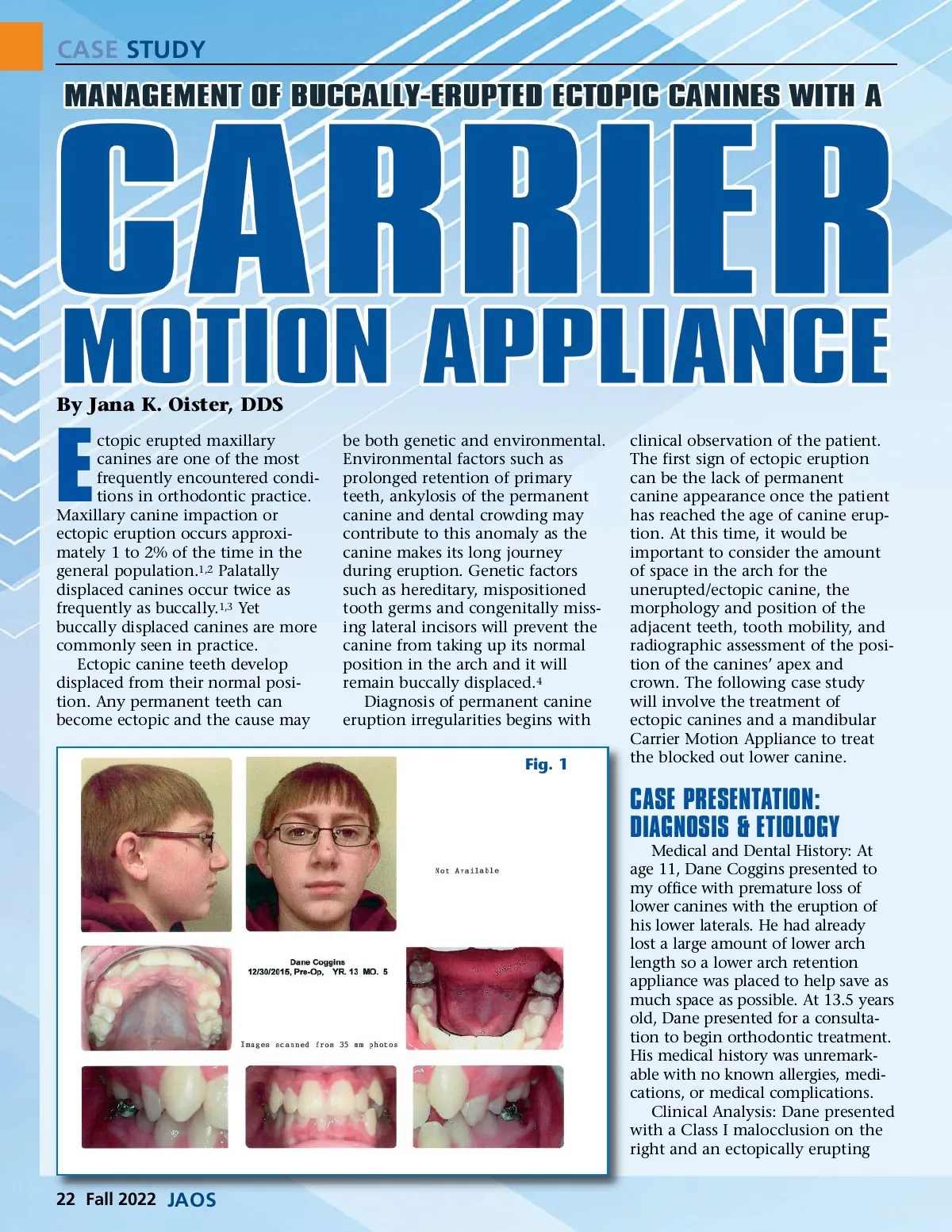
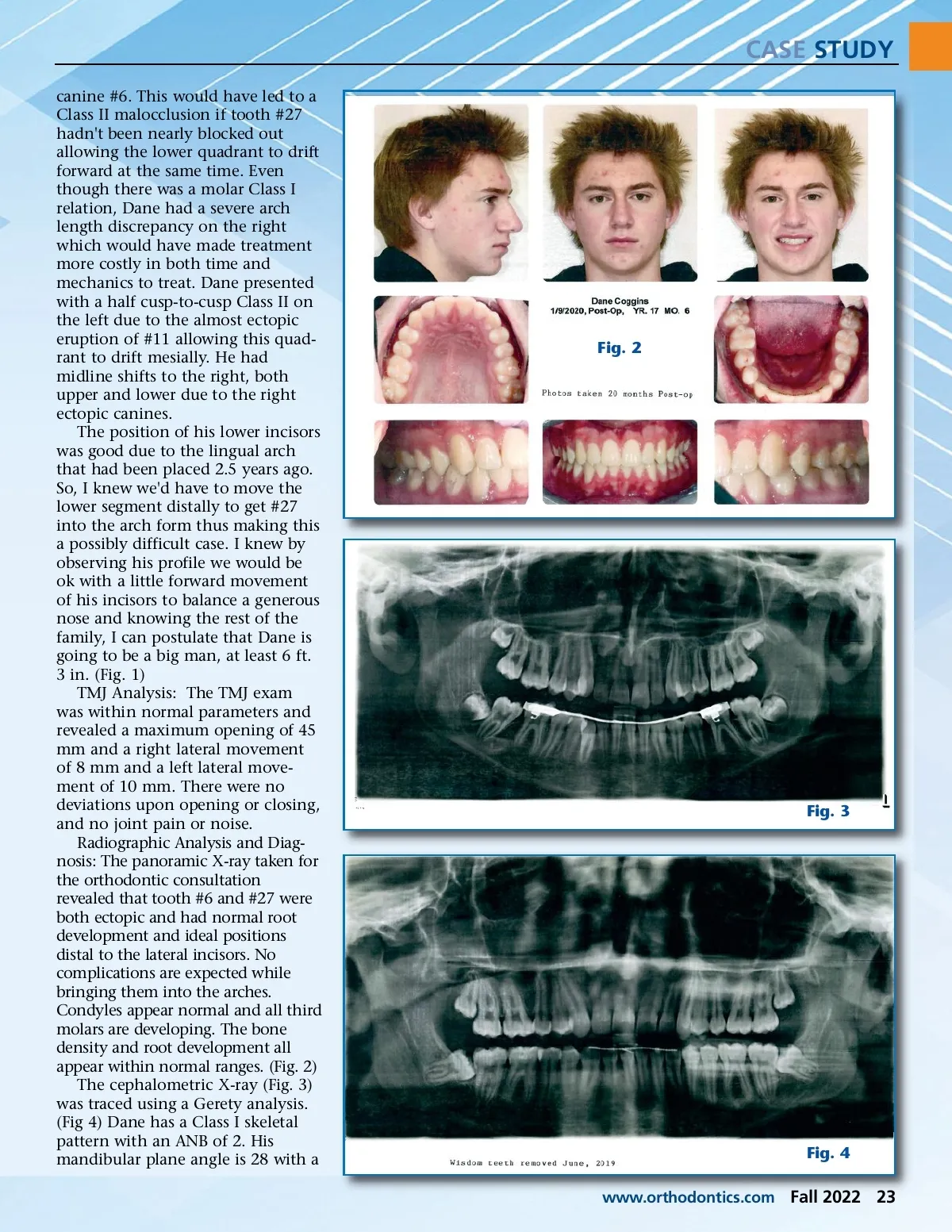
CASE STUDY canine #6. This would have led to a Class II malocclusion if tooth #27 hadn't been nearly blocked out allowing the lower quadrant to drift forward at the same time. Even though there was a molar Class I relation, Dane had a severe arch length discrepancy on the right which would have made treatment more costly in both time and mechanics to treat. Dane presented with a half cusp-to-cusp Class II on the left due to the almost ectopic eruption of #11 allowing this quad-rant to drift mesially. He had midline shifts to the right, both upper and lower due to the right ectopic canines. The position of his lower incisors was good due to the lingual arch that had been placed 2.5 years ago. So, I knew we'd have to move the lower segment distally to get #27 into the arch form thus making this a possibly difficult case. I knew by observing his profile we would be ok with a little forward movement of his incisors to balance a generous nose and knowing the rest of the family, I can postulate that Dane is going to be a big man, at least 6 ft. 3 in. (Fig. 1) TMJ Analysis: The TMJ exam was within normal parameters and revealed a maximum opening of 45 mm and a right lateral movement of 8 mm and a left lateral move-ment of 10 mm. There were no deviations upon opening or closing, and no joint pain or noise. Radiographic Analysis and Diag-nosis: The panoramic X-ray taken for the orthodontic consultation revealed that tooth #6 and #27 were both ectopic and had normal root development and ideal positions distal to the lateral incisors. No complications are expected while bringing them into the arches. Condyles appear normal and all third molars are developing. The bone density and root development all appear within normal ranges. (Fig. 2) The cephalometric X-ray (Fig. 3) was traced using a Gerety analysis. (Fig 4) Dane has a Class I skeletal pattern with an ANB of 2. His mandibular plane angle is 28 with a Fig. 2 Fig. 3 Fig. 4 www.orthodontics.com Fall 2022 23
Journal of the American Orthodontic Society Fall 2022: Page 23