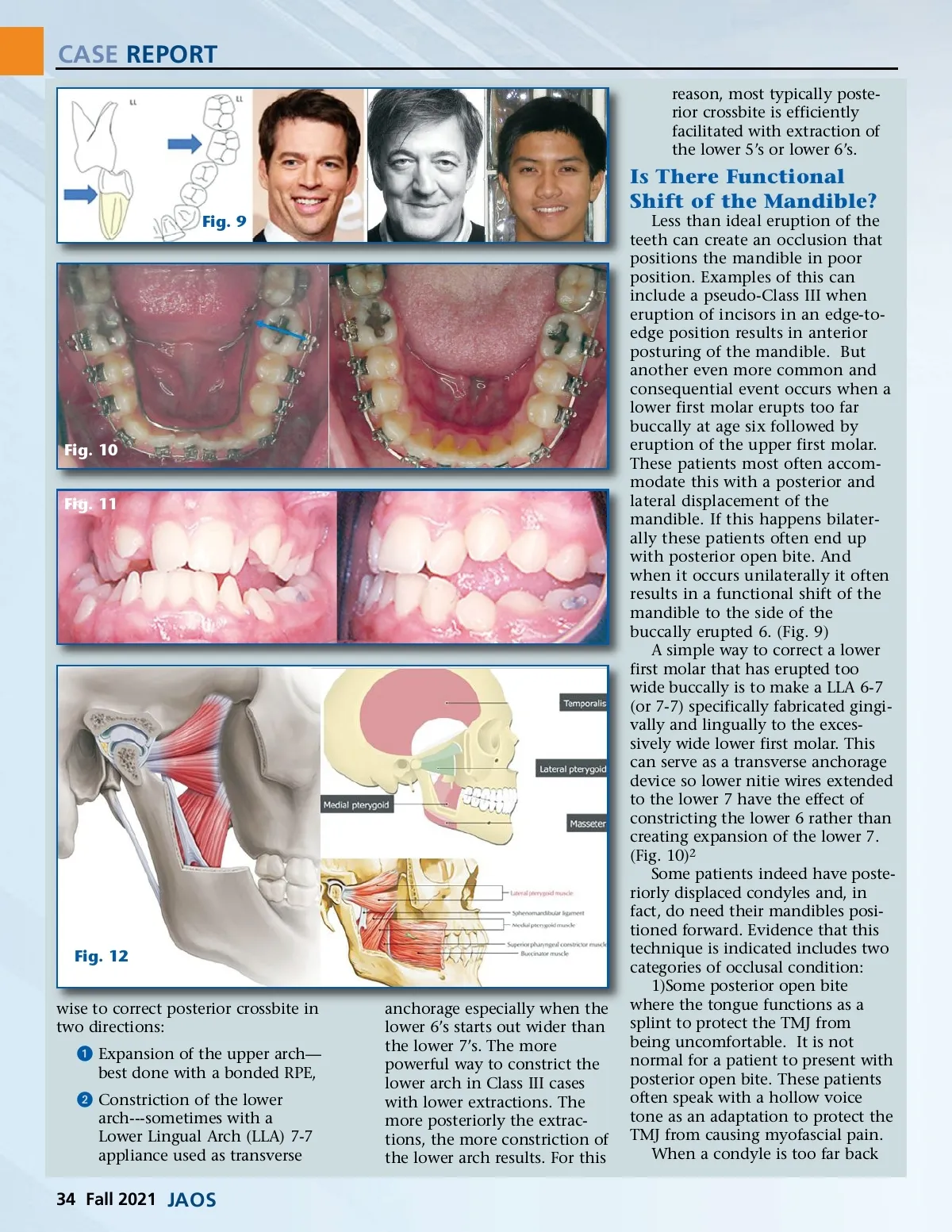
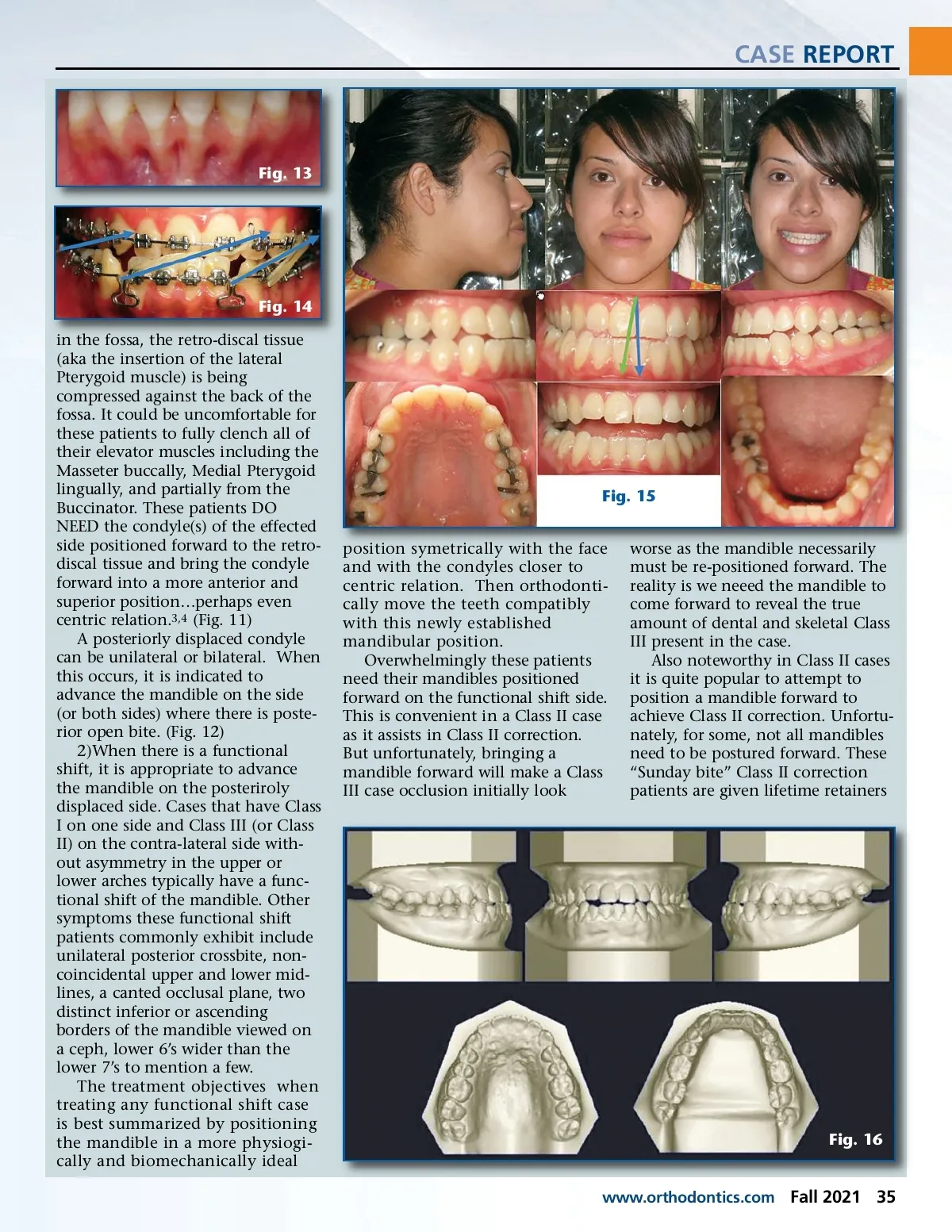
CASE REPORT Fig. 13 Fig. 14 in the fossa, the retro-discal tissue (aka the insertion of the lateral Pterygoid muscle) is being compressed against the back of the fossa. It could be uncomfortable for these patients to fully clench all of their elevator muscles including the Masseter buccally, Medial Pterygoid lingually, and partially from the Buccinator. These patients DO NEED the condyle(s) of the effected side positioned forward to the retro-discal tissue and bring the condyle forward into a more anterior and superior position…perhaps even centric relation. 3,4 (Fig. 11) A posteriorly displaced condyle can be unilateral or bilateral. When this occurs, it is indicated to advance the mandible on the side (or both sides) where there is poste-rior open bite. (Fig. 12) 2)When there is a functional shift, it is appropriate to advance the mandible on the posteriroly displaced side. Cases that have Class I on one side and Class III (or Class II) on the contra-lateral side with-out asymmetry in the upper or lower arches typically have a func-tional shift of the mandible. Other symptoms these functional shift patients commonly exhibit include unilateral posterior crossbite, non-coincidental upper and lower mid-lines, a canted occlusal plane, two distinct inferior or ascending borders of the mandible viewed on a ceph, lower 6’s wider than the lower 7’s to mention a few. The treatment objectives when treating any functional shift case is best summarized by positioning the mandible in a more physiogi-cally and biomechanically ideal Fig. 15 position symetrically with the face and with the condyles closer to centric relation. Then orthodonti-cally move the teeth compatibly with this newly established mandibular position. Overwhelmingly these patients need their mandibles positioned forward on the functional shift side. This is convenient in a Class II case as it assists in Class II correction. But unfortunately, bringing a mandible forward will make a Class III case occlusion initially look worse as the mandible necessarily must be re-positioned forward. The reality is we neeed the mandible to come forward to reveal the true amount of dental and skeletal Class III present in the case. Also noteworthy in Class II cases it is quite popular to attempt to position a mandible forward to achieve Class II correction. Unfortu-nately, for some, not all mandibles need to be postured forward. These “Sunday bite” Class II correction patients are given lifetime retainers Fig. 16 www.orthodontics.com Fall 2021 35
Journal of the American Orthodontic Society Fall 2021: Page 35