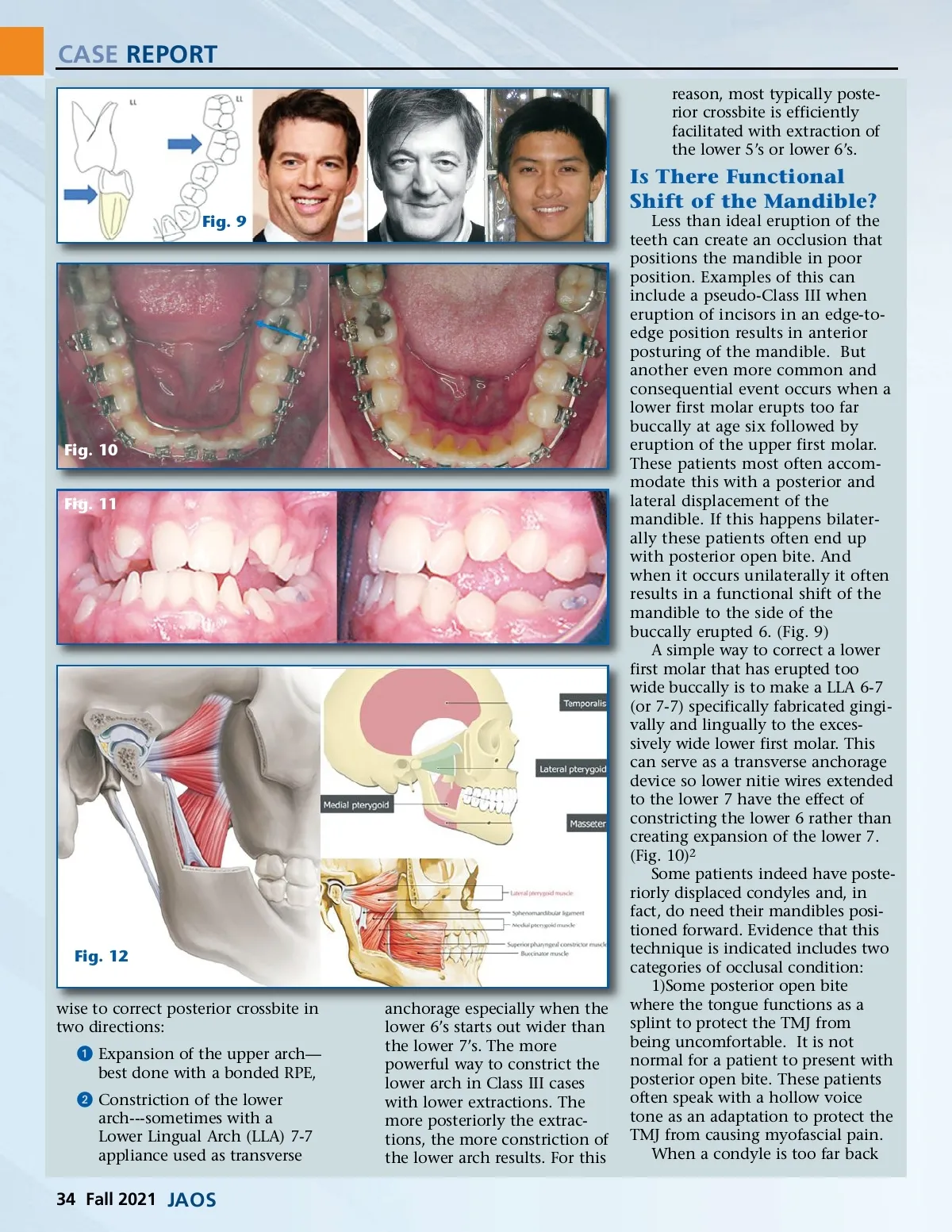
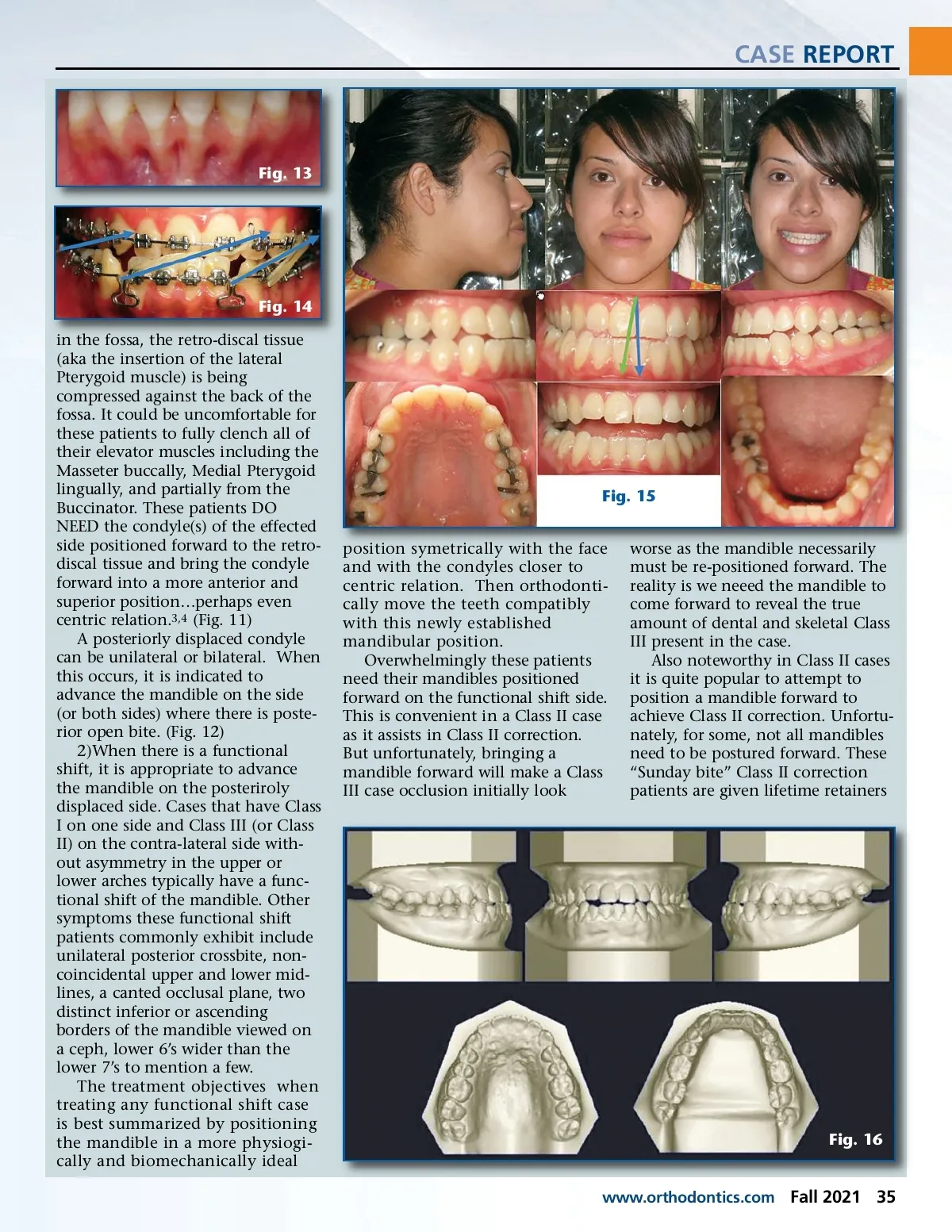
CASE REPORT reason, most typically poste-rior crossbite is efficiently facilitated with extraction of the lower 5’s or lower 6’s. Is There Functional Shift of the Mandible? Fig. 9 Less than ideal eruption of the teeth can create an occlusion that positions the mandible in poor position. Examples of this can include a pseudo-Class III when eruption of incisors in an edge-to-edge position results in anterior posturing of the mandible. But another even more common and consequential event occurs when a lower first molar erupts too far buccally at age six followed by eruption of the upper first molar. These patients most often accom-modate this with a posterior and lateral displacement of the mandible. If this happens bilater-ally these patients often end up with posterior open bite. And when it occurs unilaterally it often results in a functional shift of the mandible to the side of the buccally erupted 6. (Fig. 9) A simple way to correct a lower first molar that has erupted too wide buccally is to make a LLA 6-7 (or 7-7) specifically fabricated gingi-vally and lingually to the exces-sively wide lower first molar. This can serve as a transverse anchorage device so lower nitie wires extended to the lower 7 have the effect of constricting the lower 6 rather than creating expansion of the lower 7. (Fig. 10) 2 Some patients indeed have poste-riorly displaced condyles and, in fact, do need their mandibles posi-tioned forward. Evidence that this technique is indicated includes two categories of occlusal condition: 1)Some posterior open bite where the tongue functions as a splint to protect the TMJ from being uncomfortable. It is not normal for a patient to present with posterior open bite. These patients often speak with a hollow voice tone as an adaptation to protect the TMJ from causing myofascial pain. When a condyle is too far back Fig. 10 Fig. 11 Fig. 12 wise to correct posterior crossbite in two directions: ᕡ Expansion of the upper arch— best done with a bonded RPE, ᕢ Constriction of the lower arch---sometimes with a Lower Lingual Arch (LLA) 7-7 appliance used as transverse anchorage especially when the lower 6’s starts out wider than the lower 7’s. The more powerful way to constrict the lower arch in Class III cases with lower extractions. The more posteriorly the extrac-tions, the more constriction of the lower arch results. For this 34 Fall 2021 JAOS
Journal of the American Orthodontic Society Fall 2021: Page 34