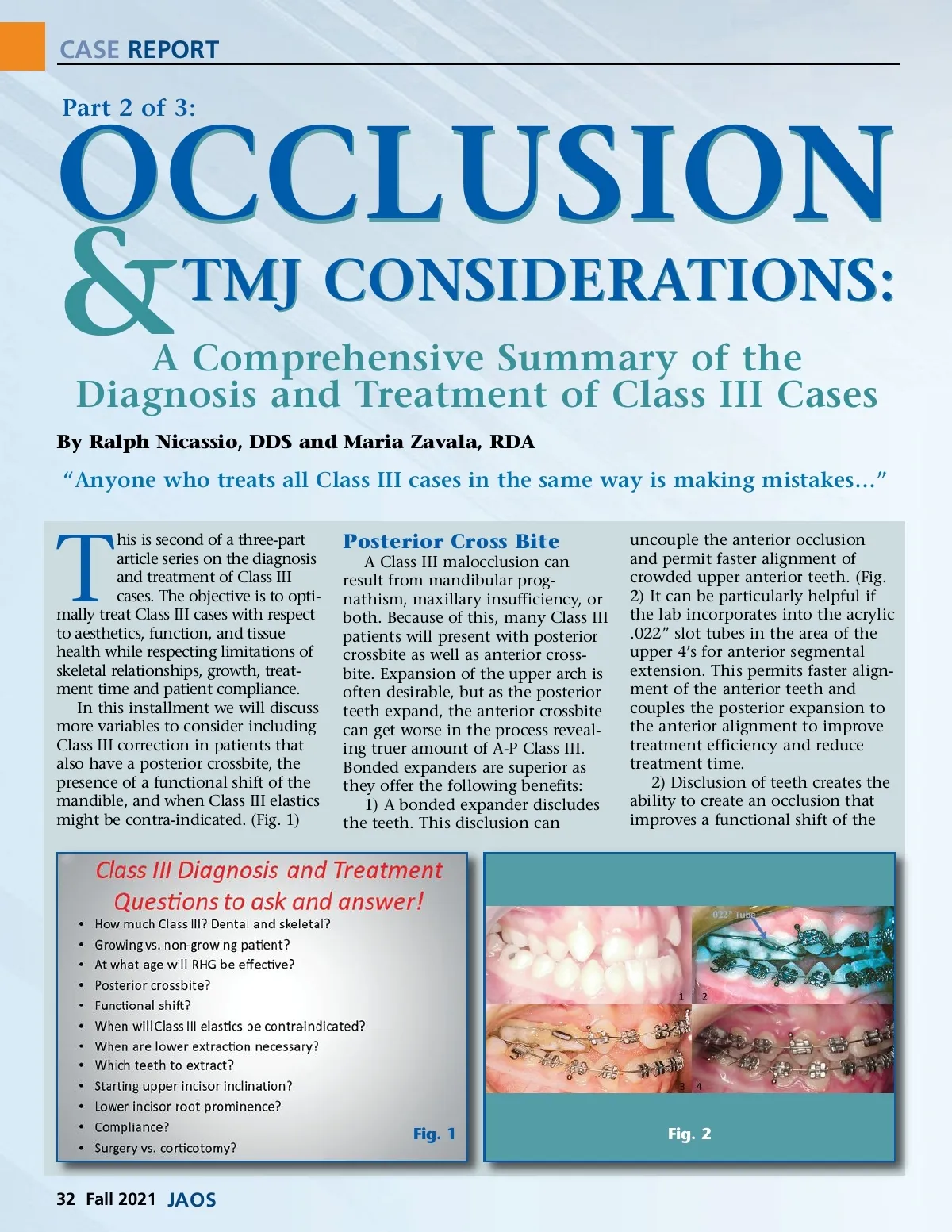
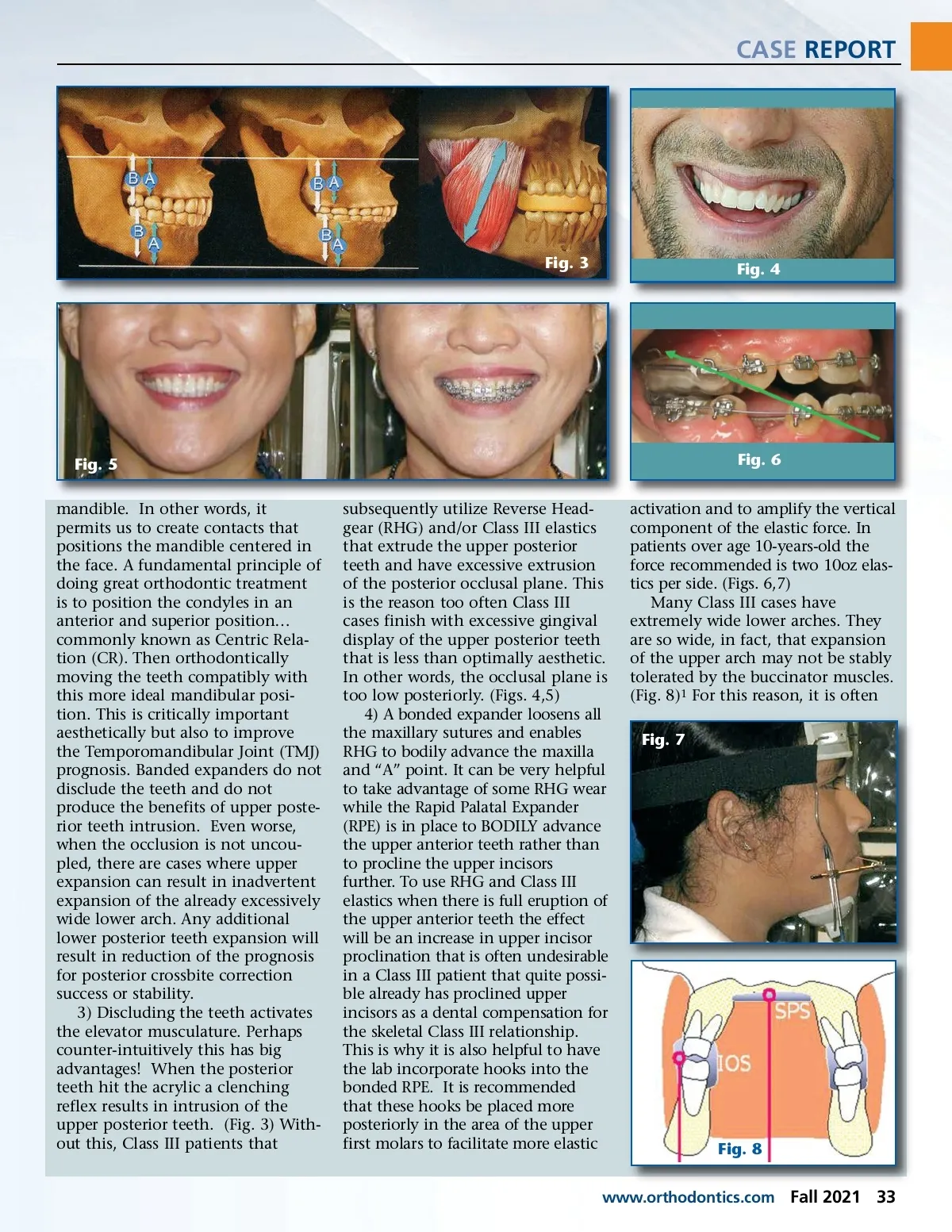
CASE REPORT Fig. 3 Fig. 4 Fig. 5 mandible. In other words, it permits us to create contacts that positions the mandible centered in the face. A fundamental principle of doing great orthodontic treatment is to position the condyles in an anterior and superior position… commonly known as Centric Rela-tion (CR). Then orthodontically moving the teeth compatibly with this more ideal mandibular posi-tion. This is critically important aesthetically but also to improve the Temporomandibular Joint (TMJ) prognosis. Banded expanders do not disclude the teeth and do not produce the benefits of upper poste-rior teeth intrusion. Even worse, when the occlusion is not uncou-pled, there are cases where upper expansion can result in inadvertent expansion of the already excessively wide lower arch. Any additional lower posterior teeth expansion will result in reduction of the prognosis for posterior crossbite correction success or stability. 3) Discluding the teeth activates the elevator musculature. Perhaps counter-intuitively this has big advantages! When the posterior teeth hit the acrylic a clenching reflex results in intrusion of the upper posterior teeth. (Fig. 3) With-out this, Class III patients that subsequently utilize Reverse Head-gear (RHG) and/or Class III elastics that extrude the upper posterior teeth and have excessive extrusion of the posterior occlusal plane. This is the reason too often Class III cases finish with excessive gingival display of the upper posterior teeth that is less than optimally aesthetic. In other words, the occlusal plane is too low posteriorly. (Figs. 4,5) 4) A bonded expander loosens all the maxillary sutures and enables RHG to bodily advance the maxilla and “A” point. It can be very helpful to take advantage of some RHG wear while the Rapid Palatal Expander (RPE) is in place to BODILY advance the upper anterior teeth rather than to procline the upper incisors further. To use RHG and Class III elastics when there is full eruption of the upper anterior teeth the effect will be an increase in upper incisor proclination that is often undesirable in a Class III patient that quite possi-ble already has proclined upper incisors as a dental compensation for the skeletal Class III relationship. This is why it is also helpful to have the lab incorporate hooks into the bonded RPE. It is recommended that these hooks be placed more posteriorly in the area of the upper first molars to facilitate more elastic Fig. 6 activation and to amplify the vertical component of the elastic force. In patients over age 10-years-old the force recommended is two 10oz elas-tics per side. (Figs. 6,7) Many Class III cases have extremely wide lower arches. They are so wide, in fact, that expansion of the upper arch may not be stably tolerated by the buccinator muscles. (Fig. 8) 1 For this reason, it is often Fig. 7 Fig. 8 www.orthodontics.com Fall 2021 33
Journal of the American Orthodontic Society Fall 2021: Page 33