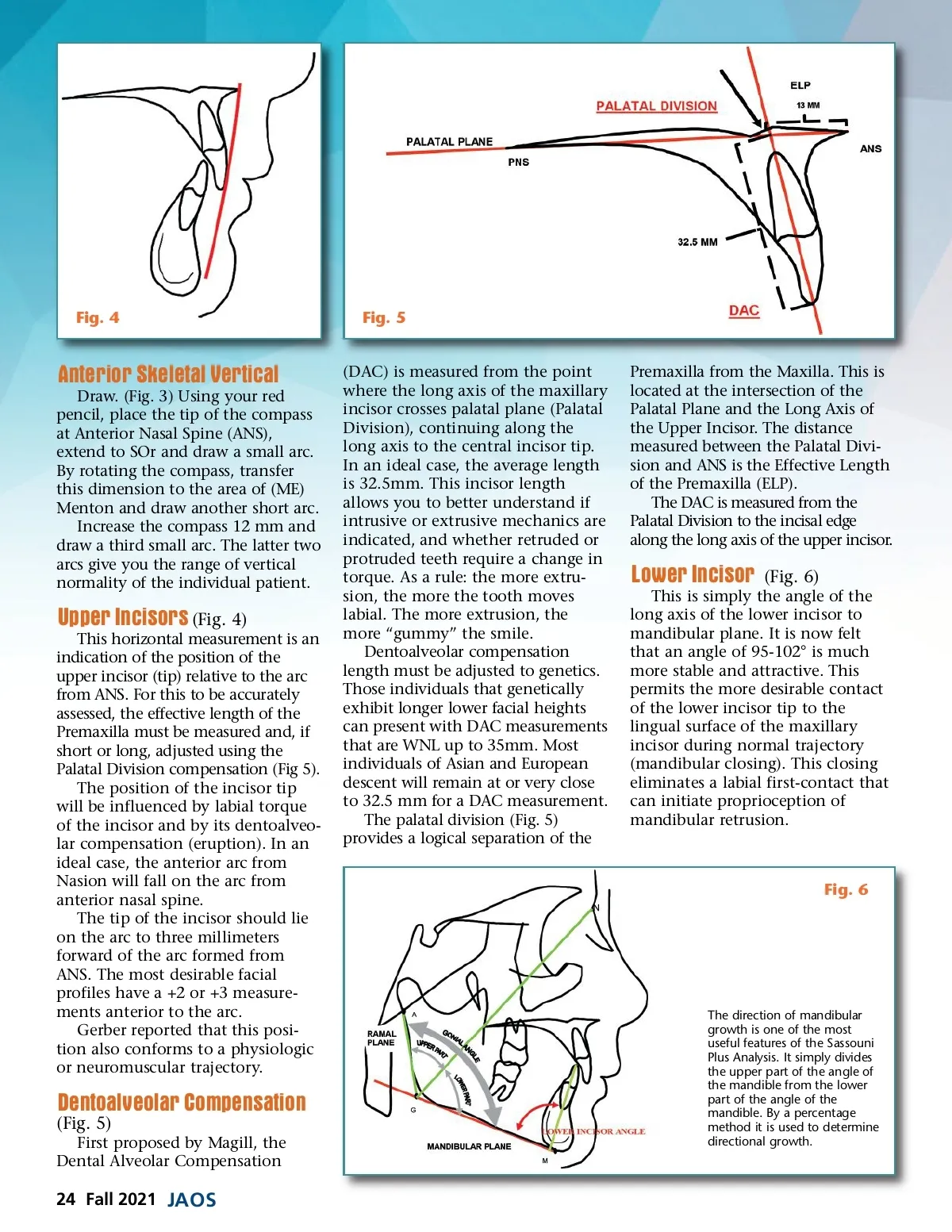
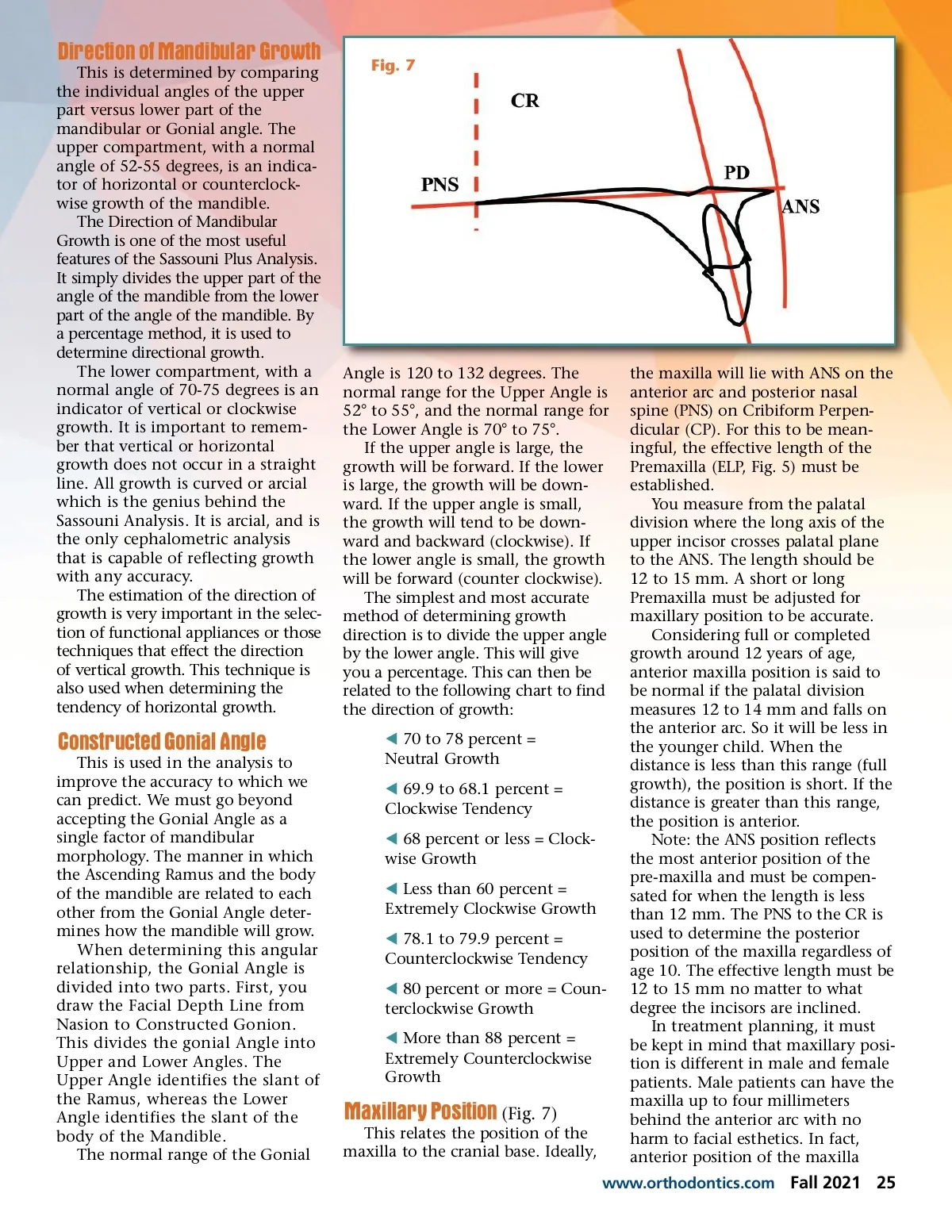
Direction of Mandibular Growth This is determined by comparing the individual angles of the upper part versus lower part of the mandibular or Gonial angle. The upper compartment, with a normal angle of 52-55 degrees, is an indica-tor of horizontal or counterclock-wise growth of the mandible. The Direction of Mandibular Growth is one of the most useful features of the Sassouni Plus Analysis. It simply divides the upper part of the angle of the mandible from the lower part of the angle of the mandible. By a percentage method, it is used to determine directional growth. The lower compartment, with a normal angle of 70-75 degrees is an indicator of vertical or clockwise growth. It is important to remem-ber that vertical or horizontal growth does not occur in a straight line. All growth is curved or arcial which is the genius behind the Sassouni Analysis. It is arcial, and is the only cephalometric analysis that is capable of reflecting growth with any accuracy. The estimation of the direction of growth is very important in the selec-tion of functional appliances or those techniques that effect the direction of vertical growth. This technique is also used when determining the tendency of horizontal growth. Fig. 7 Angle is 120 to 132 degrees. The normal range for the Upper Angle is 52° to 55°, and the normal range for the Lower Angle is 70° to 75°. If the upper angle is large, the growth will be forward. If the lower is large, the growth will be down-ward. If the upper angle is small, the growth will tend to be down-ward and backward (clockwise). If the lower angle is small, the growth will be forward (counter clockwise). The simplest and most accurate method of determining growth direction is to divide the upper angle by the lower angle. This will give you a percentage. This can then be related to the following chart to find the direction of growth: ̇ 70 to 78 percent = Neutral Growth ̇ 69.9 to 68.1 percent = Clockwise Tendency ̇ 68 percent or less = Clock-wise Growth ̇ Less than 60 percent = Extremely Clockwise Growth ̇ 78.1 to 79.9 percent = Counterclockwise Tendency ̇ 80 percent or more = Coun-terclockwise Growth ̇ More than 88 percent = Extremely Counterclockwise Growth Constructed Gonial Angle This is used in the analysis to improve the accuracy to which we can predict. We must go beyond accepting the Gonial Angle as a single factor of mandibular morphology. The manner in which the Ascending Ramus and the body of the mandible are related to each other from the Gonial Angle deter-mines how the mandible will grow. When determining this angular relationship, the Gonial Angle is divided into two parts. First, you draw the Facial Depth Line from Nasion to Constructed Gonion. This divides the gonial Angle into Upper and Lower Angles. The Upper Angle identifies the slant of the Ramus, whereas the Lower Angle identifies the slant of the body of the Mandible. The normal range of the Gonial Maxillary Position (Fig. 7) This relates the position of the maxilla to the cranial base. Ideally, the maxilla will lie with ANS on the anterior arc and posterior nasal spine (PNS) on Cribiform Perpen-dicular (CP). For this to be mean-ingful, the effective length of the Premaxilla (ELP, Fig. 5) must be established. You measure from the palatal division where the long axis of the upper incisor crosses palatal plane to the ANS. The length should be 12 to 15 mm. A short or long Premaxilla must be adjusted for maxillary position to be accurate. Considering full or completed growth around 12 years of age, anterior maxilla position is said to be normal if the palatal division measures 12 to 14 mm and falls on the anterior arc. So it will be less in the younger child. When the distance is less than this range (full growth), the position is short. If the distance is greater than this range, the position is anterior. Note: the ANS position reflects the most anterior position of the pre-maxilla and must be compen-sated for when the length is less than 12 mm. The PNS to the CR is used to determine the posterior position of the maxilla regardless of age 10. The effective length must be 12 to 15 mm no matter to what degree the incisors are inclined. In treatment planning, it must be kept in mind that maxillary posi-tion is different in male and female patients. Male patients can have the maxilla up to four millimeters behind the anterior arc with no harm to facial esthetics. In fact, anterior position of the maxilla www.orthodontics.com Fall 2021 25
Journal of the American Orthodontic Society Fall 2021: Page 25