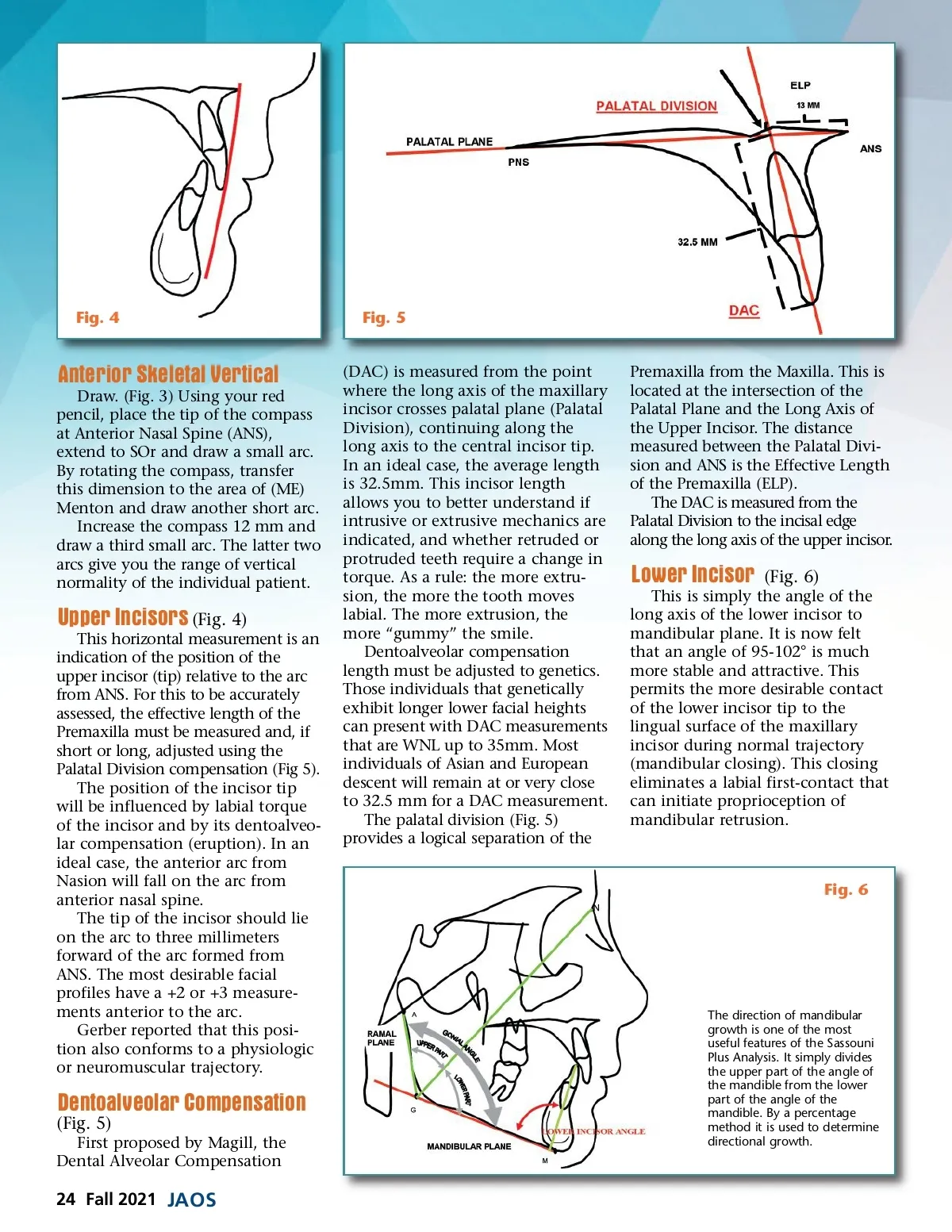
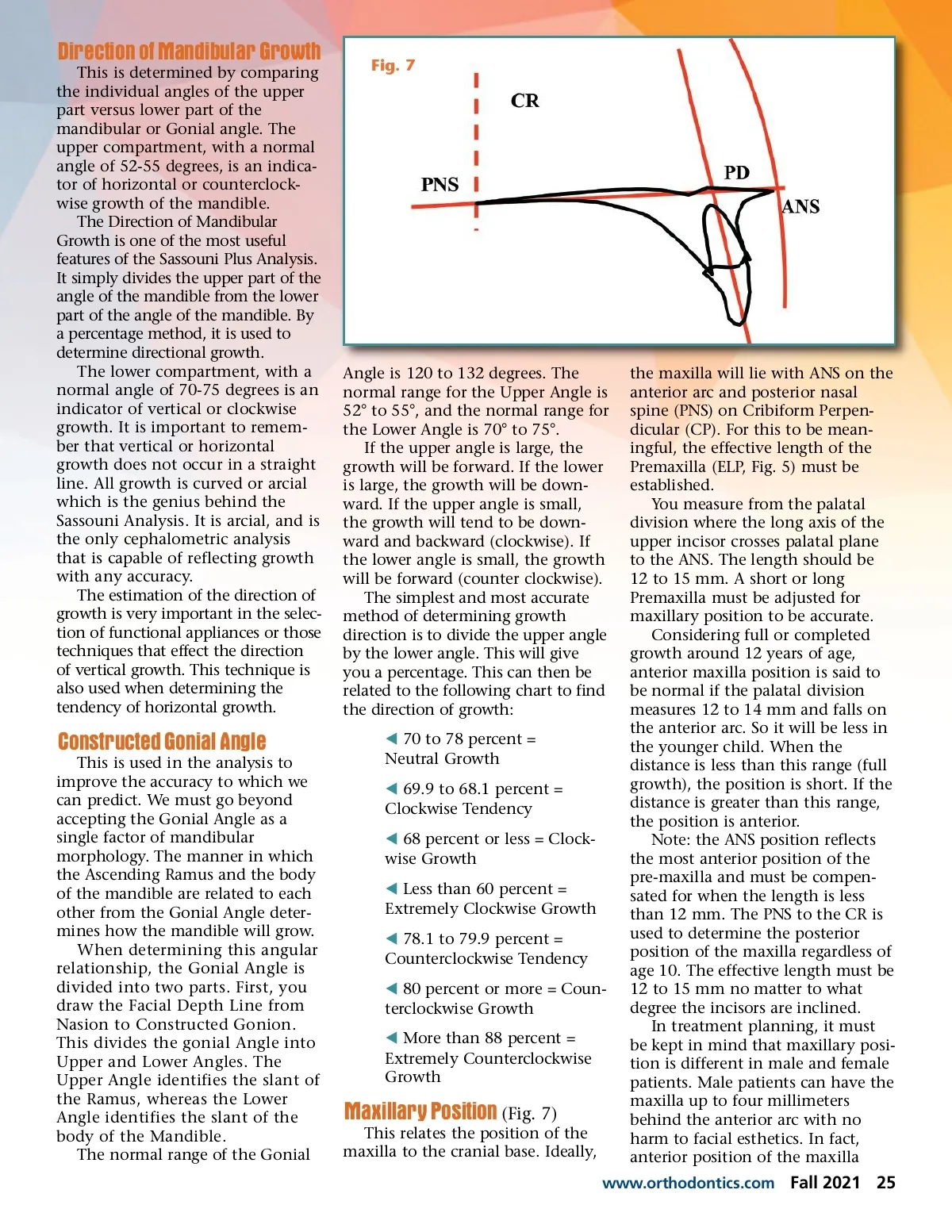
Fig. 4 Fig. 5 Anterior Skeletal Vertical Draw. (Fig. 3) Using your red pencil, place the tip of the compass at Anterior Nasal Spine (ANS), extend to SOr and draw a small arc. By rotating the compass, transfer this dimension to the area of (ME) Menton and draw another short arc. Increase the compass 12 mm and draw a third small arc. The latter two arcs give you the range of vertical normality of the individual patient. Upper Incisors (Fig. 4) This horizontal measurement is an indication of the position of the upper incisor (tip) relative to the arc from ANS. For this to be accurately assessed, the effective length of the Premaxilla must be measured and, if short or long, adjusted using the Palatal Division compensation (Fig 5). The position of the incisor tip will be influenced by labial torque of the incisor and by its dentoalveo-lar compensation (eruption). In an ideal case, the anterior arc from Nasion will fall on the arc from anterior nasal spine. The tip of the incisor should lie on the arc to three millimeters forward of the arc formed from ANS. The most desirable facial profiles have a +2 or +3 measure-ments anterior to the arc. Gerber reported that this posi-tion also conforms to a physiologic or neuromuscular trajectory. (DAC) is measured from the point where the long axis of the maxillary incisor crosses palatal plane (Palatal Division), continuing along the long axis to the central incisor tip. In an ideal case, the average length is 32.5mm. This incisor length allows you to better understand if intrusive or extrusive mechanics are indicated, and whether retruded or protruded teeth require a change in torque. As a rule: the more extru-sion, the more the tooth moves labial. The more extrusion, the more “gummy” the smile. Dentoalveolar compensation length must be adjusted to genetics. Those individuals that genetically exhibit longer lower facial heights can present with DAC measurements that are WNL up to 35mm. Most individuals of Asian and European descent will remain at or very close to 32.5 mm for a DAC measurement. The palatal division (Fig. 5) provides a logical separation of the Premaxilla from the Maxilla. This is located at the intersection of the Palatal Plane and the Long Axis of the Upper Incisor. The distance measured between the Palatal Divi-sion and ANS is the Effective Length of the Premaxilla (ELP). The DAC is measured from the Palatal Division to the incisal edge along the long axis of the upper incisor. Lower Incisor (Fig. 6) This is simply the angle of the long axis of the lower incisor to mandibular plane. It is now felt that an angle of 95-102° is much more stable and attractive. This permits the more desirable contact of the lower incisor tip to the lingual surface of the maxillary incisor during normal trajectory (mandibular closing). This closing eliminates a labial first-contact that can initiate proprioception of mandibular retrusion. Fig. 6 Dentoalveolar Compensation (Fig. 5) First proposed by Magill, the Dental Alveolar Compensation The direction of mandibular growth is one of the most useful features of the Sassouni Plus Analysis. It simply divides the upper part of the angle of the mandible from the lower part of the angle of the mandible. By a percentage method it is used to determine directional growth. 24 Fall 2021 JAOS
Journal of the American Orthodontic Society Fall 2021: Page 24