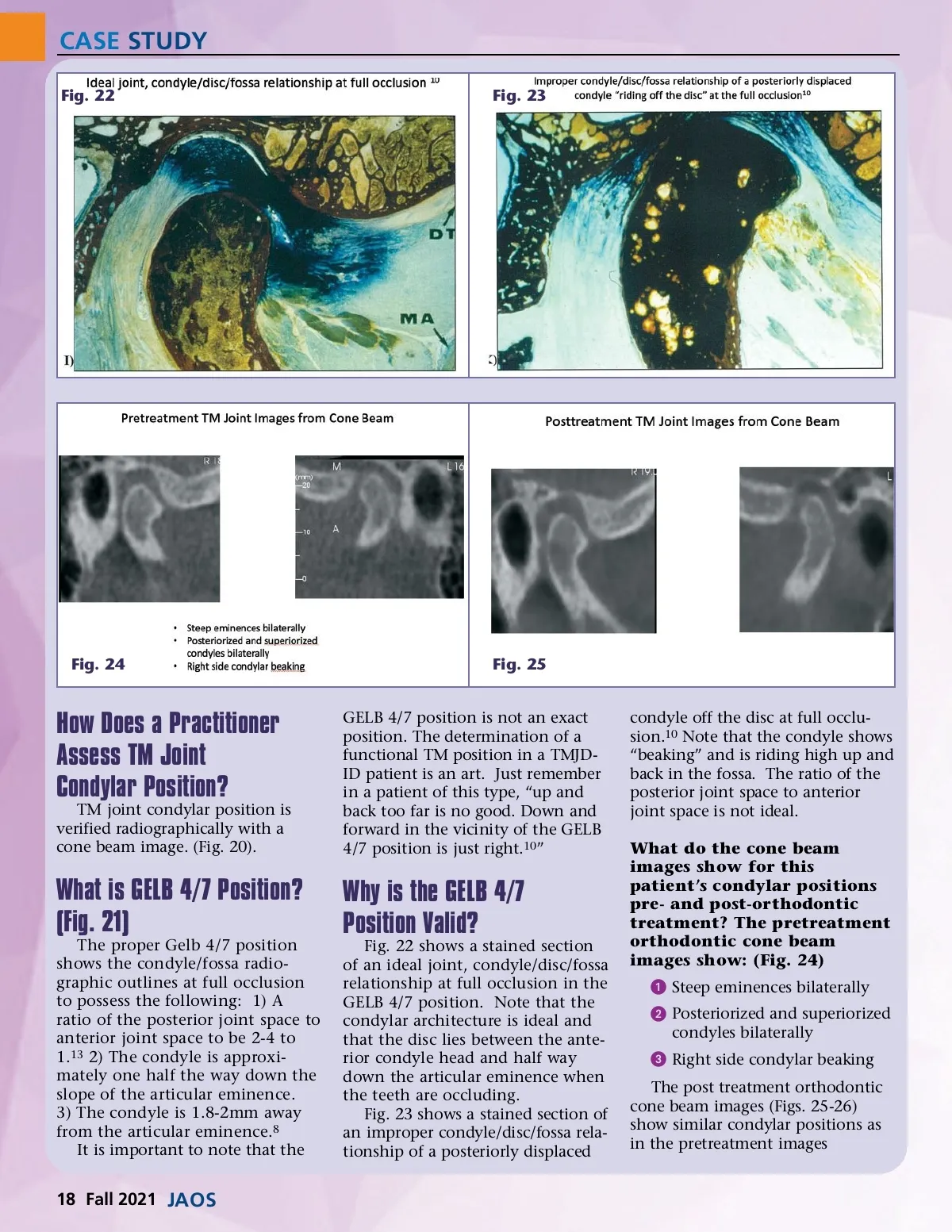
CASE STUDY Fig. 27 Fig. 26 Fig. 28 Fig. 29 although there has been a mild improvement in the amount of superior joint space bilaterally. lar patient will get better and hope-fully cease when treated properly with anterior repositioning splints. As Dr. Spahl puts it, “once such chronic trauma to those nerves and arteries of the bilaminar zone behind the condyle is eliminated, things really have a tendency to pathophysiologically calm down.” 10 10-12mm right and left border movements and 8-12mm protrusive are considered normal. 5,8,9 Impressions of both arches were taken. The mandible was opened to clear the occlusion and slightly advanced and a wax bite with Shur Wax was taken. A cone beam was taken to radiographically confirm that the condyles approximated GELB 4/7 position (Fig. 28). At this appointment, the range of motion readings were as follows: Wide Open (WO): 46mm; Right border movement: 12 mm; Left border movement: 12mm. Note that these readings already approach normal. The patient was instructed to wear the splint full time and to only remove to clean it and brush her teeth. It has been my experi-ence that many patients when they start to feel better, they begin eating with the splint out. This can be What to Do at This Point? Over the course of my career, I have treated TMJD-ID patients with an anterior repositioning appliance known as the Levandoski Splint (Fig. 27). 8 This splint is part of the anterior repositioning ther-apy (ART) protocol in that when the patient occludes with the splint in, the mandible is stabilized with the condyles in GELB 4/7 position. It has been my experi-ence with these patients that over time deficient range of motion (ROM) numbers improve, many times to normal levels. Most importantly, over time, the vast litany of TMD pain/dysfunc-tion signs that present for a particu-What is the Normal Range of Motion? A study of 500 healthy patients between the ages of 18-59 was conducted by Jayshree Agrawal, et al. 3 The results showed the mean value and range of maximum mouth opening was 50.3 ± 6.26mm for males and 49.9 ± 6.74mm for females. These numbers equate well with the 48-52mm range or the “three finger width test” that I learned in dental school years ago. www.orthodontics.com Fall 2021 19
Journal of the American Orthodontic Society Fall 2021: Page 19