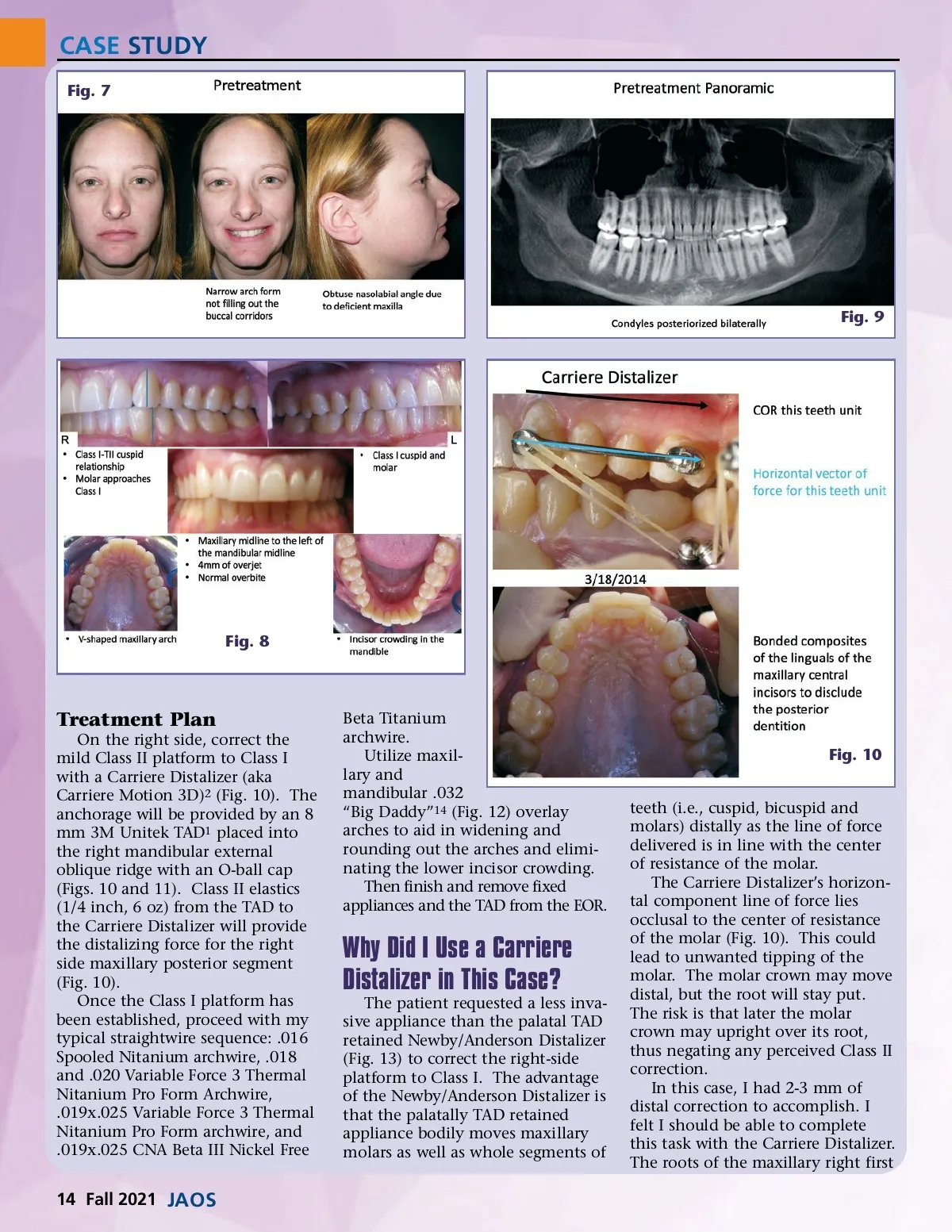
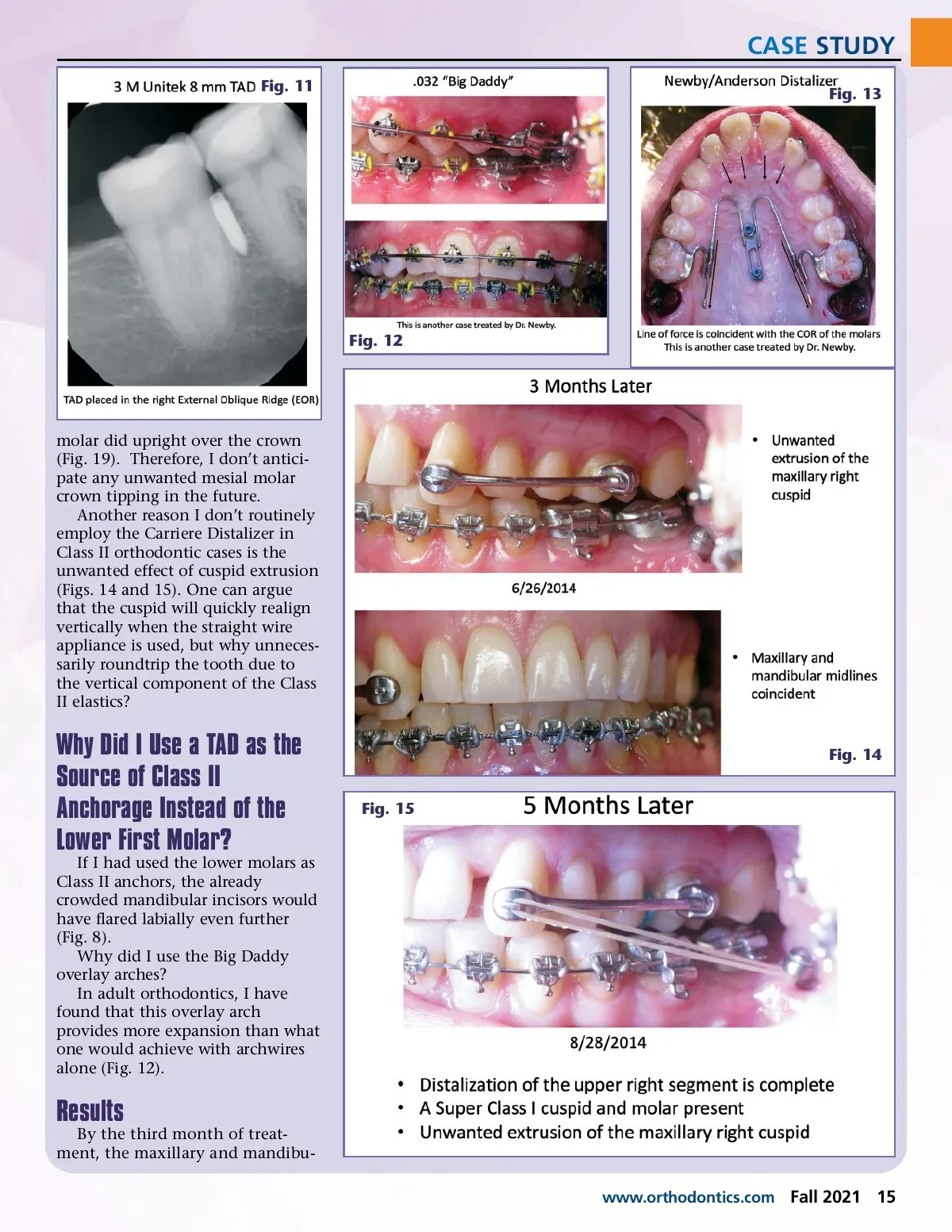
CASE STUDY Fig. 7 Fig. 9 Fig. 8 Treatment Plan On the right side, correct the mild Class II platform to Class I with a Carriere Distalizer (aka Carriere Motion 3D) 2 (Fig. 10). The anchorage will be provided by an 8 mm 3M Unitek TAD 1 placed into the right mandibular external oblique ridge with an O-ball cap (Figs. 10 and 11). Class II elastics (1/4 inch, 6 oz) from the TAD to the Carriere Distalizer will provide the distalizing force for the right side maxillary posterior segment (Fig. 10). Once the Class I platform has been established, proceed with my typical straightwire sequence: .016 Spooled Nitanium archwire, .018 and .020 Variable Force 3 Thermal Nitanium Pro Form Archwire, .019x.025 Variable Force 3 Thermal Nitanium Pro Form archwire, and .019x.025 CNA Beta III Nickel Free Beta Titanium archwire. Utilize maxil-lary and mandibular .032 “Big Daddy” 14 (Fig. 12) overlay arches to aid in widening and rounding out the arches and elimi-nating the lower incisor crowding. Then finish and remove fixed appliances and the TAD from the EOR. Fig. 10 teeth (i.e., cuspid, bicuspid and molars) distally as the line of force delivered is in line with the center of resistance of the molar. The Carriere Distalizer’s horizon-tal component line of force lies occlusal to the center of resistance of the molar (Fig. 10). This could lead to unwanted tipping of the molar. The molar crown may move distal, but the root will stay put. The risk is that later the molar crown may upright over its root, thus negating any perceived Class II correction. In this case, I had 2-3 mm of distal correction to accomplish. I felt I should be able to complete this task with the Carriere Distalizer. The roots of the maxillary right first Why Did I Use a Carriere Distalizer in This Case? The patient requested a less inva-sive appliance than the palatal TAD retained Newby/Anderson Distalizer (Fig. 13) to correct the right-side platform to Class I. The advantage of the Newby/Anderson Distalizer is that the palatally TAD retained appliance bodily moves maxillary molars as well as whole segments of 14 Fall 2021 JAOS
Journal of the American Orthodontic Society Fall 2021: Page 14