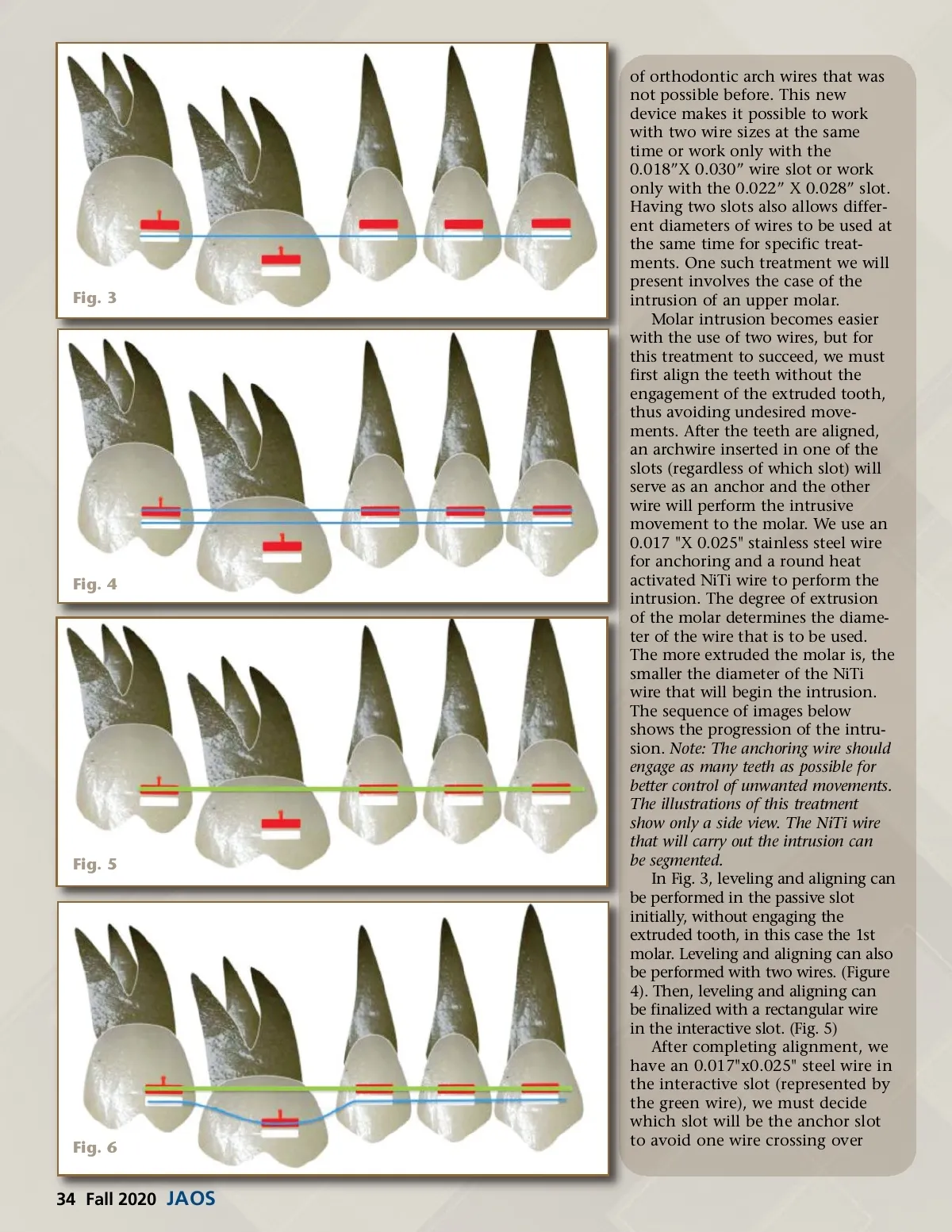
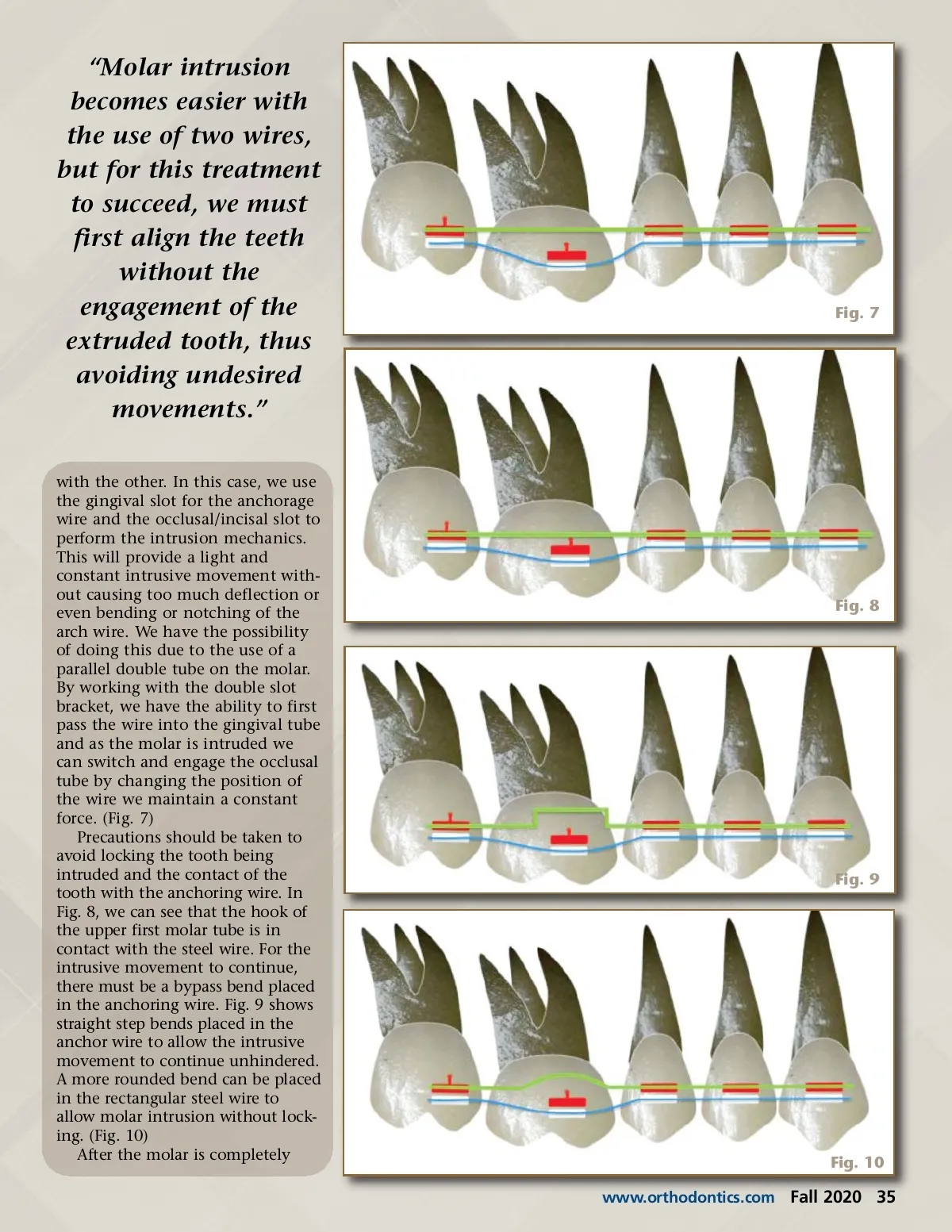
Fig. 3 Fig. 4 Fig. 5 Fig. 6 of orthodontic arch wires that was not possible before. This new device makes it possible to work with two wire sizes at the same time or work only with the 0.018”X 0.030” wire slot or work only with the 0.022” X 0.028” slot. Having two slots also allows differ-ent diameters of wires to be used at the same time for specific treat-ments. One such treatment we will present involves the case of the intrusion of an upper molar. Molar intrusion becomes easier with the use of two wires, but for this treatment to succeed, we must first align the teeth without the engagement of the extruded tooth, thus avoiding undesired move-ments. After the teeth are aligned, an archwire inserted in one of the slots (regardless of which slot) will serve as an anchor and the other wire will perform the intrusive movement to the molar. We use an 0.017 "X 0.025" stainless steel wire for anchoring and a round heat activated NiTi wire to perform the intrusion. The degree of extrusion of the molar determines the diame-ter of the wire that is to be used. The more extruded the molar is, the smaller the diameter of the NiTi wire that will begin the intrusion. The sequence of images below shows the progression of the intru-sion. Note: The anchoring wire should engage as many teeth as possible for better control of unwanted movements. The illustrations of this treatment show only a side view. The NiTi wire that will carry out the intrusion can be segmented. In Fig. 3, leveling and aligning can be performed in the passive slot initially, without engaging the extruded tooth, in this case the 1st molar. Leveling and aligning can also be performed with two wires. (Figure 4). Then, leveling and aligning can be finalized with a rectangular wire in the interactive slot. (Fig. 5) After completing alignment, we have an 0.017"x0.025" steel wire in the interactive slot (represented by the green wire), we must decide which slot will be the anchor slot to avoid one wire crossing over 34 Fall 2020 JAOS
Journal of the American Orthodontic Society Fall 2020: Page 34