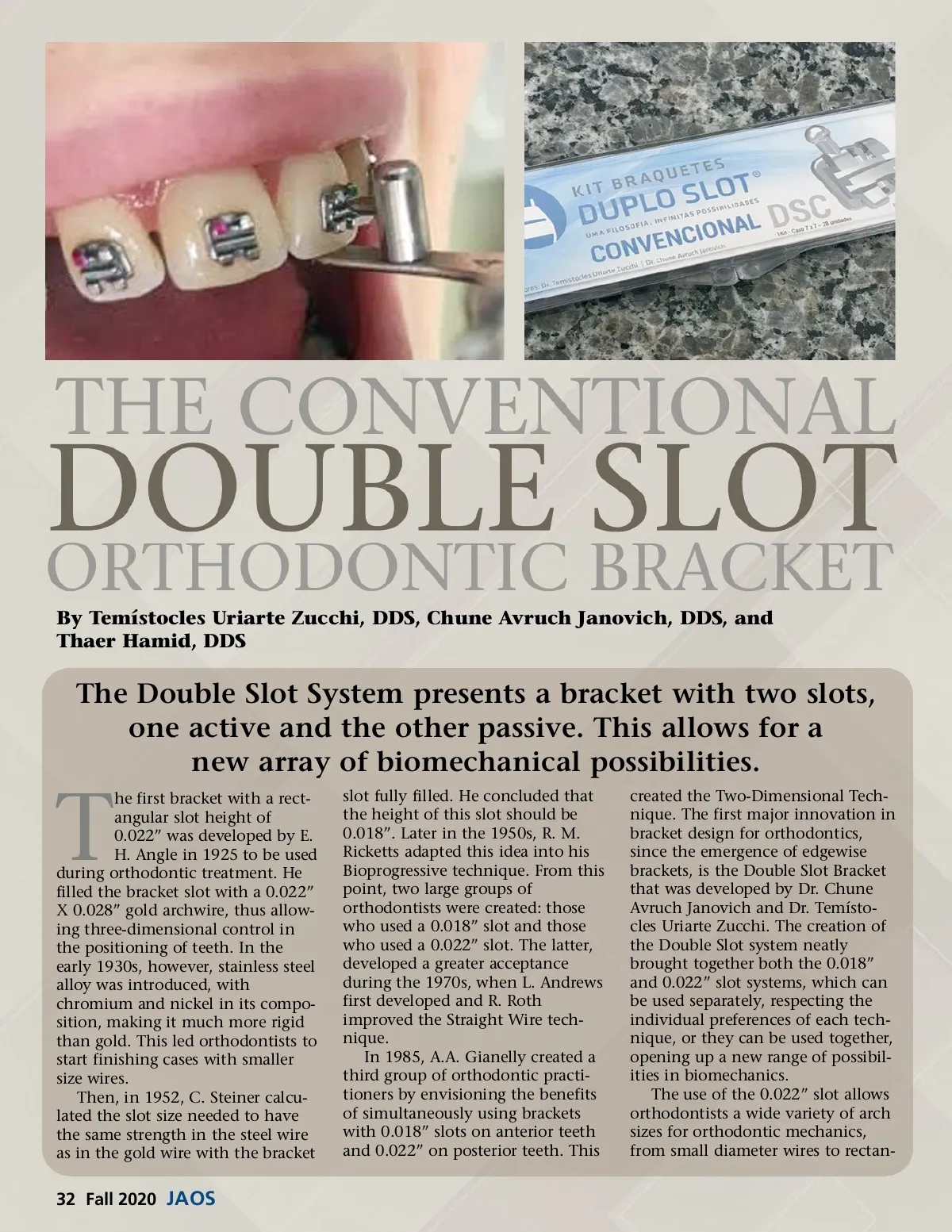
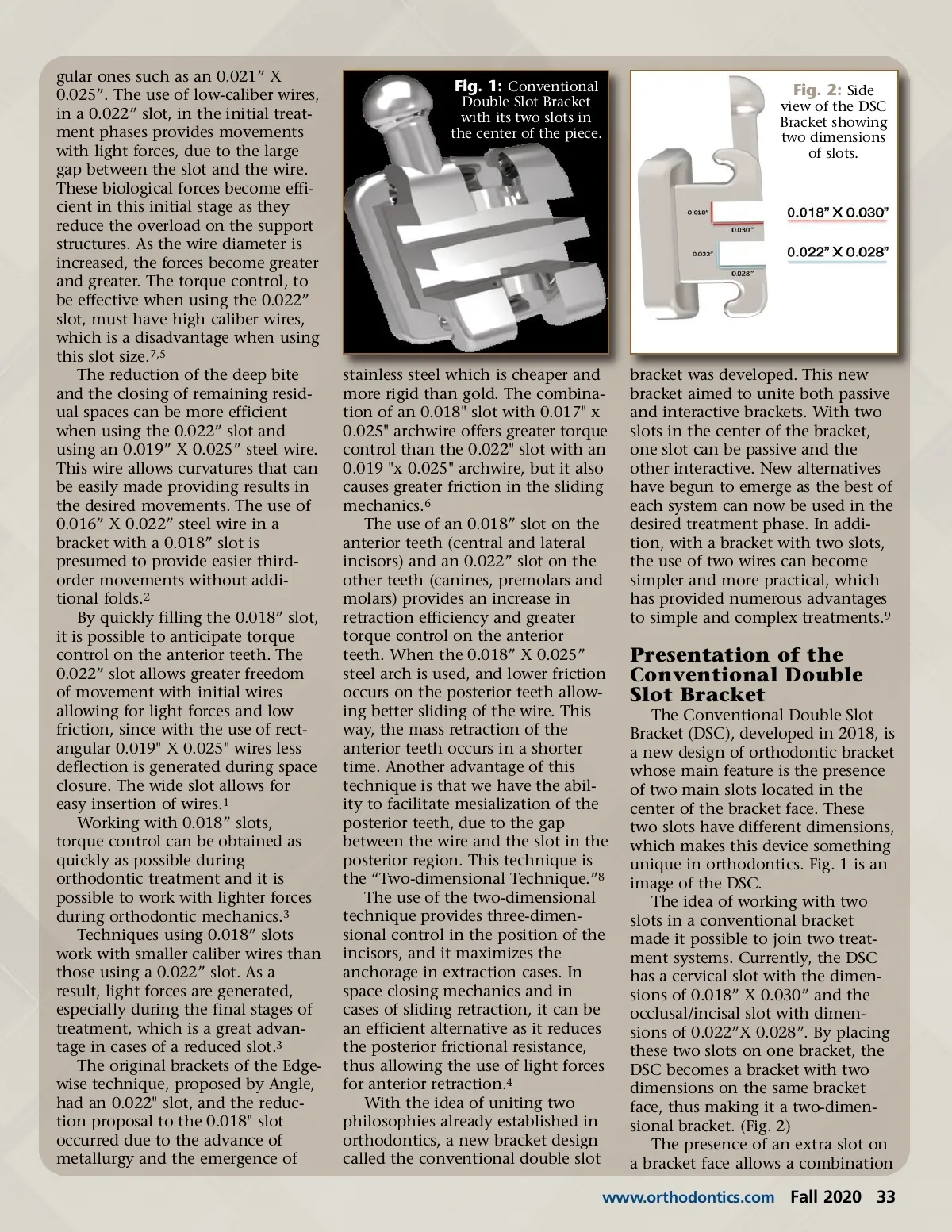
gular ones such as an 0.021” X 0.025”. The use of low-caliber wires, in a 0.022” slot, in the initial treat-ment phases provides movements with light forces, due to the large gap between the slot and the wire. These biological forces become effi-cient in this initial stage as they reduce the overload on the support structures. As the wire diameter is increased, the forces become greater and greater. The torque control, to be effective when using the 0.022” slot, must have high caliber wires, which is a disadvantage when using this slot size. 7,5 The reduction of the deep bite and the closing of remaining resid-ual spaces can be more efficient when using the 0.022” slot and using an 0.019” X 0.025” steel wire. This wire allows curvatures that can be easily made providing results in the desired movements. The use of 0.016” X 0.022” steel wire in a bracket with a 0.018” slot is presumed to provide easier third-order movements without addi-tional folds. 2 By quickly filling the 0.018” slot, it is possible to anticipate torque control on the anterior teeth. The 0.022” slot allows greater freedom of movement with initial wires allowing for light forces and low friction, since with the use of rect-angular 0.019" X 0.025" wires less deflection is generated during space closure. The wide slot allows for easy insertion of wires. 1 Working with 0.018” slots, torque control can be obtained as quickly as possible during orthodontic treatment and it is possible to work with lighter forces during orthodontic mechanics. 3 Techniques using 0.018” slots work with smaller caliber wires than those using a 0.022” slot. As a result, light forces are generated, especially during the final stages of treatment, which is a great advan-tage in cases of a reduced slot. 3 The original brackets of the Edge-wise technique, proposed by Angle, had an 0.022" slot, and the reduc-tion proposal to the 0.018" slot occurred due to the advance of metallurgy and the emergence of Fig. 1: Conventional Double Slot Bracket with its two slots in the center of the piece. Fig. 2: Side view of the DSC Bracket showing two dimensions of slots. stainless steel which is cheaper and more rigid than gold. The combina-tion of an 0.018" slot with 0.017" x 0.025" archwire offers greater torque control than the 0.022" slot with an 0.019 "x 0.025" archwire, but it also causes greater friction in the sliding mechanics. 6 The use of an 0.018” slot on the anterior teeth (central and lateral incisors) and an 0.022” slot on the other teeth (canines, premolars and molars) provides an increase in retraction efficiency and greater torque control on the anterior teeth. When the 0.018” X 0.025” steel arch is used, and lower friction occurs on the posterior teeth allow-ing better sliding of the wire. This way, the mass retraction of the anterior teeth occurs in a shorter time. Another advantage of this technique is that we have the abil-ity to facilitate mesialization of the posterior teeth, due to the gap between the wire and the slot in the posterior region. This technique is the “Two-dimensional Technique.” 8 The use of the two-dimensional technique provides three-dimen-sional control in the position of the incisors, and it maximizes the anchorage in extraction cases. In space closing mechanics and in cases of sliding retraction, it can be an efficient alternative as it reduces the posterior frictional resistance, thus allowing the use of light forces for anterior retraction. 4 With the idea of uniting two philosophies already established in orthodontics, a new bracket design called the conventional double slot bracket was developed. This new bracket aimed to unite both passive and interactive brackets. With two slots in the center of the bracket, one slot can be passive and the other interactive. New alternatives have begun to emerge as the best of each system can now be used in the desired treatment phase. In addi-tion, with a bracket with two slots, the use of two wires can become simpler and more practical, which has provided numerous advantages to simple and complex treatments. 9 Presentation of the Conventional Double Slot Bracket The Conventional Double Slot Bracket (DSC), developed in 2018, is a new design of orthodontic bracket whose main feature is the presence of two main slots located in the center of the bracket face. These two slots have different dimensions, which makes this device something unique in orthodontics. Fig. 1 is an image of the DSC. The idea of working with two slots in a conventional bracket made it possible to join two treat-ment systems. Currently, the DSC has a cervical slot with the dimen-sions of 0.018” X 0.030” and the occlusal/incisal slot with dimen-sions of 0.022”X 0.028”. By placing these two slots on one bracket, the DSC becomes a bracket with two dimensions on the same bracket face, thus making it a two-dimen-sional bracket. (Fig. 2) The presence of an extra slot on a bracket face allows a combination www.orthodontics.com Fall 2020 33
Journal of the American Orthodontic Society Fall 2020: Page 33