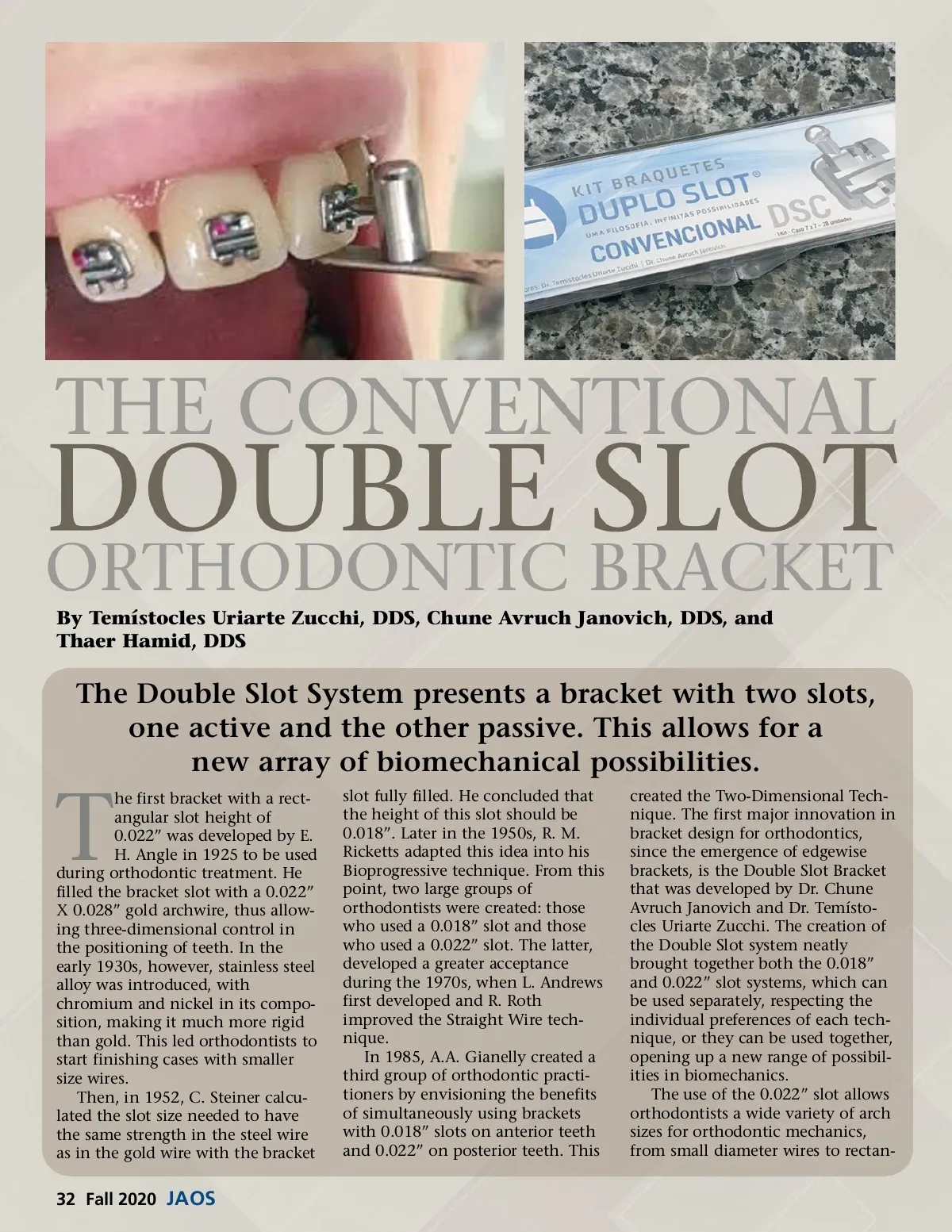
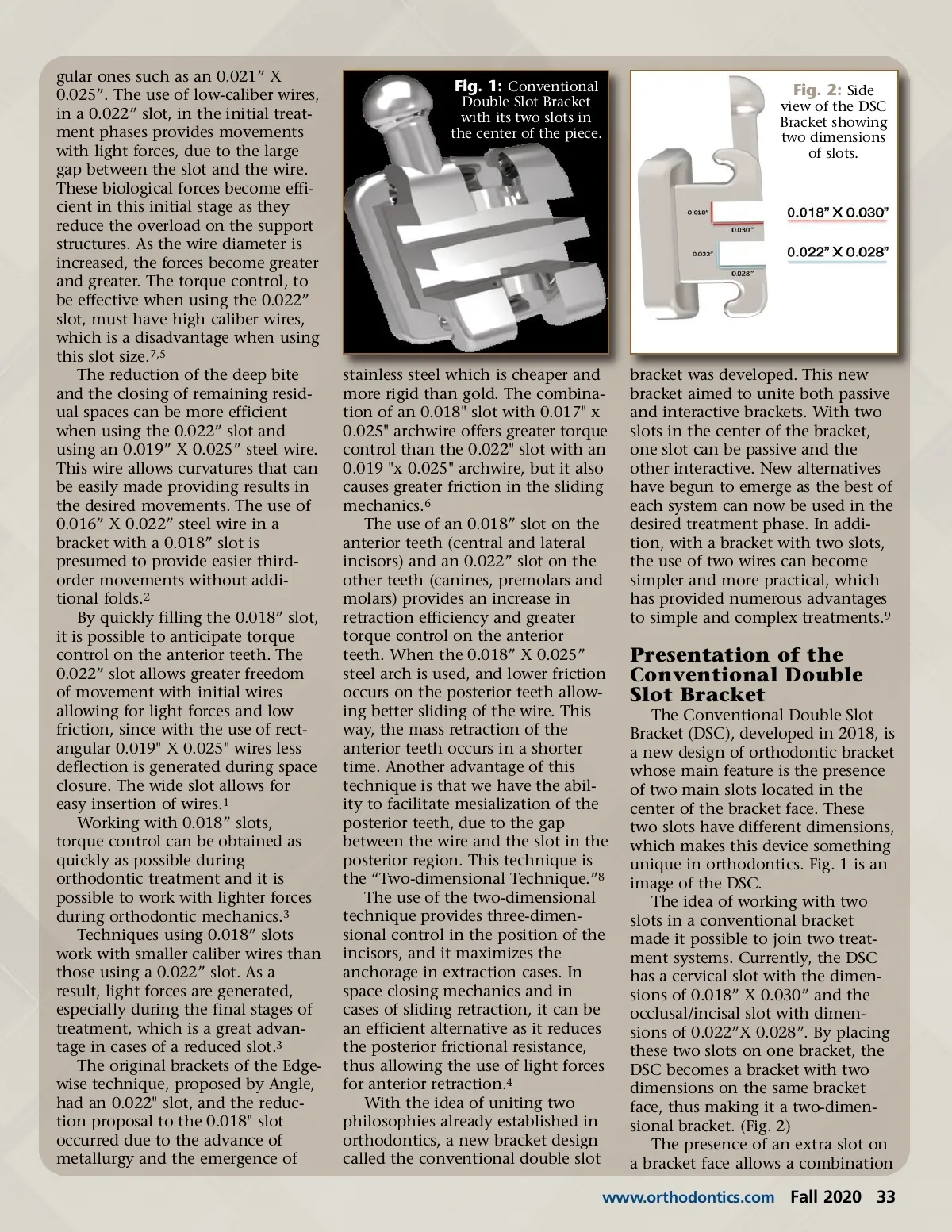
By Temístocles Uriarte Zucchi, DDS, Chune Avruch Janovich, DDS, and Thaer Hamid, DDS The Double Slot System presents a bracket with two slots, one active and the other passive. This allows for a new array of biomechanical possibilities. T he first bracket with a rect-angular slot height of 0.022” was developed by E. H. Angle in 1925 to be used during orthodontic treatment. He filled the bracket slot with a 0.022” X 0.028” gold archwire, thus allow-ing three-dimensional control in the positioning of teeth. In the early 1930s, however, stainless steel alloy was introduced, with chromium and nickel in its compo-sition, making it much more rigid than gold. This led orthodontists to start finishing cases with smaller size wires. Then, in 1952, C. Steiner calcu-lated the slot size needed to have the same strength in the steel wire as in the gold wire with the bracket slot fully filled. He concluded that the height of this slot should be 0.018”. Later in the 1950s, R. M. Ricketts adapted this idea into his Bioprogressive technique. From this point, two large groups of orthodontists were created: those who used a 0.018” slot and those who used a 0.022” slot. The latter, developed a greater acceptance during the 1970s, when L. Andrews first developed and R. Roth improved the Straight Wire tech-nique. In 1985, A.A. Gianelly created a third group of orthodontic practi-tioners by envisioning the benefits of simultaneously using brackets with 0.018” slots on anterior teeth and 0.022” on posterior teeth. This created the Two-Dimensional Tech-nique. The first major innovation in bracket design for orthodontics, since the emergence of edgewise brackets, is the Double Slot Bracket that was developed by Dr. Chune Avruch Janovich and Dr. Temísto-cles Uriarte Zucchi. The creation of the Double Slot system neatly brought together both the 0.018” and 0.022” slot systems, which can be used separately, respecting the individual preferences of each tech-nique, or they can be used together, opening up a new range of possibil-ities in biomechanics. The use of the 0.022” slot allows orthodontists a wide variety of arch sizes for orthodontic mechanics, from small diameter wires to rectan-32 Fall 2020 JAOS
Journal of the American Orthodontic Society Fall 2020: Page 32