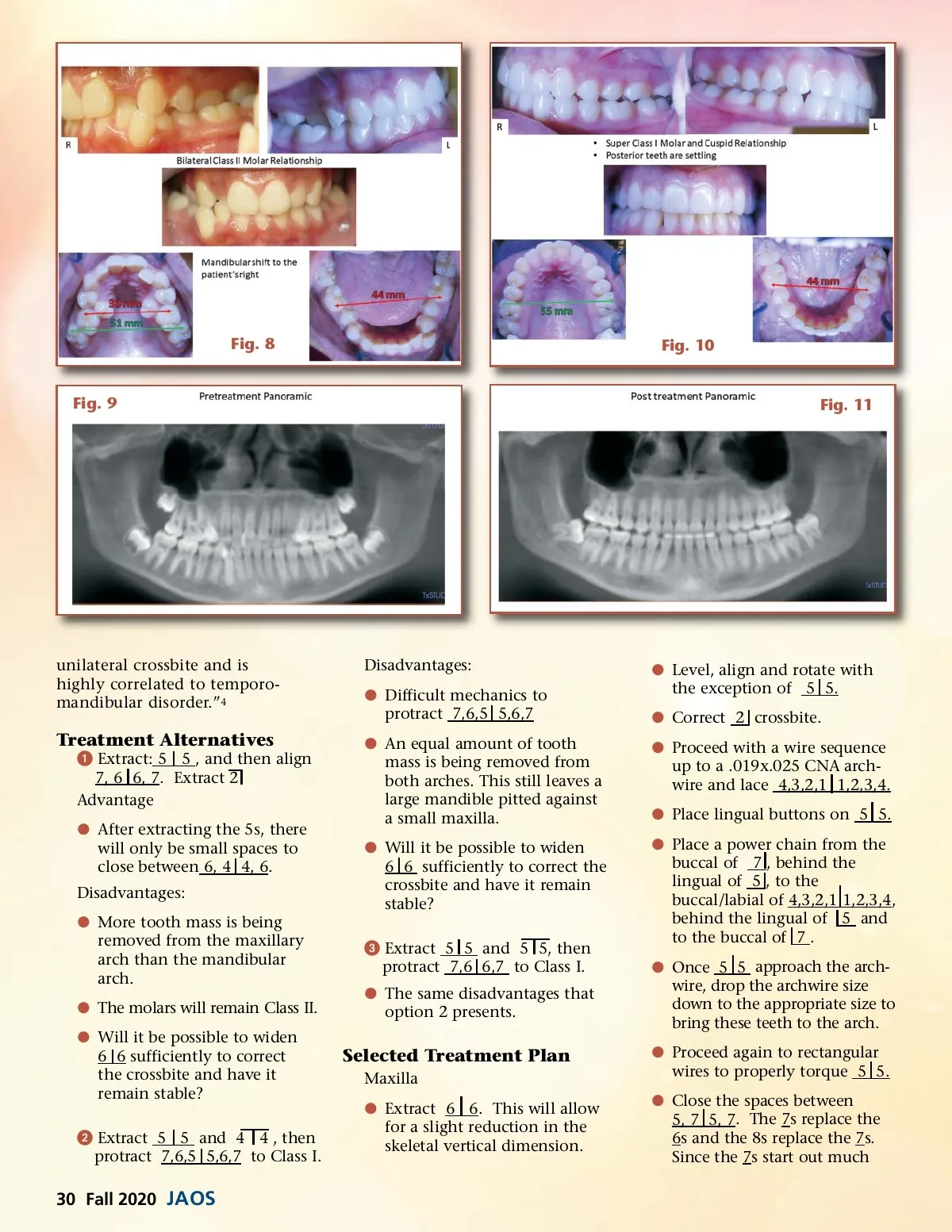
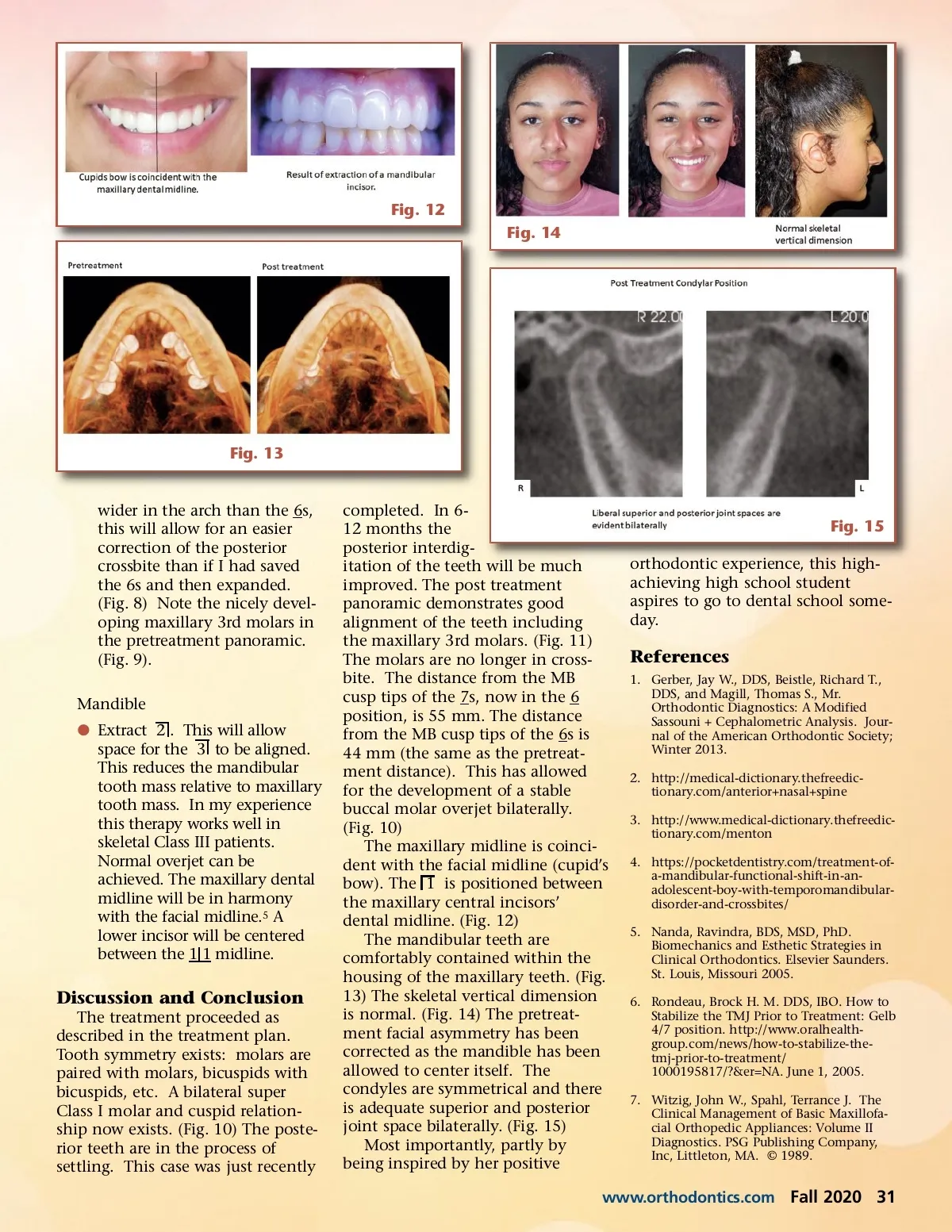
Fig. 12 Fig. 14 Fig. 13 wider in the arch than the 6s, this will allow for an easier correction of the posterior crossbite than if I had saved the 6s and then expanded. (Fig. 8) Note the nicely devel-oping maxillary 3rd molars in the pretreatment panoramic. (Fig. 9). Mandible b Extract 2 . This will allow space for the 3 to be aligned. This reduces the mandibular tooth mass relative to maxillary tooth mass. In my experience this therapy works well in skeletal Class III patients. Normal overjet can be achieved. The maxillary dental midline will be in harmony with the facial midline. 5 A lower incisor will be centered between the 1 1 midline. Discussion and Conclusion The treatment proceeded as described in the treatment plan. Tooth symmetry exists: molars are paired with molars, bicuspids with bicuspids, etc. A bilateral super Class I molar and cuspid relation-ship now exists. (Fig. 10) The poste-rior teeth are in the process of settling. This case was just recently completed. In 6-12 months the posterior interdig-itation of the teeth will be much improved. The post treatment panoramic demonstrates good alignment of the teeth including the maxillary 3rd molars. (Fig. 11) The molars are no longer in cross-bite. The distance from the MB cusp tips of the 7s, now in the 6 position, is 55 mm. The distance from the MB cusp tips of the 6s is 44 mm (the same as the pretreat-ment distance). This has allowed for the development of a stable buccal molar overjet bilaterally. (Fig. 10) The maxillary midline is coinci-dent with the facial midline (cupid’s bow). The 1 is positioned between the maxillary central incisors’ dental midline. (Fig. 12) The mandibular teeth are comfortably contained within the housing of the maxillary teeth. (Fig. 13) The skeletal vertical dimension is normal. (Fig. 14) The pretreat-ment facial asymmetry has been corrected as the mandible has been allowed to center itself. The condyles are symmetrical and there is adequate superior and posterior joint space bilaterally. (Fig. 15) Most importantly, partly by being inspired by her positive Fig. 15 orthodontic experience, this high-achieving high school student aspires to go to dental school some-day. References 1. Gerber, Jay W., DDS, Beistle, Richard T., DDS, and Magill, Thomas S., Mr. Orthodontic Diagnostics: A Modified Sassouni + Cephalometric Analysis. Jour-nal of the American Orthodontic Society; Winter 2013. 2. http://medical-dictionary.thefreedic-tionary.com/anterior+nasal+spine 3. http://www.medical-dictionary.thefreedic-tionary.com/menton 4. https://pocketdentistry.com/treatment-of-a-mandibular-functional-shift-in-an-adolescent-boy-with-temporomandibular-disorder-and-crossbites/ 5. Nanda, Ravindra, BDS, MSD, PhD. Biomechanics and Esthetic Strategies in Clinical Orthodontics. Elsevier Saunders. St. Louis, Missouri 2005. 6. Rondeau, Brock H. M. DDS, IBO. How to Stabilize the TMJ Prior to Treatment: Gelb 4/7 position. http://www.oralhealth-group.com/news/how-to-stabilize-the-tmj-prior-to-treatment/ 1000195817/?&er=NA. June 1, 2005. 7. Witzig, John W., Spahl, Terrance J. The Clinical Management of Basic Maxillofa-cial Orthopedic Appliances: Volume II Diagnostics. PSG Publishing Company, Inc, Littleton, MA. © 1989. www.orthodontics.com Fall 2020 31
Journal of the American Orthodontic Society Fall 2020: Page 31