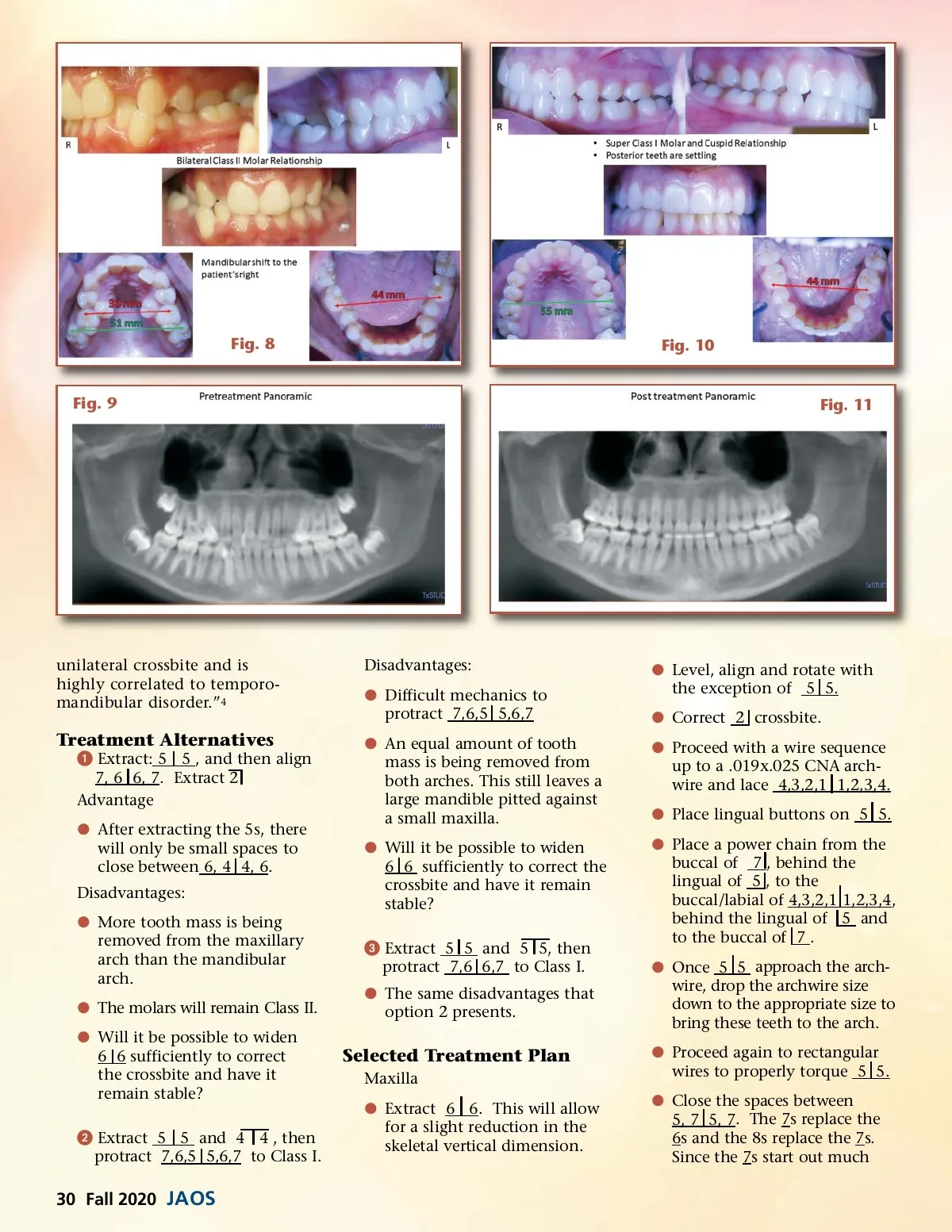
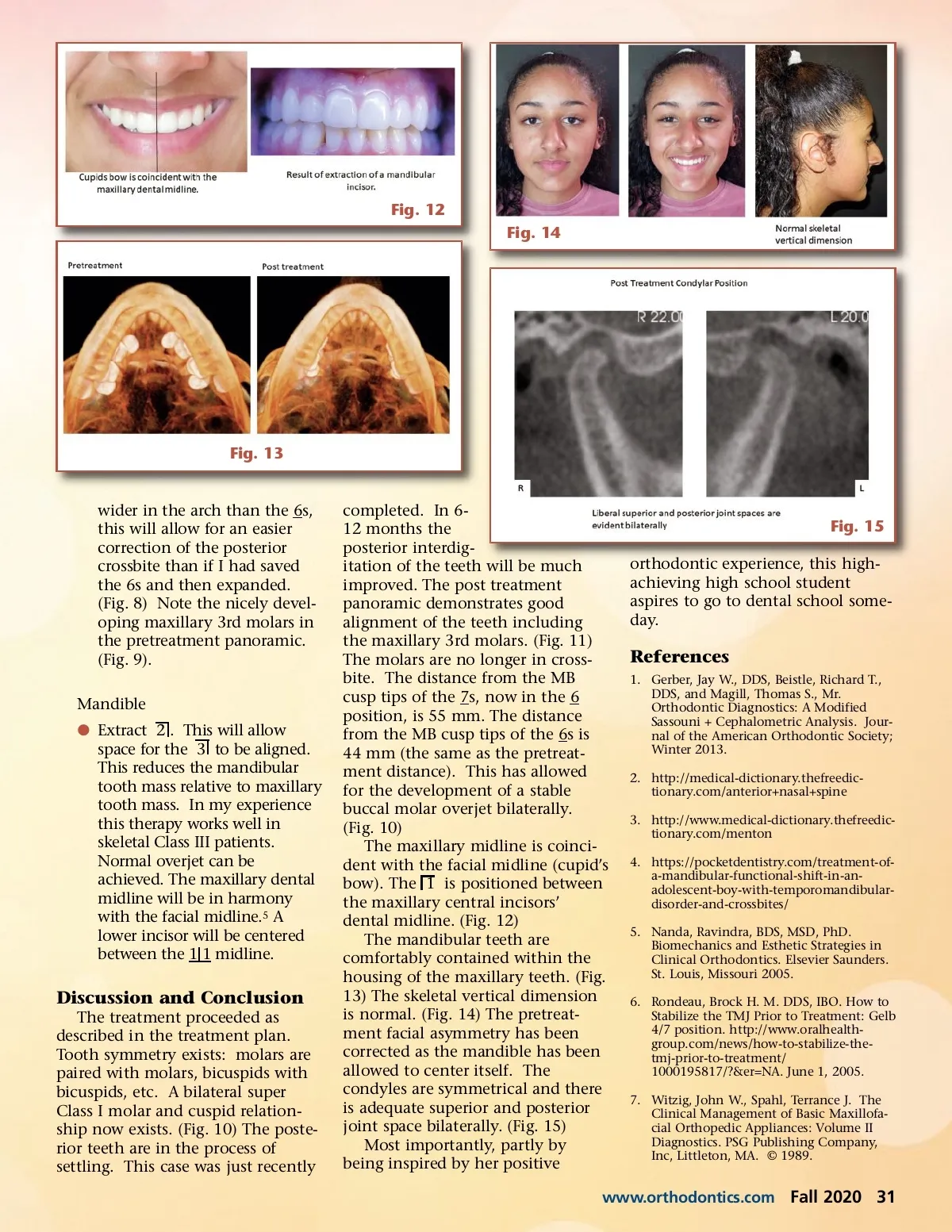
Fig. 8 Fig. 10 Fig. 9 Fig. 11 unilateral crossbite and is highly correlated to temporo-mandibular disorder.” 4 Disadvantages: b Difficult mechanics to protract 7,6,5 5,6,7 b An equal amount of tooth mass is being removed from both arches. This still leaves a large mandible pitted against a small maxilla. b Will it be possible to widen 6 6 sufficiently to correct the crossbite and have it remain stable? ᕣ Extract 5 5 and 5 5, then protract 7,6 6,7 to Class I. b The same disadvantages that option 2 presents. b Level, align and rotate with the exception of 5 5. b Correct 2 crossbite. b Proceed with a wire sequence up to a .019x.025 CNA arch-wire and lace 4,3,2,1 1,2,3,4. b Place lingual buttons on 5 5. b Place a power chain from the buccal of 7 , behind the lingual of 5 , to the buccal/labial of 4,3,2,1 1,2,3,4, behind the lingual of 5 and to the buccal of 7 . b Once 5 5 approach the arch-wire, drop the archwire size down to the appropriate size to bring these teeth to the arch. b Proceed again to rectangular wires to properly torque 5 5. b Close the spaces between 5, 7 5, 7. The 7s replace the 6s and the 8s replace the 7s. Since the 7s start out much Treatment Alternatives ᕡ Extract: 5 5 , and then align 7, 6 6, 7. Extract 2 Advantage b After extracting the 5s, there will only be small spaces to close between 6, 4 4, 6. Disadvantages: b More tooth mass is being removed from the maxillary arch than the mandibular arch. b The molars will remain Class II. b Will it be possible to widen 6 6 sufficiently to correct the crossbite and have it remain stable? ᕢ Extract 5 5 and 4 4 , then protract 7,6,5 5,6,7 to Class I. Selected Treatment Plan Maxilla b Extract 6 6. This will allow for a slight reduction in the skeletal vertical dimension. 30 Fall 2020 JAOS
Journal of the American Orthodontic Society Fall 2020: Page 30