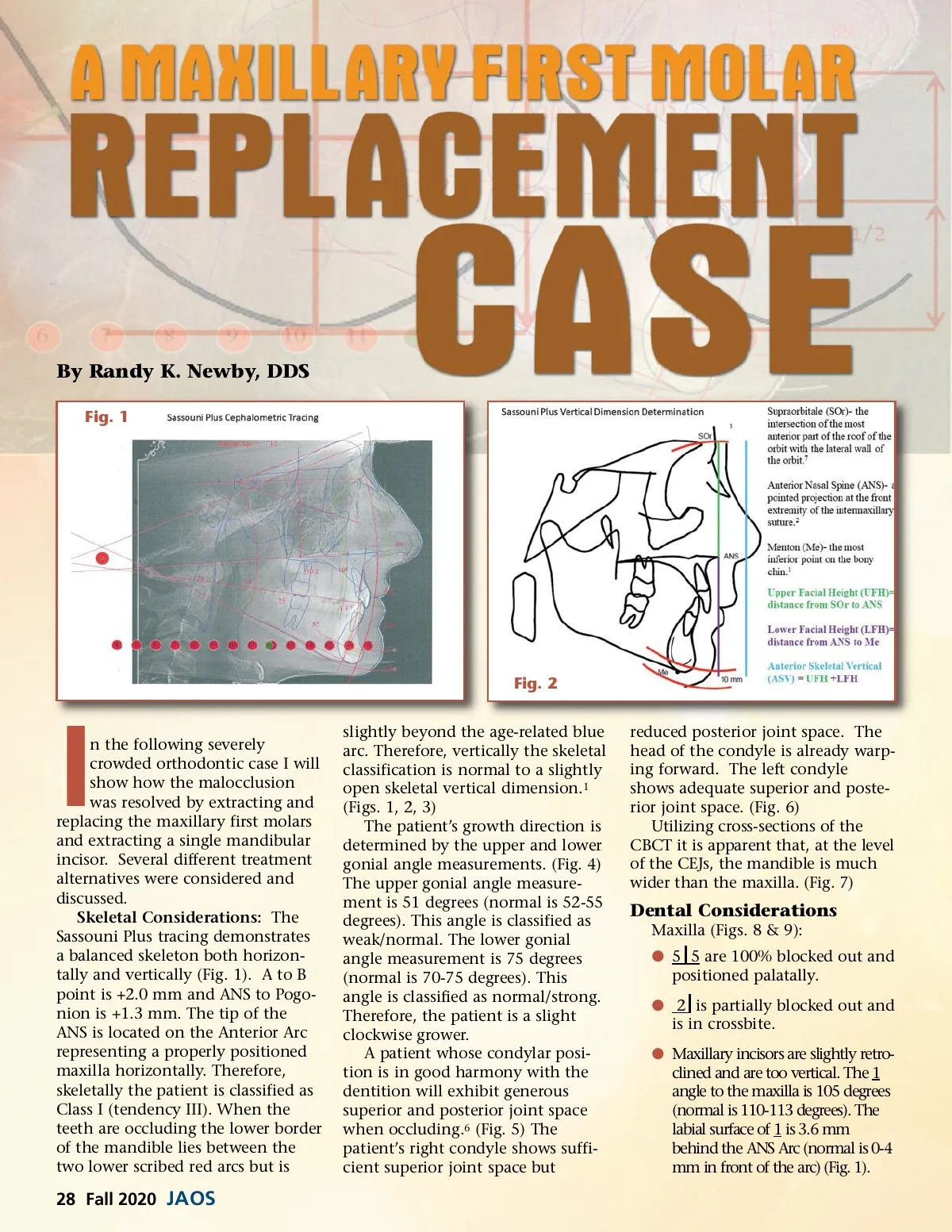
Fig. 5 Fig. 3 Fig. 4 “A patient whose condylar position is in good harmony with the dentition will exhibit generous superior and posterior joint space when occluding.” b 6 6 are in a posterior crossbite. b 6 6 are mesially rotated and have drifted mesially totally blocking out 5 5. This has resulted in a Class II molar and Class I cuspid bilaterally. b The mesial buccal cusp tip distance from 6 to 6 is 38 mm. b The mesial buccal cusp tip distance from 7 to 7 is 51 mm. Mandible (Figs. 7, 8 and 9): b The mandible is large relative to the maxilla. b 3 is totally blocked out and positioned labially. b The mesial buccal cusp tip distance from 6 to 6 is 44 mm. b The mandibular incisors are slightly retroclined and over erupted. Fig. 6 Fig. 7 b There is a functional shift of the mandible to the patient’s right causing a compression of the right TM joint. (Figs. 3 and 6) It is very important to correct TMJ disfunction early in orthodontic treatment if possible. “A mandibular functional shift is an intractable type of malocclu-sion for orthodontists. It is clini-cally characterized by facial asym-metry, dental midline discrepancy, www.orthodontics.com Fall 2020 29
Journal of the American Orthodontic Society Fall 2020: Page 29