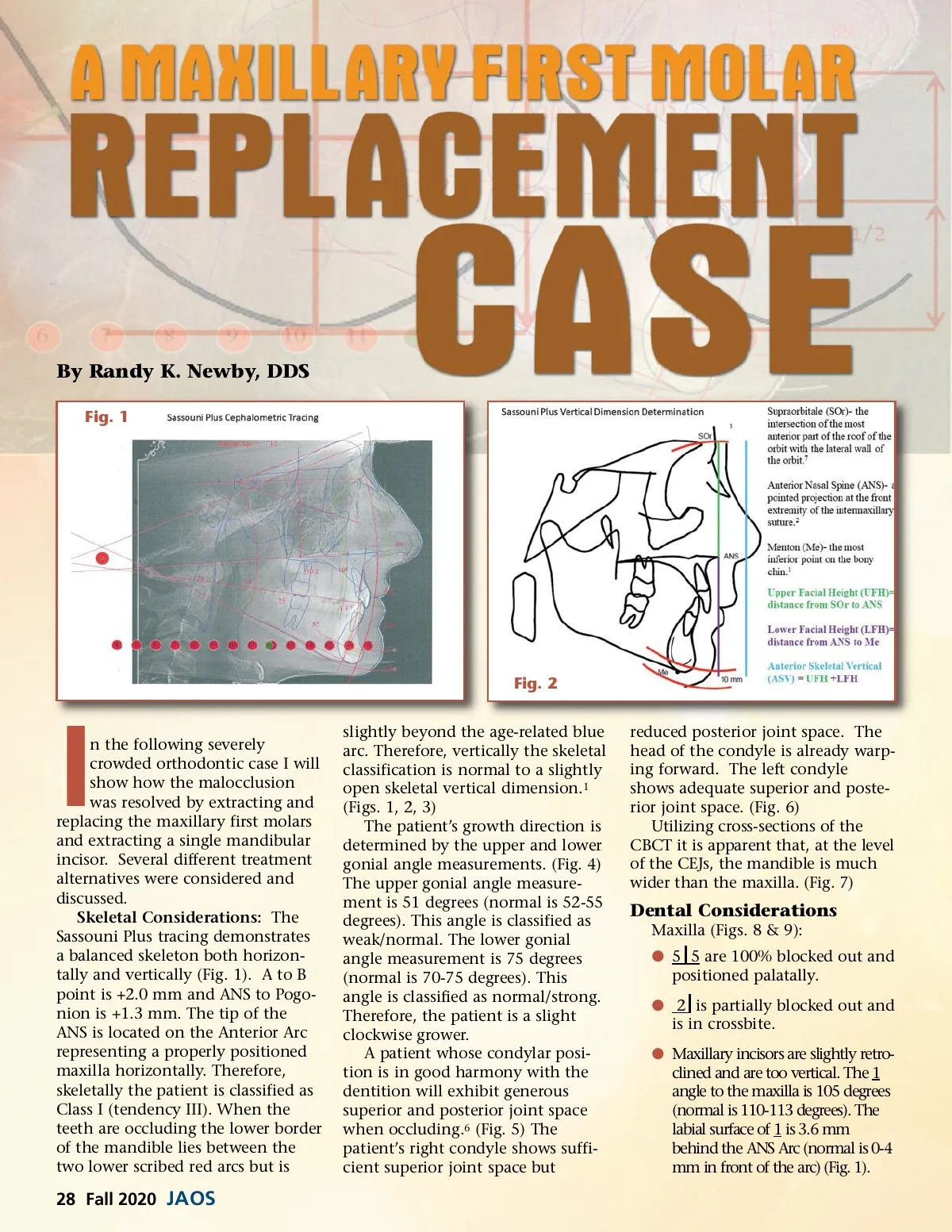
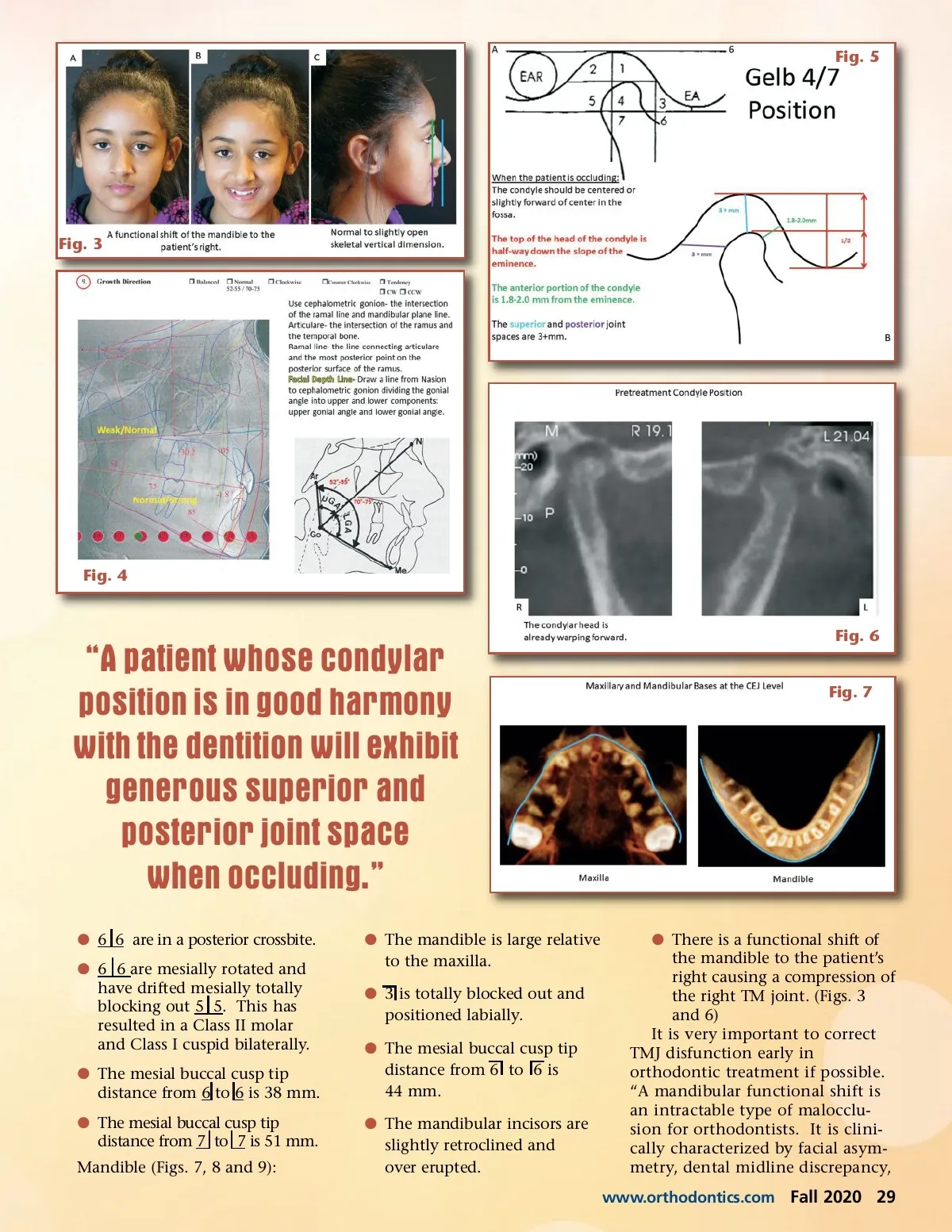
By Randy K. Newby, DDS Fig. 1 Fig. 2 n the following severely crowded orthodontic case I will show how the malocclusion was resolved by extracting and replacing the maxillary first molars and extracting a single mandibular incisor. Several different treatment alternatives were considered and discussed. Skeletal Considerations: The Sassouni Plus tracing demonstrates a balanced skeleton both horizon-tally and vertically (Fig. 1). A to B point is +2.0 mm and ANS to Pogo-nion is +1.3 mm. The tip of the ANS is located on the Anterior Arc representing a properly positioned maxilla horizontally. Therefore, skeletally the patient is classified as Class I (tendency III). When the teeth are occluding the lower border of the mandible lies between the two lower scribed red arcs but is I slightly beyond the age-related blue arc. Therefore, vertically the skeletal classification is normal to a slightly open skeletal vertical dimension. 1 (Figs. 1, 2, 3) The patient’s growth direction is determined by the upper and lower gonial angle measurements. (Fig. 4) The upper gonial angle measure-ment is 51 degrees (normal is 52-55 degrees). This angle is classified as weak/normal. The lower gonial angle measurement is 75 degrees (normal is 70-75 degrees). This angle is classified as normal/strong. Therefore, the patient is a slight clockwise grower. A patient whose condylar posi-tion is in good harmony with the dentition will exhibit generous superior and posterior joint space when occluding. 6 (Fig. 5) The patient’s right condyle shows suffi-cient superior joint space but reduced posterior joint space. The head of the condyle is already warp-ing forward. The left condyle shows adequate superior and poste-rior joint space. (Fig. 6) Utilizing cross-sections of the CBCT it is apparent that, at the level of the CEJs, the mandible is much wider than the maxilla. (Fig. 7) Dental Considerations Maxilla (Figs. 8 & 9): b 5 5 are 100% blocked out and positioned palatally. b 2 is partially blocked out and is in crossbite. b Maxillary incisors are slightly retro-clined and are too vertical. The 1 angle to the maxilla is 105 degrees (normal is 110-113 degrees). The labial surface of 1 is 3.6 mm behind the ANS Arc (normal is 0-4 mm in front of the arc) (Fig. 1). 28 Fall 2020 JAOS
Journal of the American Orthodontic Society Fall 2020: Page 28