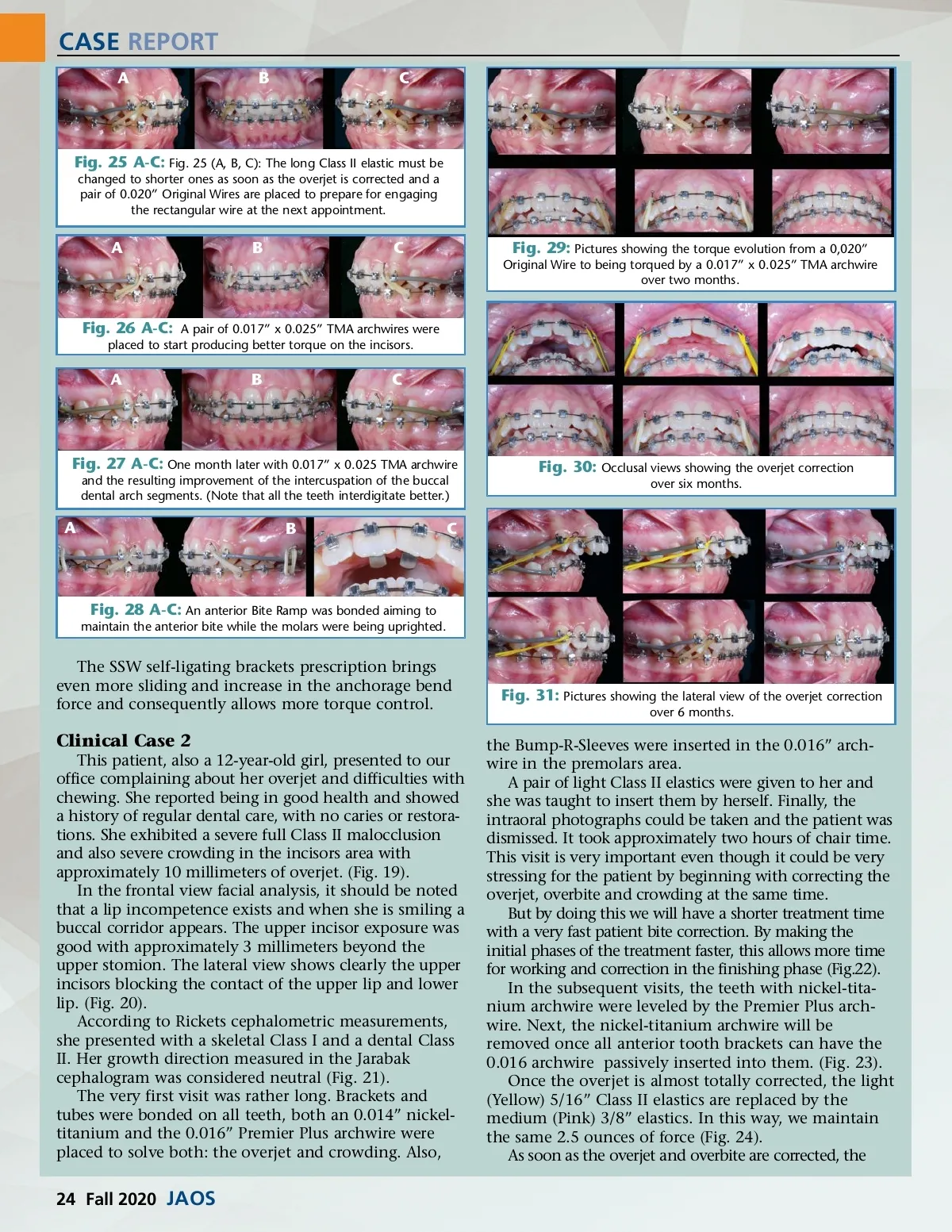
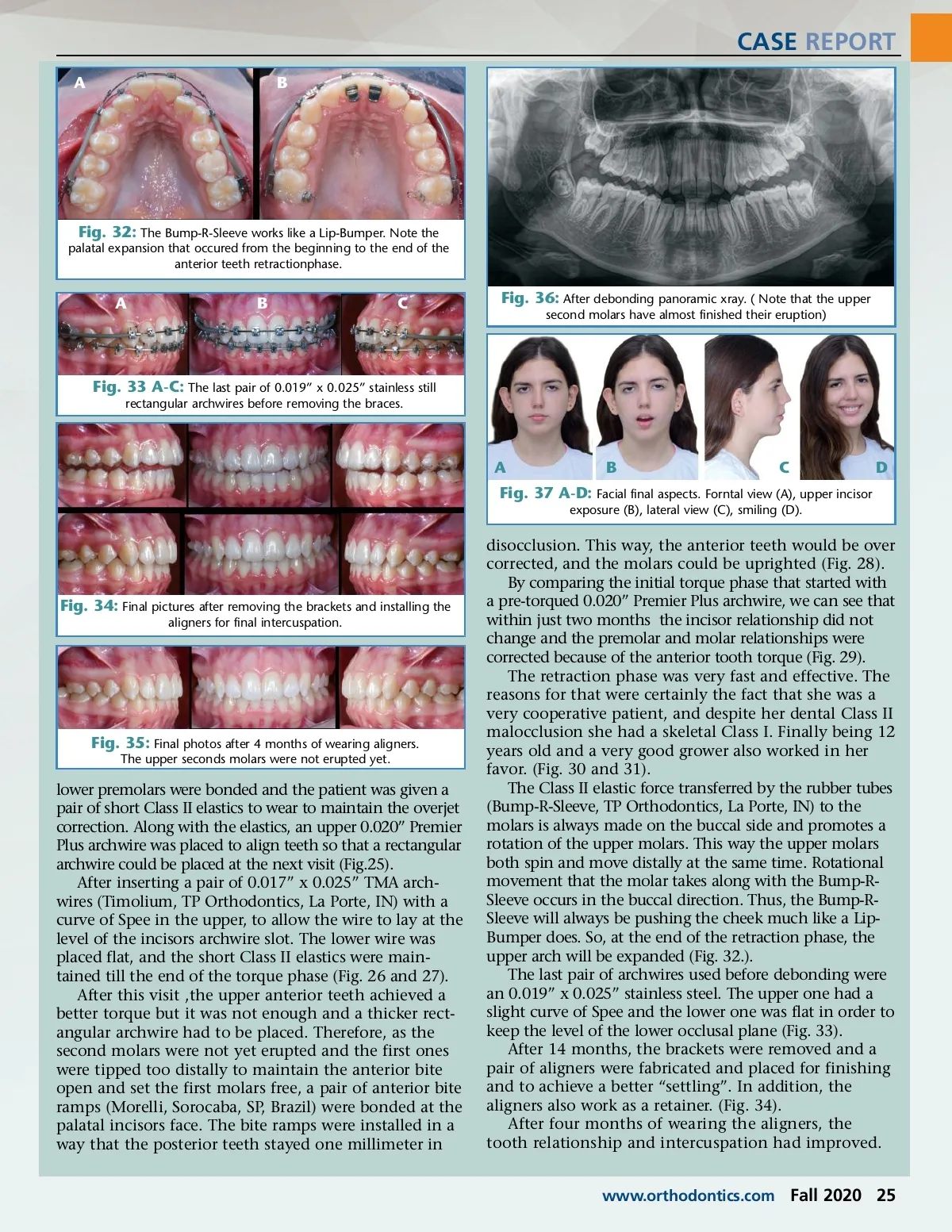
CASE REPORT AB Fig. 32: The Bump-R-Sleeve works like a Lip-Bumper. Note the palatal expansion that occured from the beginning to the end of the anterior teeth retractionphase. ABC Fig. 36: After debonding panoramic xray. ( Note that the upper second molars have almost finished their eruption) Fig. 33 A-C: The last pair of 0.019” x 0.025” stainless still rectangular archwires before removing the braces. AB C D Fig. 37 A-D: Facial final aspects. Forntal view (A), upper incisor exposure (B), lateral view (C), smiling (D). Fig. 34: Final pictures after removing the brackets and installing the aligners for final intercuspation. Fig. 35: Final photos after 4 months of wearing aligners. The upper seconds molars were not erupted yet. lower premolars were bonded and the patient was given a pair of short Class II elastics to wear to maintain the overjet correction. Along with the elastics, an upper 0.020” Premier Plus archwire was placed to align teeth so that a rectangular archwire could be placed at the next visit (Fig.25). After inserting a pair of 0.017” x 0.025” TMA arch-wires (Timolium, TP Orthodontics, La Porte, IN) with a curve of Spee in the upper, to allow the wire to lay at the level of the incisors archwire slot. The lower wire was placed flat, and the short Class II elastics were main-tained till the end of the torque phase (Fig. 26 and 27). After this visit ,the upper anterior teeth achieved a better torque but it was not enough and a thicker rect-angular archwire had to be placed. Therefore, as the second molars were not yet erupted and the first ones were tipped too distally to maintain the anterior bite open and set the first molars free, a pair of anterior bite ramps (Morelli, Sorocaba, SP, Brazil) were bonded at the palatal incisors face. The bite ramps were installed in a way that the posterior teeth stayed one millimeter in disocclusion. This way, the anterior teeth would be over corrected, and the molars could be uprighted (Fig. 28). By comparing the initial torque phase that started with a pre-torqued 0.020” Premier Plus archwire, we can see that within just two months the incisor relationship did not change and the premolar and molar relationships were corrected because of the anterior tooth torque (Fig. 29). The retraction phase was very fast and effective. The reasons for that were certainly the fact that she was a very cooperative patient, and despite her dental Class II malocclusion she had a skeletal Class I. Finally being 12 years old and a very good grower also worked in her favor. (Fig. 30 and 31). The Class II elastic force transferred by the rubber tubes (Bump-R-Sleeve, TP Orthodontics, La Porte, IN) to the molars is always made on the buccal side and promotes a rotation of the upper molars. This way the upper molars both spin and move distally at the same time. Rotational movement that the molar takes along with the Bump-R-Sleeve occurs in the buccal direction. Thus, the Bump-R-Sleeve will always be pushing the cheek much like a Lip-Bumper does. So, at the end of the retraction phase, the upper arch will be expanded (Fig. 32.). The last pair of archwires used before debonding were an 0.019” x 0.025” stainless steel. The upper one had a slight curve of Spee and the lower one was flat in order to keep the level of the lower occlusal plane (Fig. 33). After 14 months, the brackets were removed and a pair of aligners were fabricated and placed for finishing and to achieve a better “settling”. In addition, the aligners also work as a retainer. (Fig. 34). After four months of wearing the aligners, the tooth relationship and intercuspation had improved. www.orthodontics.com Fall 2020 25
Journal of the American Orthodontic Society Fall 2020: Page 25