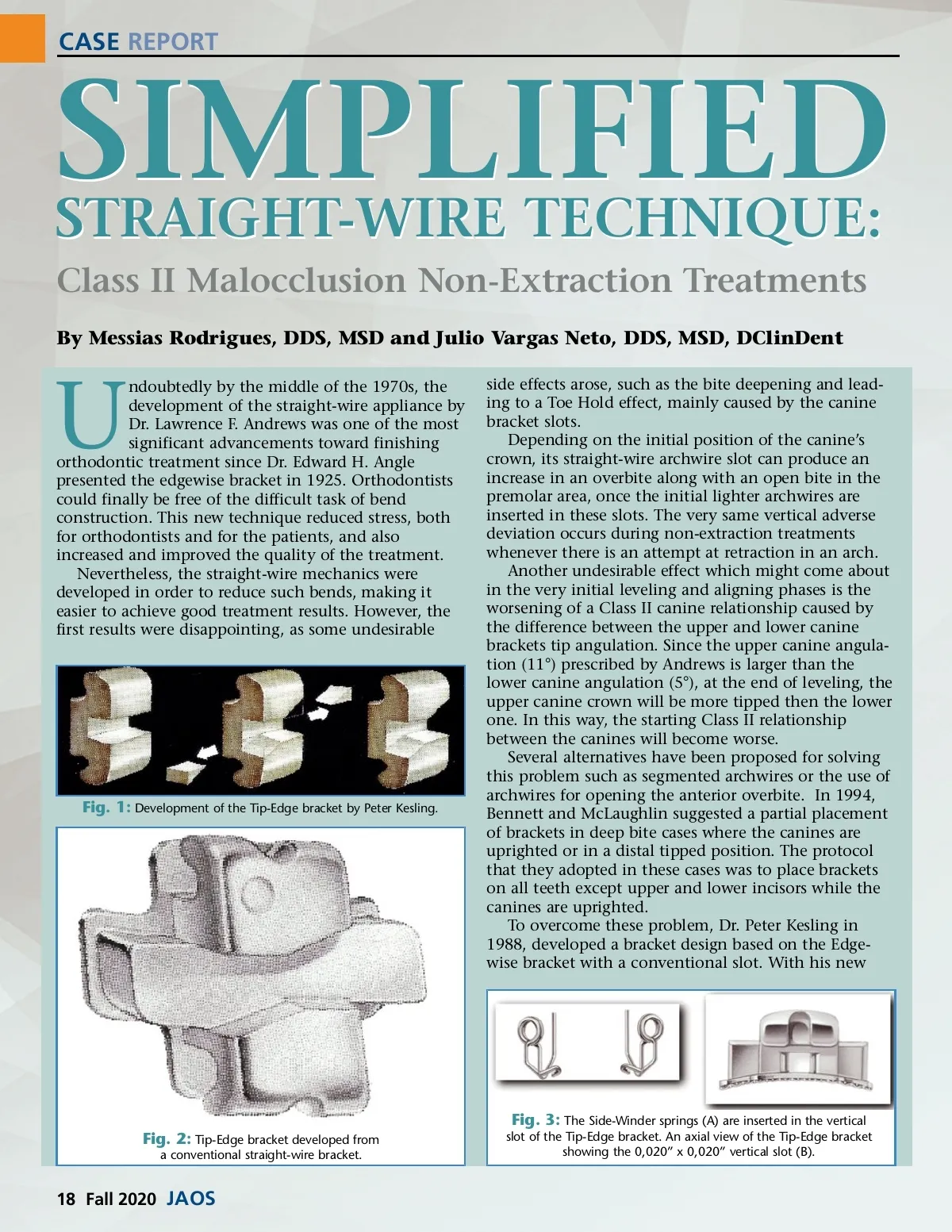
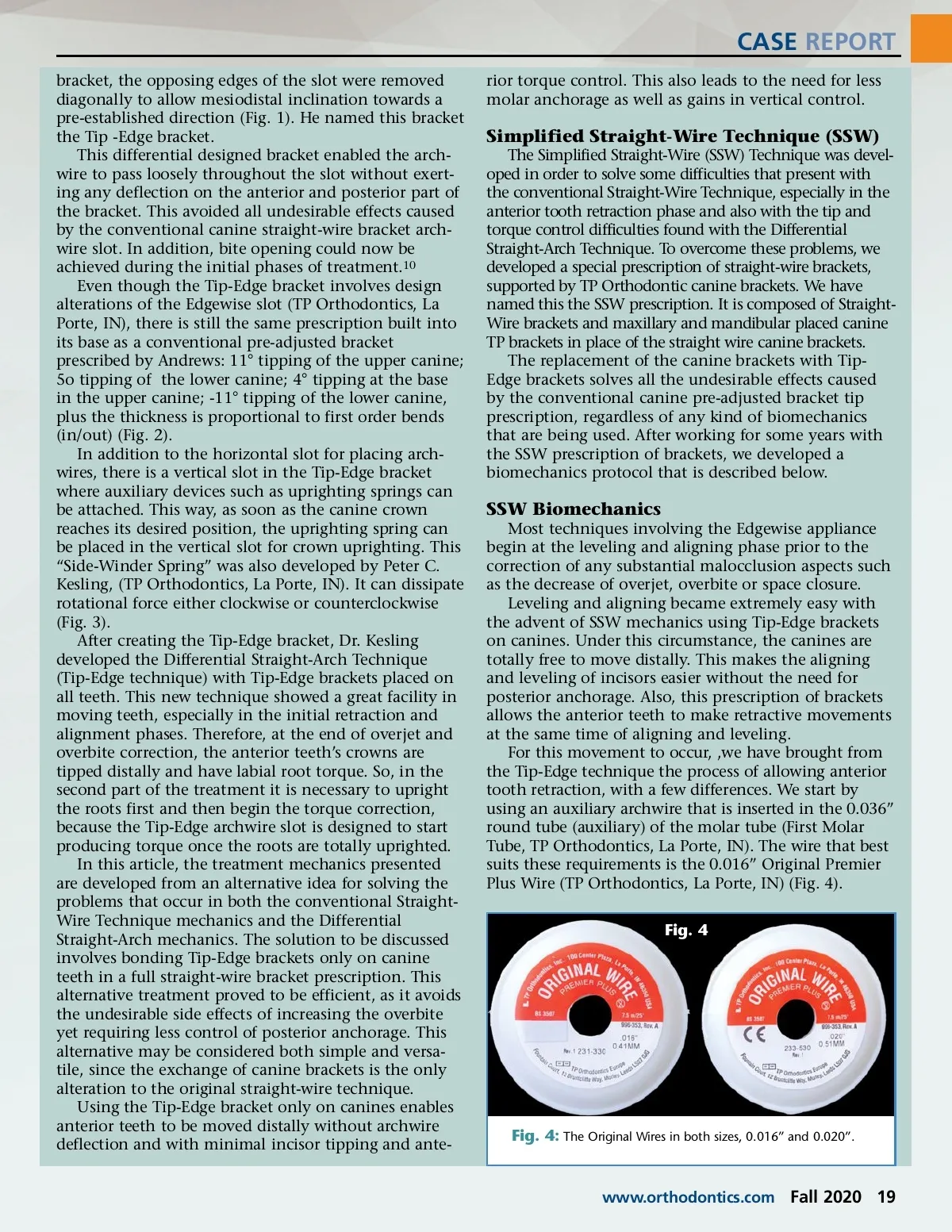
CASE REPORT bracket, the opposing edges of the slot were removed diagonally to allow mesiodistal inclination towards a pre-established direction (Fig. 1). He named this bracket the Tip -Edge bracket. This differential designed bracket enabled the arch-wire to pass loosely throughout the slot without exert-ing any deflection on the anterior and posterior part of the bracket. This avoided all undesirable effects caused by the conventional canine straight-wire bracket arch-wire slot. In addition, bite opening could now be achieved during the initial phases of treatment. 10 Even though the Tip-Edge bracket involves design alterations of the Edgewise slot (TP Orthodontics, La Porte, IN), there is still the same prescription built into its base as a conventional pre-adjusted bracket prescribed by Andrews: 11° tipping of the upper canine; 5o tipping of the lower canine; 4° tipping at the base in the upper canine; -11° tipping of the lower canine, plus the thickness is proportional to first order bends (in/out) (Fig. 2). In addition to the horizontal slot for placing arch-wires, there is a vertical slot in the Tip-Edge bracket where auxiliary devices such as uprighting springs can be attached. This way, as soon as the canine crown reaches its desired position, the uprighting spring can be placed in the vertical slot for crown uprighting. This “Side-Winder Spring” was also developed by Peter C. Kesling, (TP Orthodontics, La Porte, IN). It can dissipate rotational force either clockwise or counterclockwise (Fig. 3). After creating the Tip-Edge bracket, Dr. Kesling developed the Differential Straight-Arch Technique (Tip-Edge technique) with Tip-Edge brackets placed on all teeth. This new technique showed a great facility in moving teeth, especially in the initial retraction and alignment phases. Therefore, at the end of overjet and overbite correction, the anterior teeth’s crowns are tipped distally and have labial root torque. So, in the second part of the treatment it is necessary to upright the roots first and then begin the torque correction, because the Tip-Edge archwire slot is designed to start producing torque once the roots are totally uprighted. In this article, the treatment mechanics presented are developed from an alternative idea for solving the problems that occur in both the conventional Straight-Wire Technique mechanics and the Differential Straight-Arch mechanics. The solution to be discussed involves bonding Tip-Edge brackets only on canine teeth in a full straight-wire bracket prescription. This alternative treatment proved to be efficient, as it avoids the undesirable side effects of increasing the overbite yet requiring less control of posterior anchorage. This alternative may be considered both simple and versa-tile, since the exchange of canine brackets is the only alteration to the original straight-wire technique. Using the Tip-Edge bracket only on canines enables anterior teeth to be moved distally without archwire deflection and with minimal incisor tipping and ante-rior torque control. This also leads to the need for less molar anchorage as well as gains in vertical control. Simplified Straight-Wire Technique (SSW) The Simplified Straight-Wire (SSW) Technique was devel-oped in order to solve some difficulties that present with the conventional Straight-Wire Technique, especially in the anterior tooth retraction phase and also with the tip and torque control difficulties found with the Differential Straight-Arch Technique. To overcome these problems, we developed a special prescription of straight-wire brackets, supported by TP Orthodontic canine brackets. We have named this the SSW prescription. It is composed of Straight-Wire brackets and maxillary and mandibular placed canine TP brackets in place of the straight wire canine brackets. The replacement of the canine brackets with Tip-Edge brackets solves all the undesirable effects caused by the conventional canine pre-adjusted bracket tip prescription, regardless of any kind of biomechanics that are being used. After working for some years with the SSW prescription of brackets, we developed a biomechanics protocol that is described below. SSW Biomechanics Most techniques involving the Edgewise appliance begin at the leveling and aligning phase prior to the correction of any substantial malocclusion aspects such as the decrease of overjet, overbite or space closure. Leveling and aligning became extremely easy with the advent of SSW mechanics using Tip-Edge brackets on canines. Under this circumstance, the canines are totally free to move distally. This makes the aligning and leveling of incisors easier without the need for posterior anchorage. Also, this prescription of brackets allows the anterior teeth to make retractive movements at the same time of aligning and leveling. For this movement to occur, ,we have brought from the Tip-Edge technique the process of allowing anterior tooth retraction, with a few differences. We start by using an auxiliary archwire that is inserted in the 0.036” round tube (auxiliary) of the molar tube (First Molar Tube, TP Orthodontics, La Porte, IN). The wire that best suits these requirements is the 0.016” Original Premier Plus Wire (TP Orthodontics, La Porte, IN) (Fig. 4). Fig. 4 Fig. 4: The Original Wires in both sizes, 0.016” and 0.020”. www.orthodontics.com Fall 2020 19
Journal of the American Orthodontic Society Fall 2020: Page 19