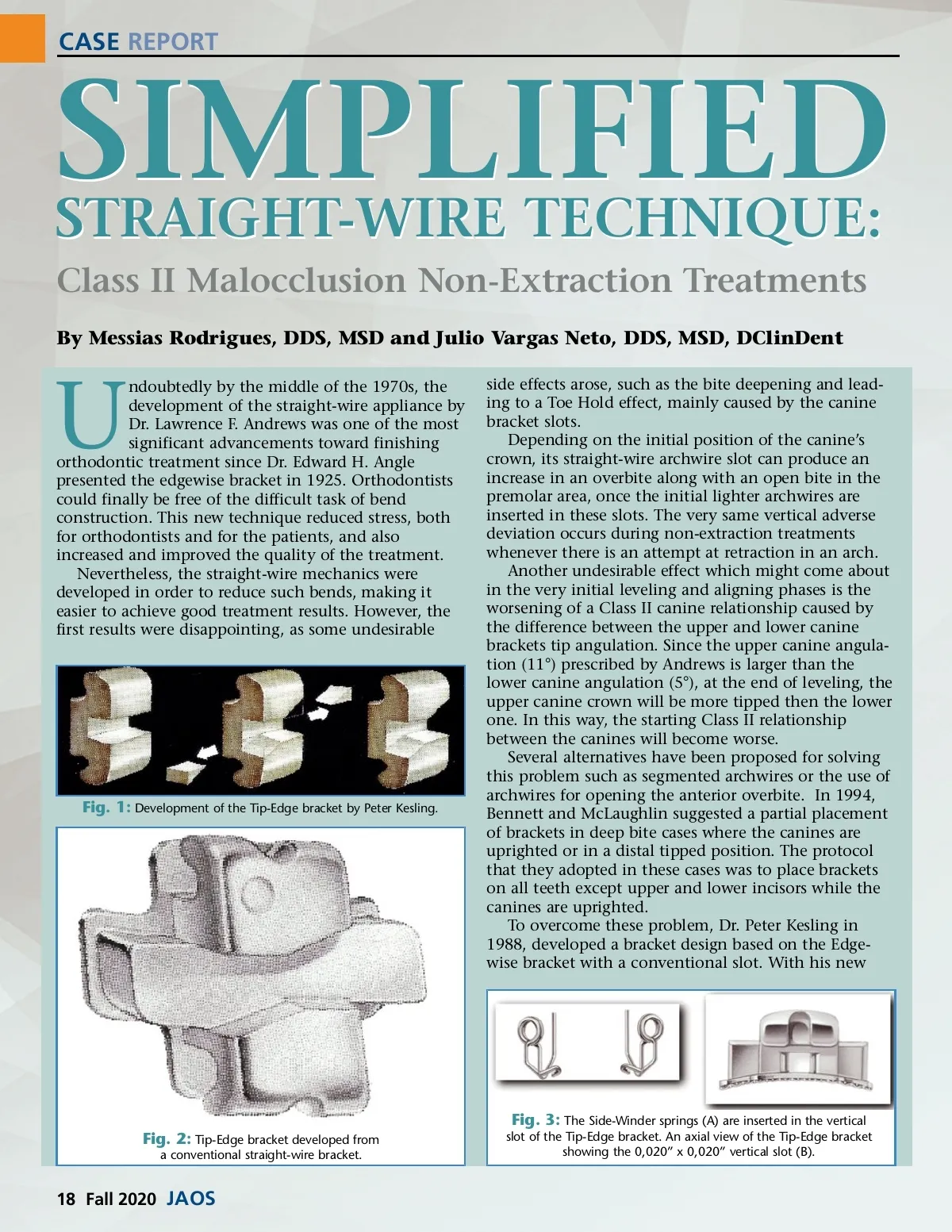
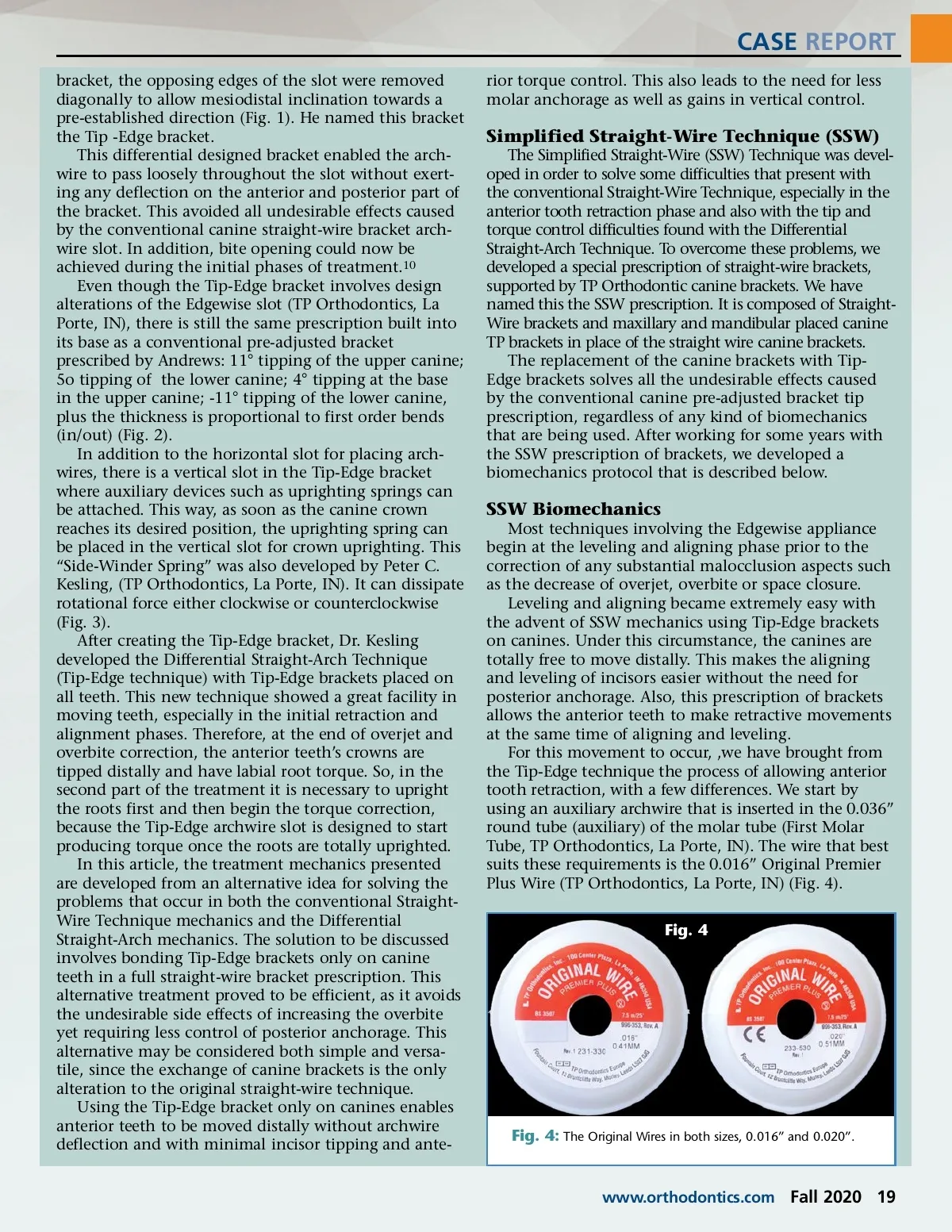
CASE REPORT SIMPLIFIED STRAIGHT-WIRE TECHNIQUE: Class II Malocclusion Non-Extraction Treatments By Messias Rodrigues, DDS, MSD and Julio Vargas Neto, DDS, MSD, DClinDent U ndoubtedly by the middle of the 1970s, the development of the straight-wire appliance by Dr. Lawrence F. Andrews was one of the most significant advancements toward finishing orthodontic treatment since Dr. Edward H. Angle presented the edgewise bracket in 1925. Orthodontists could finally be free of the difficult task of bend construction. This new technique reduced stress, both for orthodontists and for the patients, and also increased and improved the quality of the treatment. Nevertheless, the straight-wire mechanics were developed in order to reduce such bends, making it easier to achieve good treatment results. However, the first results were disappointing, as some undesirable Fig. 1: Development of the Tip-Edge bracket by Peter Kesling. side effects arose, such as the bite deepening and lead-ing to a Toe Hold effect, mainly caused by the canine bracket slots. Depending on the initial position of the canine’s crown, its straight-wire archwire slot can produce an increase in an overbite along with an open bite in the premolar area, once the initial lighter archwires are inserted in these slots. The very same vertical adverse deviation occurs during non-extraction treatments whenever there is an attempt at retraction in an arch. Another undesirable effect which might come about in the very initial leveling and aligning phases is the worsening of a Class II canine relationship caused by the difference between the upper and lower canine brackets tip angulation. Since the upper canine angula-tion (11°) prescribed by Andrews is larger than the lower canine angulation (5°), at the end of leveling, the upper canine crown will be more tipped then the lower one. In this way, the starting Class II relationship between the canines will become worse. Several alternatives have been proposed for solving this problem such as segmented archwires or the use of archwires for opening the anterior overbite. In 1994, Bennett and McLaughlin suggested a partial placement of brackets in deep bite cases where the canines are uprighted or in a distal tipped position. The protocol that they adopted in these cases was to place brackets on all teeth except upper and lower incisors while the canines are uprighted. To overcome these problem, Dr. Peter Kesling in 1988, developed a bracket design based on the Edge-wise bracket with a conventional slot. With his new Fig. 2: Tip-Edge bracket developed from a conventional straight-wire bracket. Fig. 3: The Side-Winder springs (A) are inserted in the vertical slot of the Tip-Edge bracket. An axial view of the Tip-Edge bracket showing the 0,020” x 0,020” vertical slot (B). 18 Fall 2020 JAOS
Journal of the American Orthodontic Society Fall 2020: Page 18