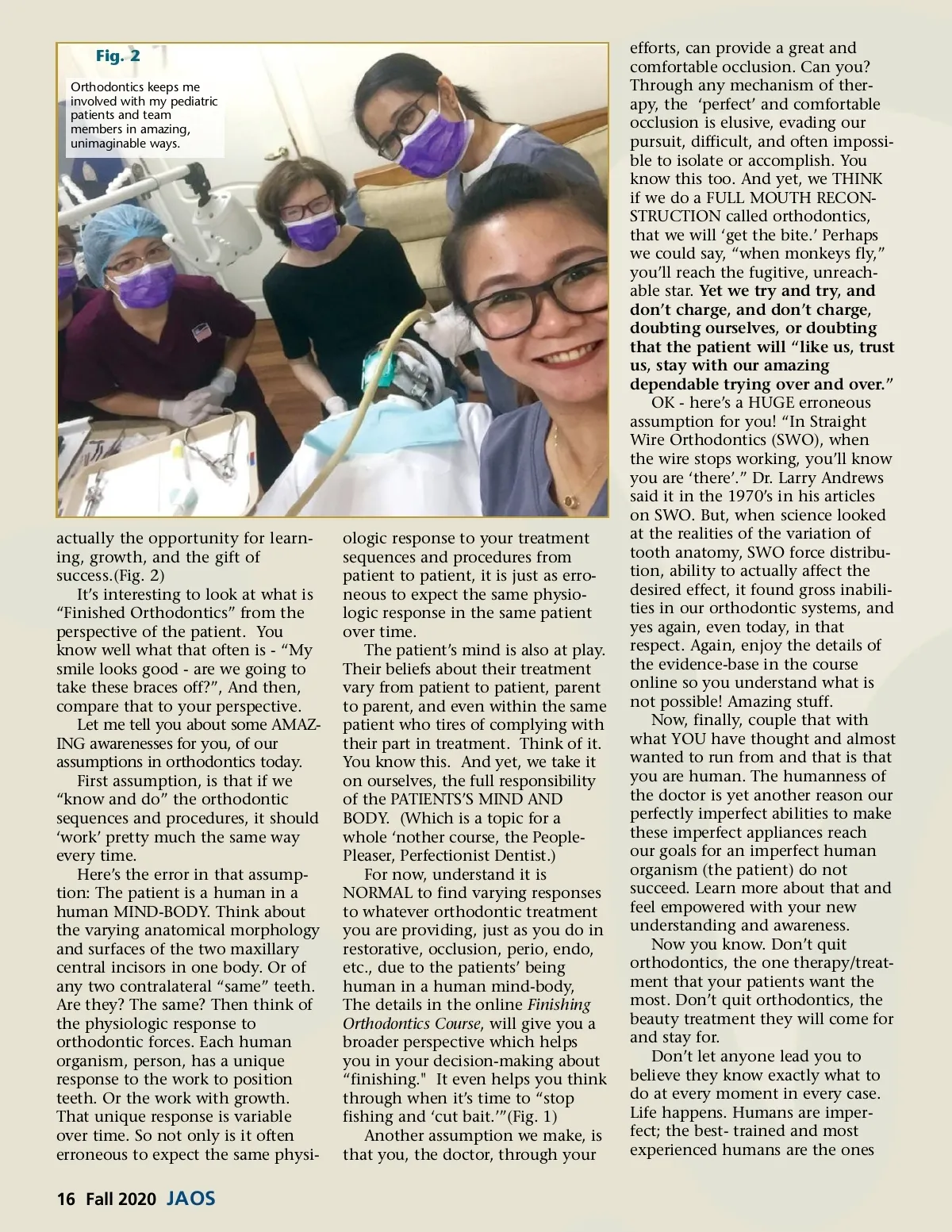
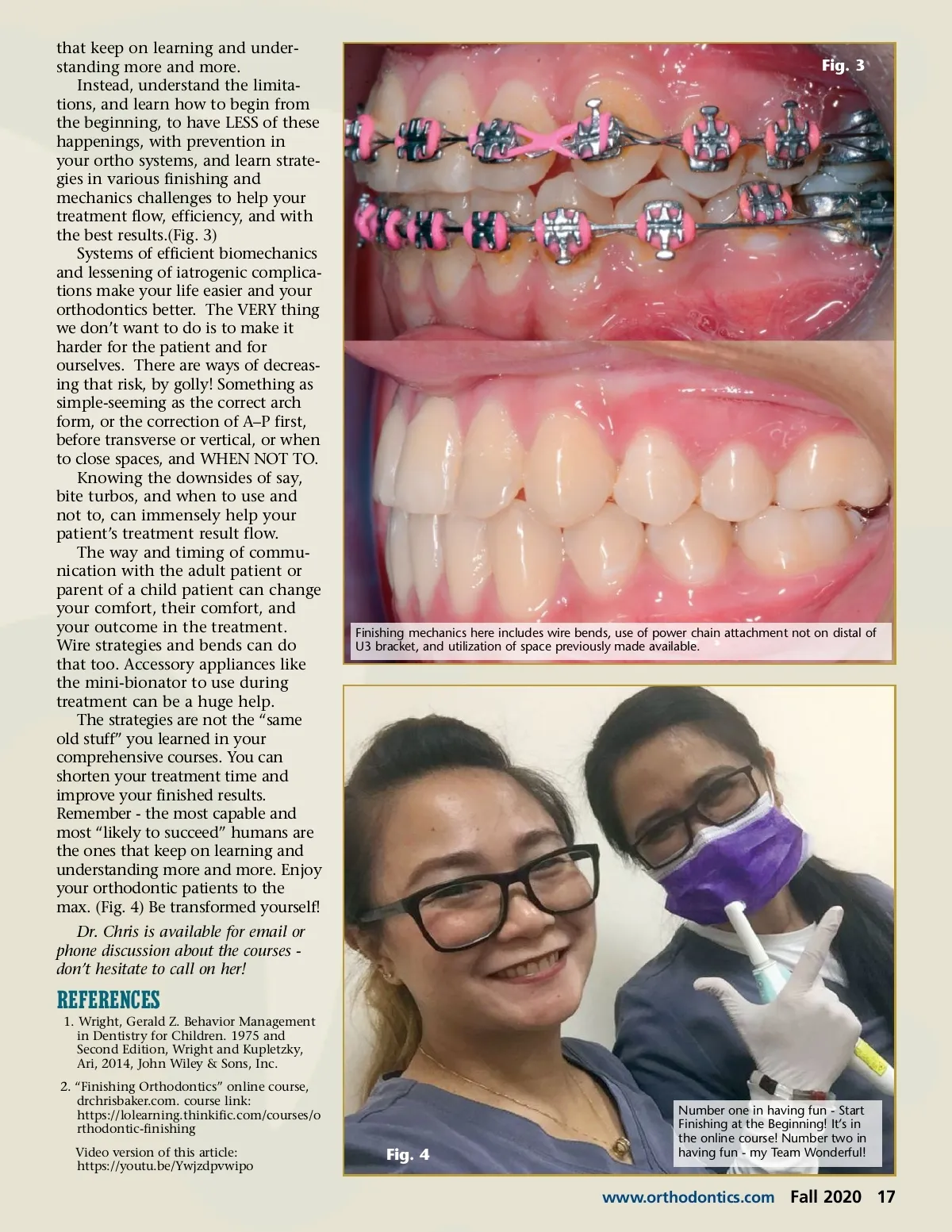
Fig. 2 Orthodontics keeps me involved with my pediatric patients and team members in amazing, unimaginable ways. actually the opportunity for learn-ing, growth, and the gift of success.(Fig. 2) It’s interesting to look at what is “Finished Orthodontics” from the perspective of the patient. You know well what that often is -“My smile looks good -are we going to take these braces off?”, And then, compare that to your perspective. Let me tell you about some AMAZ-ING awarenesses for you, of our assumptions in orthodontics today. First assumption, is that if we “know and do” the orthodontic sequences and procedures, it should ‘work’ pretty much the same way every time. Here’s the error in that assump-tion: The patient is a human in a human MIND-BODY. Think about the varying anatomical morphology and surfaces of the two maxillary central incisors in one body. Or of any two contralateral “same” teeth. Are they? The same? Then think of the physiologic response to orthodontic forces. Each human organism, person, has a unique response to the work to position teeth. Or the work with growth. That unique response is variable over time. So not only is it often erroneous to expect the same physi-ologic response to your treatment sequences and procedures from patient to patient, it is just as erro-neous to expect the same physio-logic response in the same patient over time. The patient’s mind is also at play. Their beliefs about their treatment vary from patient to patient, parent to parent, and even within the same patient who tires of complying with their part in treatment. Think of it. You know this. And yet, we take it on ourselves, the full responsibility of the PATIENTS’S MIND AND BODY. (Which is a topic for a whole ‘nother course, the People-Pleaser, Perfectionist Dentist.) For now, understand it is NORMAL to find varying responses to whatever orthodontic treatment you are providing, just as you do in restorative, occlusion, perio, endo, etc., due to the patients’ being human in a human mind-body, The details in the online Finishing Orthodontics Course , will give you a broader perspective which helps you in your decision-making about “finishing." It even helps you think through when it’s time to “stop fishing and ‘cut bait.’”(Fig. 1) Another assumption we make, is that you, the doctor, through your efforts, can provide a great and comfortable occlusion. Can you? Through any mechanism of ther-apy, the ‘perfect’ and comfortable occlusion is elusive, evading our pursuit, difficult, and often impossi-ble to isolate or accomplish. You know this too. And yet, we THINK if we do a FULL MOUTH RECON-STRUCTION called orthodontics, that we will ‘get the bite.’ Perhaps we could say, “when monkeys fly,” you’ll reach the fugitive, unreach-able star. Yet we try and try, and don’t charge, and don’t charge, doubting ourselves, or doubting that the patient will “like us, trust us, stay with our amazing dependable trying over and over.” OK -here’s a HUGE erroneous assumption for you! “In Straight Wire Orthodontics (SWO), when the wire stops working, you’ll know you are ‘there’.” Dr. Larry Andrews said it in the 1970’s in his articles on SWO. But, when science looked at the realities of the variation of tooth anatomy, SWO force distribu-tion, ability to actually affect the desired effect, it found gross inabili-ties in our orthodontic systems, and yes again, even today, in that respect. Again, enjoy the details of the evidence-base in the course online so you understand what is not possible! Amazing stuff. Now, finally, couple that with what YOU have thought and almost wanted to run from and that is that you are human. The humanness of the doctor is yet another reason our perfectly imperfect abilities to make these imperfect appliances reach our goals for an imperfect human organism (the patient) do not succeed. Learn more about that and feel empowered with your new understanding and awareness. Now you know. Don’t quit orthodontics, the one therapy/treat-ment that your patients want the most. Don’t quit orthodontics, the beauty treatment they will come for and stay for. Don’t let anyone lead you to believe they know exactly what to do at every moment in every case. Life happens. Humans are imper-fect; the best-trained and most experienced humans are the ones 16 Fall 2020 JAOS
Journal of the American Orthodontic Society Fall 2020: Page 16