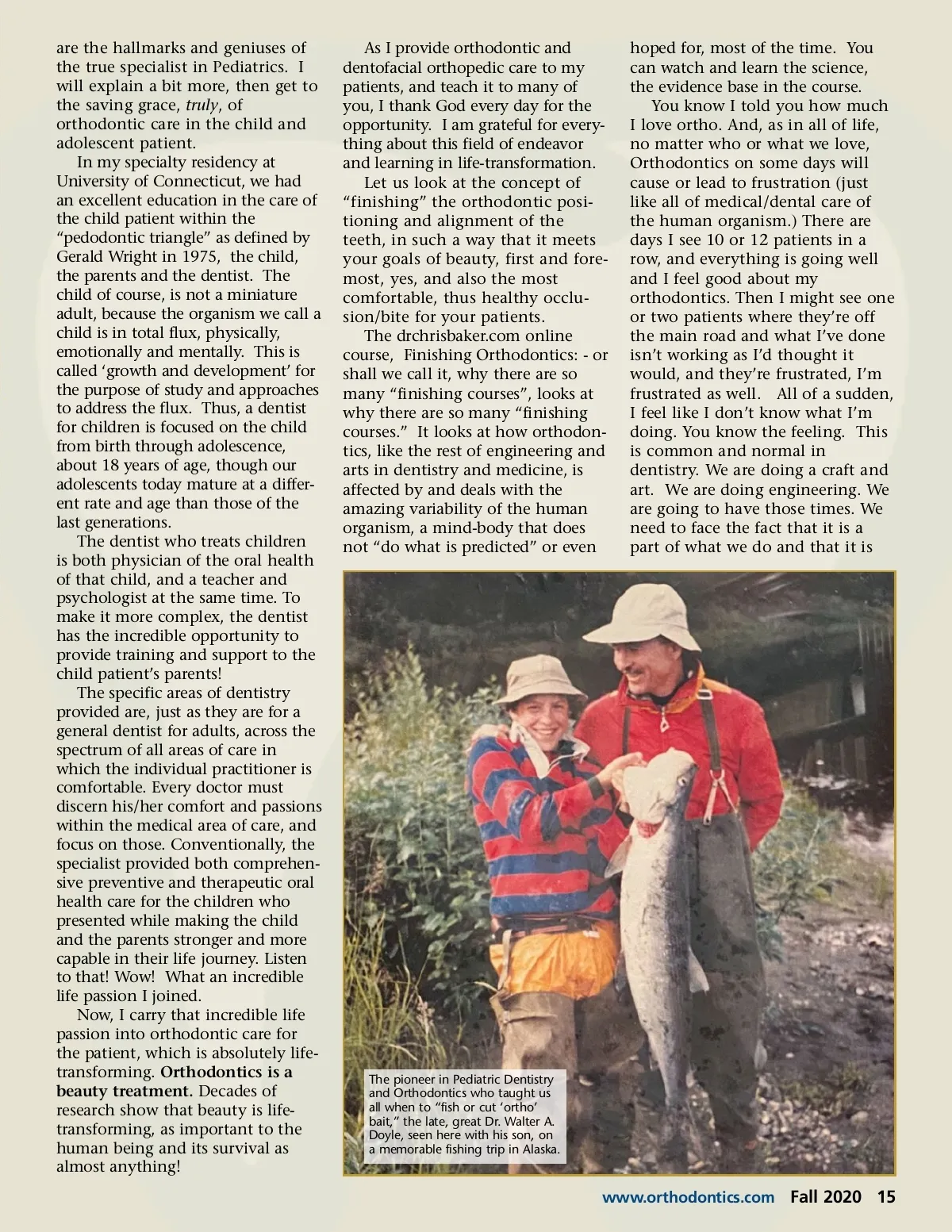
are the hallmarks and geniuses of the true specialist in Pediatrics. I will explain a bit more, then get to the saving grace, truly , of orthodontic care in the child and adolescent patient. In my specialty residency at University of Connecticut, we had an excellent education in the care of the child patient within the “pedodontic triangle” as defined by Gerald Wright in 1975, the child, the parents and the dentist. The child of course, is not a miniature adult, because the organism we call a child is in total flux, physically, emotionally and mentally. This is called ‘growth and development’ for the purpose of study and approaches to address the flux. Thus, a dentist for children is focused on the child from birth through adolescence, about 18 years of age, though our adolescents today mature at a differ-ent rate and age than those of the last generations. The dentist who treats children is both physician of the oral health of that child, and a teacher and psychologist at the same time. To make it more complex, the dentist has the incredible opportunity to provide training and support to the child patient’s parents! The specific areas of dentistry provided are, just as they are for a general dentist for adults, across the spectrum of all areas of care in which the individual practitioner is comfortable. Every doctor must discern his/her comfort and passions within the medical area of care, and focus on those. Conventionally, the specialist provided both comprehen-sive preventive and therapeutic oral health care for the children who presented while making the child and the parents stronger and more capable in their life journey. Listen to that! Wow! What an incredible life passion I joined. Now, I carry that incredible life passion into orthodontic care for the patient, which is absolutely life-transforming. Orthodontics is a beauty treatment. Decades of research show that beauty is life-transforming, as important to the human being and its survival as almost anything! As I provide orthodontic and dentofacial orthopedic care to my patients, and teach it to many of you, I thank God every day for the opportunity. I am grateful for every-thing about this field of endeavor and learning in life-transformation. Let us look at the concept of “finishing” the orthodontic posi-tioning and alignment of the teeth, in such a way that it meets your goals of beauty, first and fore-most, yes, and also the most comfortable, thus healthy occlu-sion/bite for your patients. The drchrisbaker.com online course, Finishing Orthodontics: -or shall we call it, why there are so many “finishing courses”, looks at why there are so many “finishing courses.” It looks at how orthodon-tics, like the rest of engineering and arts in dentistry and medicine, is affected by and deals with the amazing variability of the human organism, a mind-body that does not “do what is predicted” or even hoped for, most of the time. You can watch and learn the science, the evidence base in the course. You know I told you how much I love ortho. And, as in all of life, no matter who or what we love, Orthodontics on some days will cause or lead to frustration (just like all of medical/dental care of the human organism.) There are days I see 10 or 12 patients in a row, and everything is going well and I feel good about my orthodontics. Then I might see one or two patients where they’re off the main road and what I’ve done isn’t working as I’d thought it would, and they’re frustrated, I’m frustrated as well. All of a sudden, I feel like I don’t know what I’m doing. You know the feeling. This is common and normal in dentistry. We are doing a craft and art. We are doing engineering. We are going to have those times. We need to face the fact that it is a part of what we do and that it is The pioneer in Pediatric Dentistry and Orthodontics who taught us all when to “fish or cut ‘ortho’ bait,” the late, great Dr. Walter A. Doyle, seen here with his son, on a memorable fishing trip in Alaska. www.orthodontics.com Fall 2020 15
Journal of the American Orthodontic Society Fall 2020: Page 15