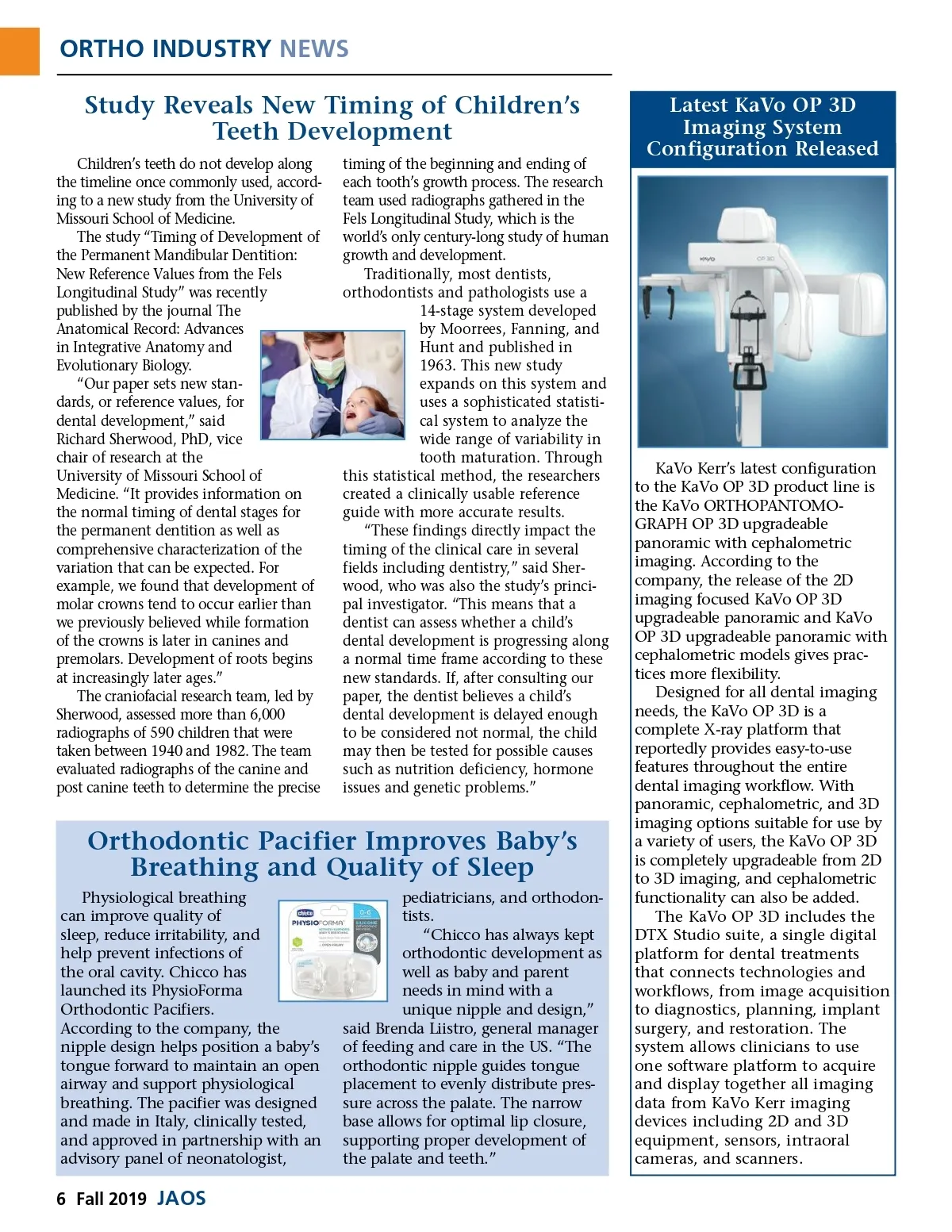
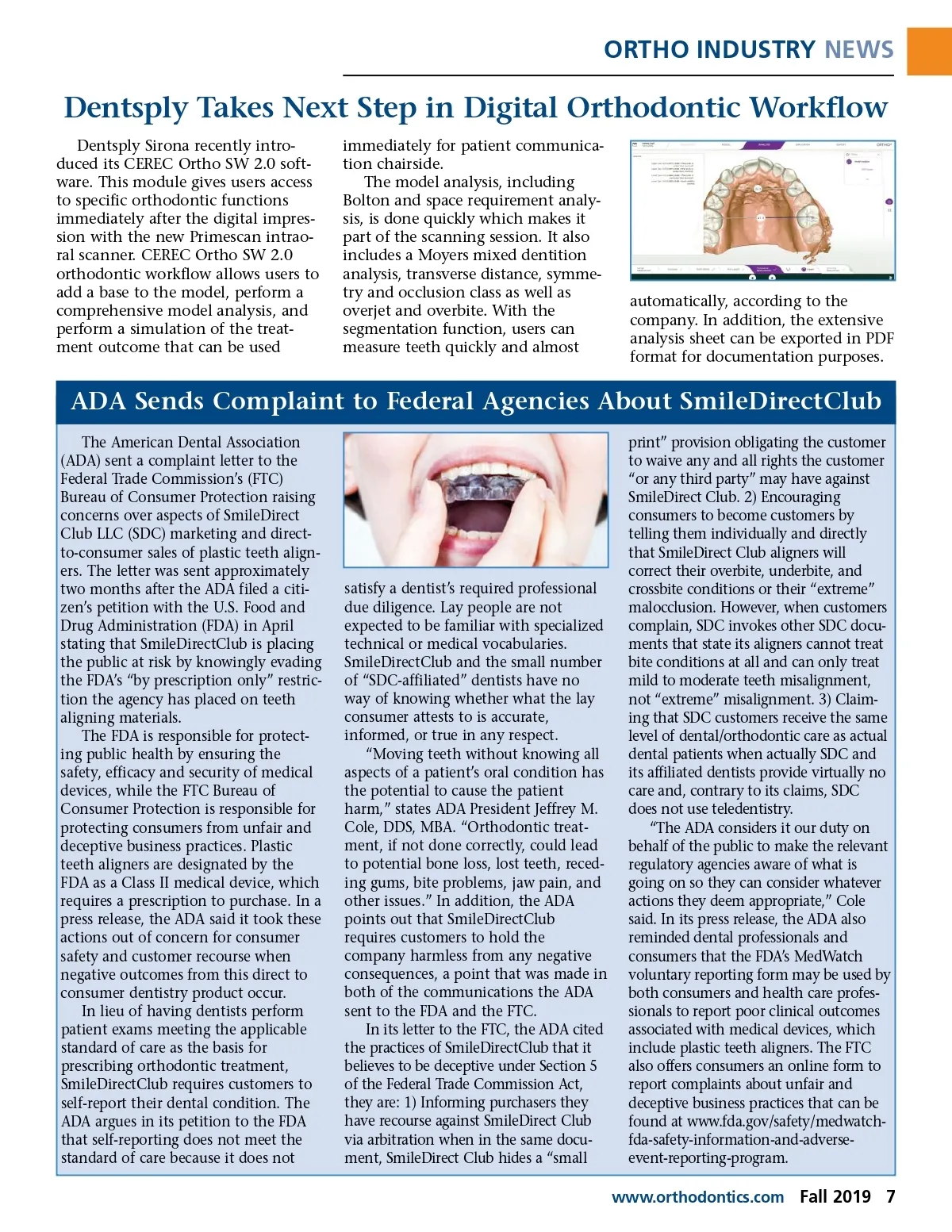
ORTHO INDUSTRY NEWS Dentsply Takes Next Step in Digital Orthodontic Workflow Dentsply Sirona recently intro-duced its CEREC Ortho SW 2.0 soft-ware. This module gives users access to specific orthodontic functions immediately after the digital impres-sion with the new Primescan intrao-ral scanner. CEREC Ortho SW 2.0 orthodontic workflow allows users to add a base to the model, perform a comprehensive model analysis, and perform a simulation of the treat-ment outcome that can be used immediately for patient communica-tion chairside. The model analysis, including Bolton and space requirement analy-sis, is done quickly which makes it part of the scanning session. It also includes a Moyers mixed dentition analysis, transverse distance, symme-try and occlusion class as well as overjet and overbite. With the segmentation function, users can measure teeth quickly and almost automatically, according to the company. In addition, the extensive analysis sheet can be exported in PDF format for documentation purposes. ADA Sends Complaint to Federal Agencies About SmileDirectClub The American Dental Association (ADA) sent a complaint letter to the Federal Trade Commission’s (FTC) Bureau of Consumer Protection raising concerns over aspects of SmileDirect Club LLC (SDC) marketing and direct-to-consumer sales of plastic teeth align-ers. The letter was sent approximately two months after the ADA filed a citi-zen’s petition with the U.S. Food and Drug Administration (FDA) in April stating that SmileDirectClub is placing the public at risk by knowingly evading the FDA’s “by prescription only” restric-tion the agency has placed on teeth aligning materials. The FDA is responsible for protect-ing public health by ensuring the safety, efficacy and security of medical devices, while the FTC Bureau of Consumer Protection is responsible for protecting consumers from unfair and deceptive business practices. Plastic teeth aligners are designated by the FDA as a Class II medical device, which requires a prescription to purchase. In a press release, the ADA said it took these actions out of concern for consumer safety and customer recourse when negative outcomes from this direct to consumer dentistry product occur. In lieu of having dentists perform patient exams meeting the applicable standard of care as the basis for prescribing orthodontic treatment, SmileDirectClub requires customers to self-report their dental condition. The ADA argues in its petition to the FDA that self-reporting does not meet the standard of care because it does not print” provision obligating the customer to waive any and all rights the customer “or any third party” may have against SmileDirect Club. 2) Encouraging consumers to become customers by telling them individually and directly that SmileDirect Club aligners will correct their overbite, underbite, and crossbite conditions or their “extreme” malocclusion. However, when customers complain, SDC invokes other SDC docu-ments that state its aligners cannot treat bite conditions at all and can only treat mild to moderate teeth misalignment, not “extreme” misalignment. 3) Claim-ing that SDC customers receive the same level of dental/orthodontic care as actual dental patients when actually SDC and its affiliated dentists provide virtually no care and, contrary to its claims, SDC does not use teledentistry. “The ADA considers it our duty on behalf of the public to make the relevant regulatory agencies aware of what is going on so they can consider whatever actions they deem appropriate,” Cole said. In its press release, the ADA also reminded dental professionals and consumers that the FDA’s MedWatch voluntary reporting form may be used by both consumers and health care profes-sionals to report poor clinical outcomes associated with medical devices, which include plastic teeth aligners. The FTC also offers consumers an online form to report complaints about unfair and deceptive business practices that can be found at www.fda.gov/safety/medwatch-fda-safety-information-and-adverse-event-reporting-program. www.orthodontics.com satisfy a dentist’s required professional due diligence. Lay people are not expected to be familiar with specialized technical or medical vocabularies. SmileDirectClub and the small number of “SDC-affiliated” dentists have no way of knowing whether what the lay consumer attests to is accurate, informed, or true in any respect. “Moving teeth without knowing all aspects of a patient’s oral condition has the potential to cause the patient harm,” states ADA President Jeffrey M. Cole, DDS, MBA. “Orthodontic treat-ment, if not done correctly, could lead to potential bone loss, lost teeth, reced-ing gums, bite problems, jaw pain, and other issues.” In addition, the ADA points out that SmileDirectClub requires customers to hold the company harmless from any negative consequences, a point that was made in both of the communications the ADA sent to the FDA and the FTC. In its letter to the FTC, the ADA cited the practices of SmileDirectClub that it believes to be deceptive under Section 5 of the Federal Trade Commission Act, they are: 1) Informing purchasers they have recourse against SmileDirect Club via arbitration when in the same docu-ment, SmileDirect Club hides a “small Fall 2019 7
Journal of the American Orthodontic Society Fall 2019: Page 7