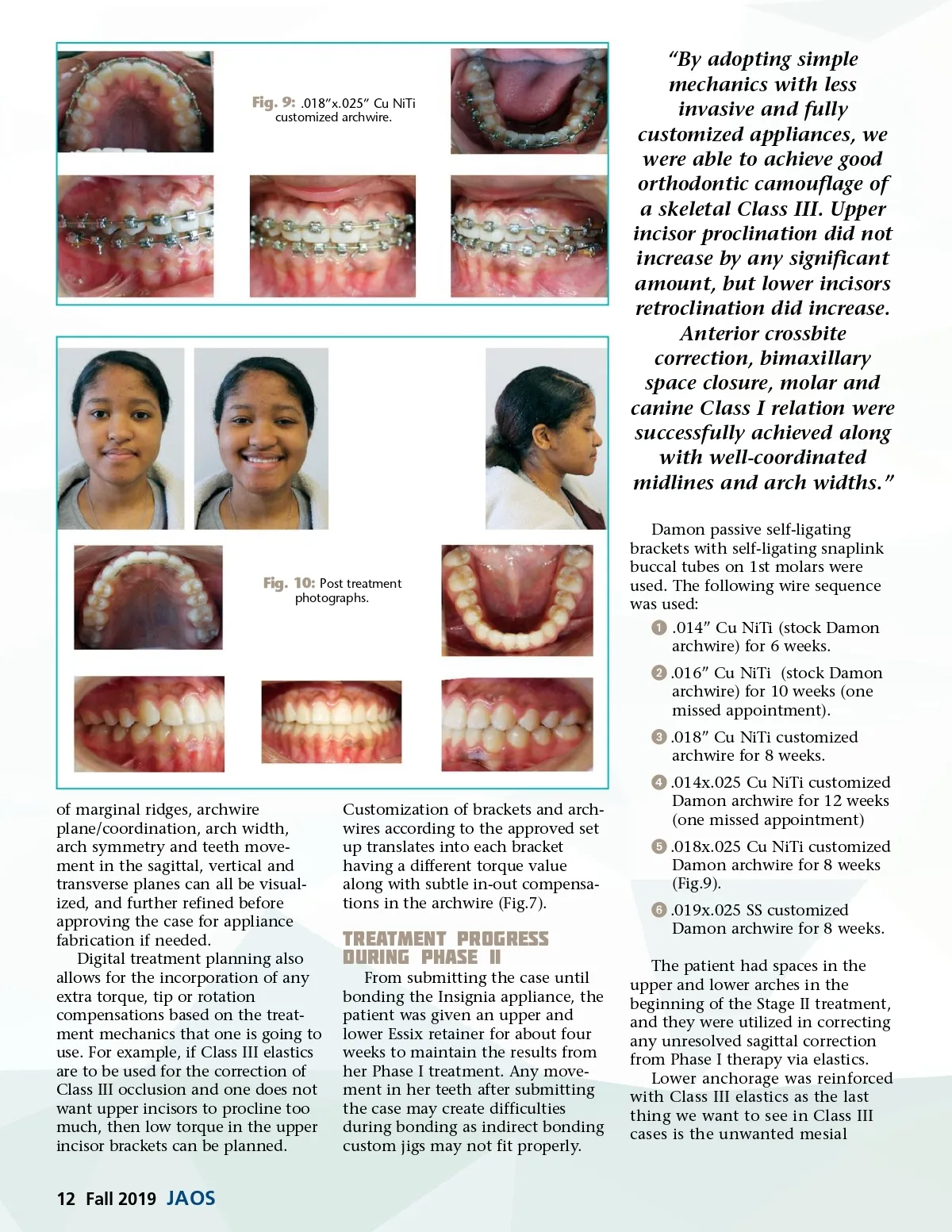
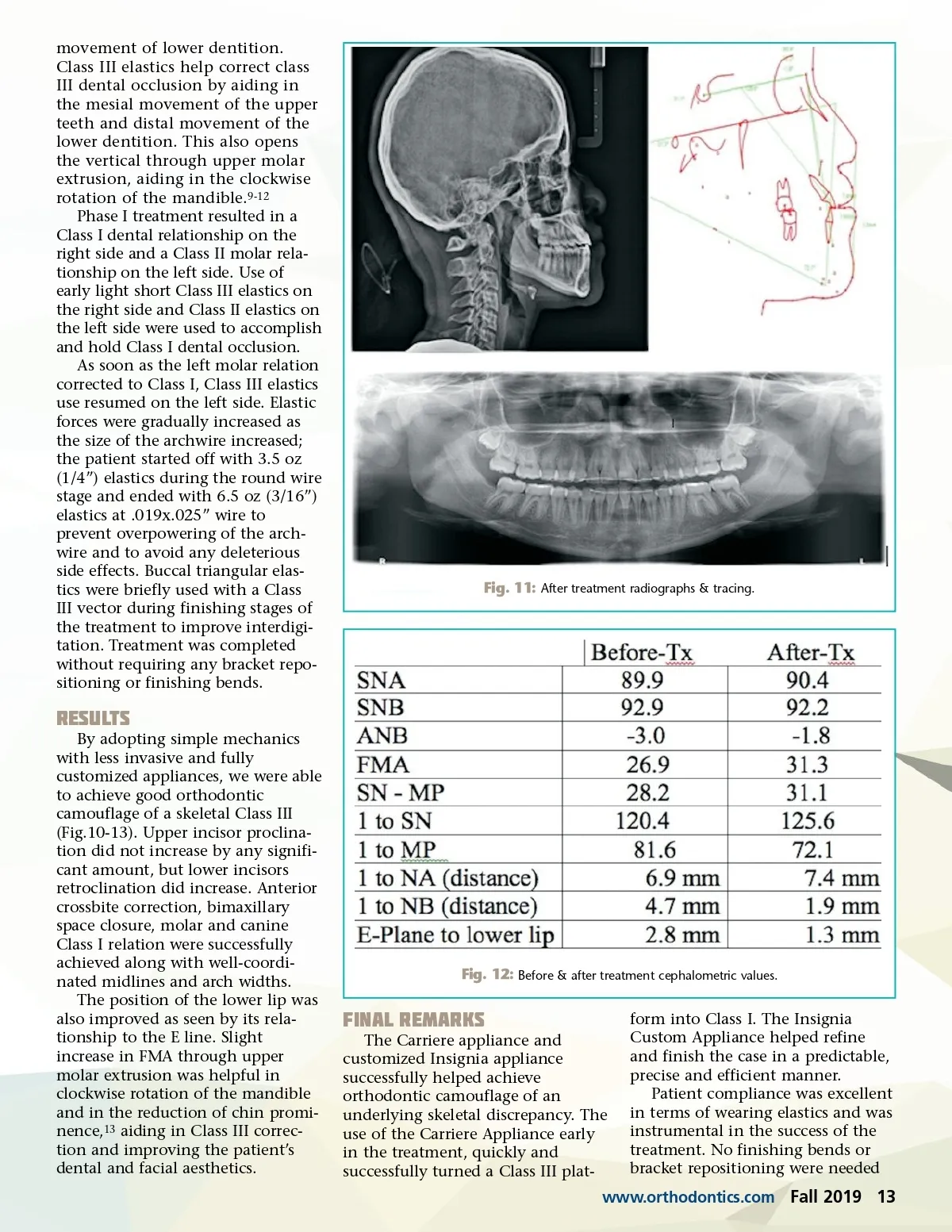
movement of lower dentition. Class III elastics help correct class III dental occlusion by aiding in the mesial movement of the upper teeth and distal movement of the lower dentition. This also opens the vertical through upper molar extrusion, aiding in the clockwise rotation of the mandible. 9-12 Phase I treatment resulted in a Class I dental relationship on the right side and a Class II molar rela-tionship on the left side. Use of early light short Class III elastics on the right side and Class II elastics on the left side were used to accomplish and hold Class I dental occlusion. As soon as the left molar relation corrected to Class I, Class III elastics use resumed on the left side. Elastic forces were gradually increased as the size of the archwire increased; the patient started off with 3.5 oz (1/4”) elastics during the round wire stage and ended with 6.5 oz (3/16”) elastics at .019x.025” wire to prevent overpowering of the arch-wire and to avoid any deleterious side effects. Buccal triangular elas-tics were briefly used with a Class III vector during finishing stages of the treatment to improve interdigi-tation. Treatment was completed without requiring any bracket repo-sitioning or finishing bends. Fig. 11: After treatment radiographs & tracing. RESULTS By adopting simple mechanics with less invasive and fully customized appliances, we were able to achieve good orthodontic camouflage of a skeletal Class III (Fig.10-13). Upper incisor proclina-tion did not increase by any signifi-cant amount, but lower incisors retroclination did increase. Anterior crossbite correction, bimaxillary space closure, molar and canine Class I relation were successfully achieved along with well-coordi-nated midlines and arch widths. The position of the lower lip was also improved as seen by its rela-tionship to the E line. Slight increase in FMA through upper molar extrusion was helpful in clockwise rotation of the mandible and in the reduction of chin promi-nence, 13 aiding in Class III correc-tion and improving the patient’s dental and facial aesthetics. Fig. 12: Before & after treatment cephalometric values. FINAL REMARKS The Carriere appliance and customized Insignia appliance successfully helped achieve orthodontic camouflage of an underlying skeletal discrepancy. The use of the Carriere Appliance early in the treatment, quickly and successfully turned a Class III plat-form into Class I. The Insignia Custom Appliance helped refine and finish the case in a predictable, precise and efficient manner. Patient compliance was excellent in terms of wearing elastics and was instrumental in the success of the treatment. No finishing bends or bracket repositioning were needed www.orthodontics.com Fall 2019 13
Journal of the American Orthodontic Society Fall 2019: Page 13