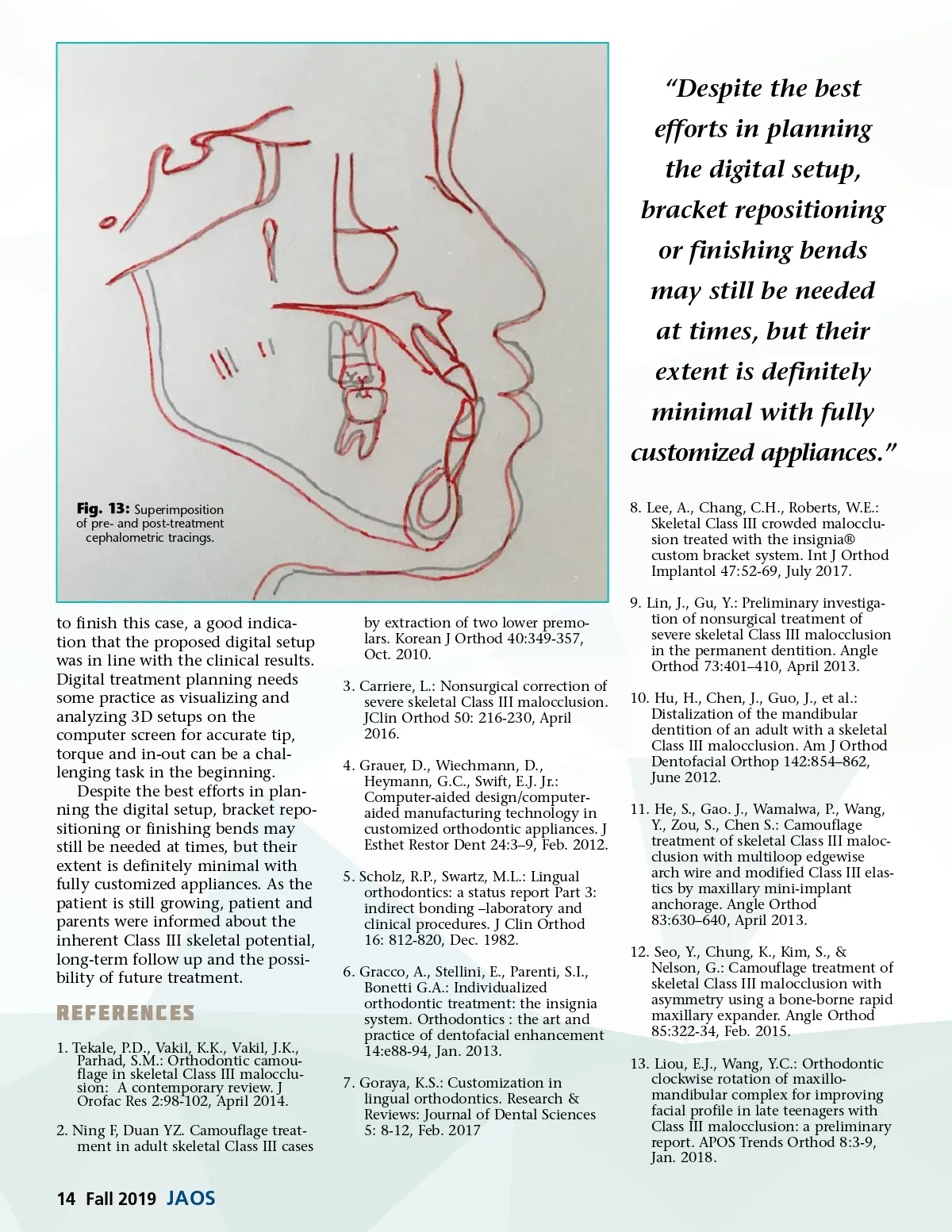
“Despite the best efforts in planning the digital setup, bracket repositioning or finishing bends may still be needed at times, but their extent is definitely minimal with fully customized appliances.” Fig. 13: Superimposition of pre-and post-treatment cephalometric tracings. 8. Lee, A., Chang, C.H., Roberts, W.E.: Skeletal Class III crowded malocclu-sion treated with the insignia® custom bracket system. Int J Orthod Implantol 47:52-69, July 2017. 9. Lin, J., Gu, Y.: Preliminary investiga-tion of nonsurgical treatment of severe skeletal Class III malocclusion in the permanent dentition. Angle Orthod 73:401–410, April 2013. 10. Hu, H., Chen, J., Guo, J., et al.: Distalization of the mandibular dentition of an adult with a skeletal Class III malocclusion. Am J Orthod Dentofacial Orthop 142:854–862, June 2012. 11. He, S., Gao. J., Wamalwa, P., Wang, Y., Zou, S., Chen S.: Camouflage treatment of skeletal Class III maloc-clusion with multiloop edgewise arch wire and modified Class III elas-tics by maxillary mini-implant anchorage. Angle Orthod 83:630–640, April 2013. 12. Seo, Y., Chung, K., Kim, S., & Nelson, G.: Camouflage treatment of skeletal Class III malocclusion with asymmetry using a bone-borne rapid maxillary expander. Angle Orthod 85:322-34, Feb. 2015. 13. Liou, E.J., Wang, Y.C.: Orthodontic clockwise rotation of maxillo-mandibular complex for improving facial profile in late teenagers with Class III malocclusion: a preliminary report. APOS Trends Orthod 8:3-9, Jan. 2018. to finish this case, a good indica-tion that the proposed digital setup was in line with the clinical results. Digital treatment planning needs some practice as visualizing and analyzing 3D setups on the computer screen for accurate tip, torque and in-out can be a chal-lenging task in the beginning. Despite the best efforts in plan-ning the digital setup, bracket repo-sitioning or finishing bends may still be needed at times, but their extent is definitely minimal with fully customized appliances. As the patient is still growing, patient and parents were informed about the inherent Class III skeletal potential, long-term follow up and the possi-bility of future treatment. by extraction of two lower premo-lars. Korean J Orthod 40:349-357, Oct. 2010. 3. Carriere, L.: Nonsurgical correction of severe skeletal Class III malocclusion. JClin Orthod 50: 216-230, April 2016. 4. Grauer, D., Wiechmann, D., Heymann, G.C., Swift, E.J. Jr.: Computer-aided design/computer-aided manufacturing technology in customized orthodontic appliances. J Esthet Restor Dent 24:3–9, Feb. 2012. 5. Scholz, R.P., Swartz, M.L.: Lingual orthodontics: a status report Part 3: indirect bonding –laboratory and clinical procedures. J Clin Orthod 16: 812-820, Dec. 1982. 6. Gracco, A., Stellini, E., Parenti, S.I., Bonetti G.A.: Individualized orthodontic treatment: the insignia system. Orthodontics : the art and practice of dentofacial enhancement 14:e88-94, Jan. 2013. 7. Goraya, K.S.: Customization in lingual orthodontics. Research & Reviews: Journal of Dental Sciences 5: 8-12, Feb. 2017 REFERENCES 1. Tekale, P.D., Vakil, K.K., Vakil, J.K., Parhad, S.M.: Orthodontic camou-flage in skeletal Class III malocclu-sion: A contemporary review. J Orofac Res 2:98-102, April 2014. 2. Ning F, Duan YZ. Camouflage treat-ment in adult skeletal Class III cases 14 Fall 2019 JAOS
Journal of the American Orthodontic Society Fall 2019: Page 14