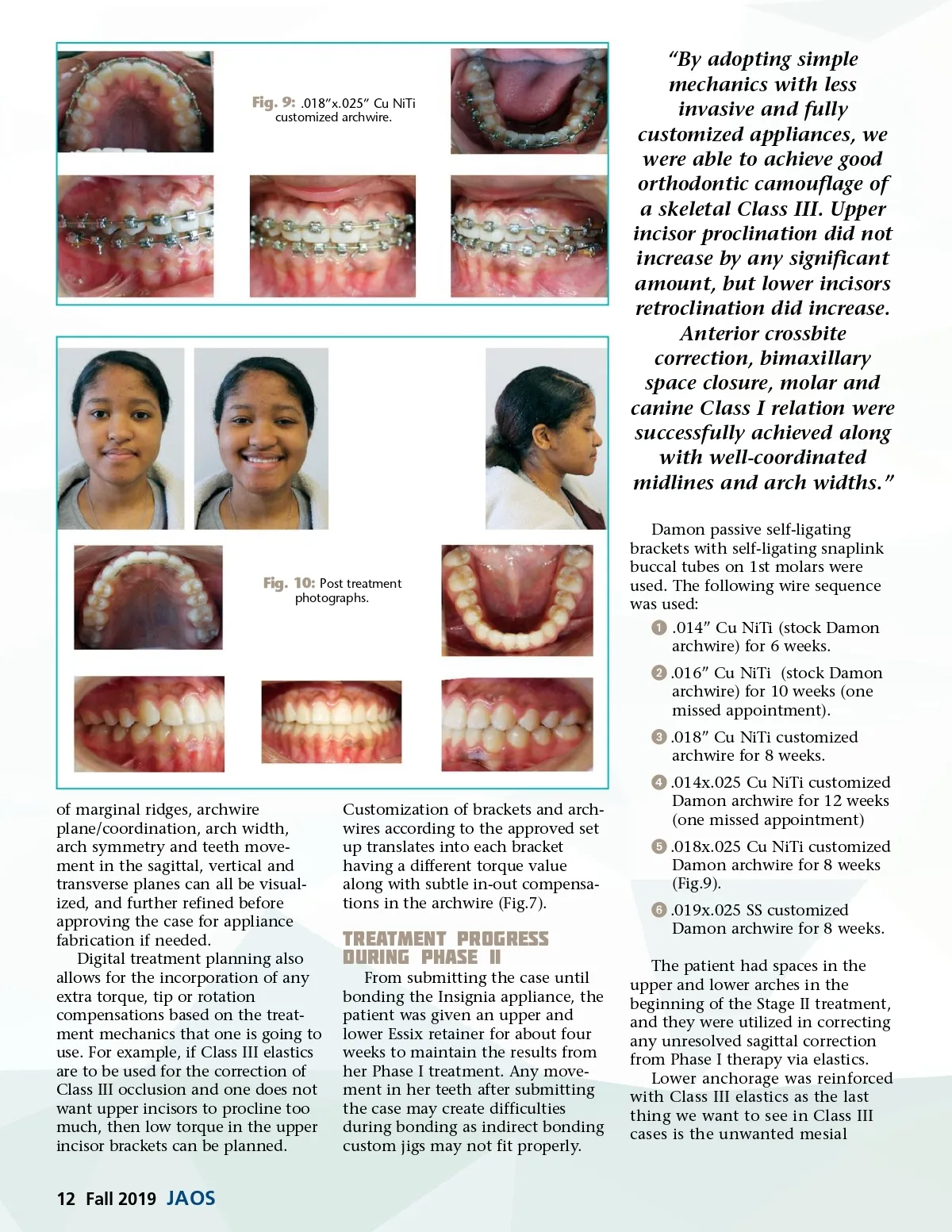
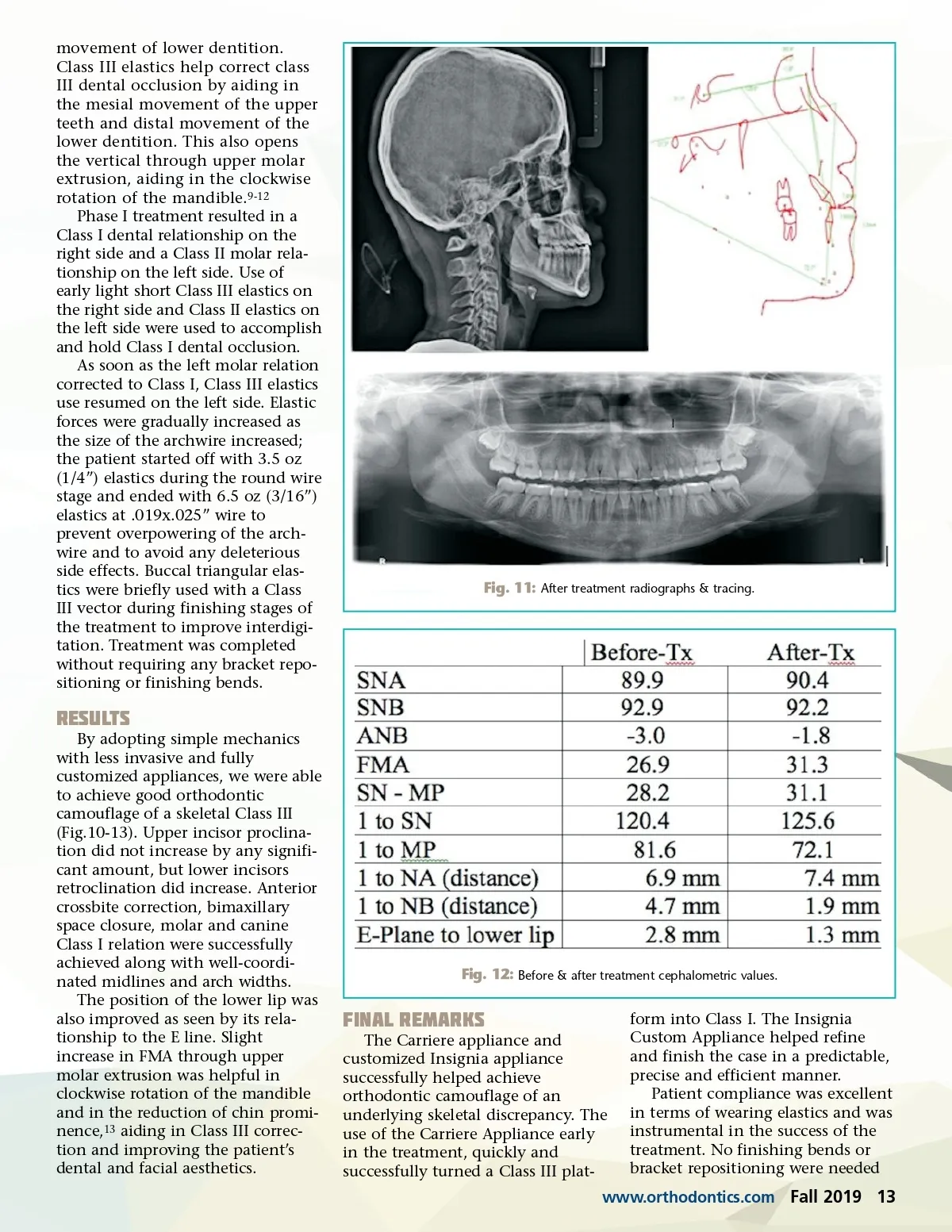
Fig. 9: .018”x.025” Cu NiTi customized archwire. “By adopting simple mechanics with less invasive and fully customized appliances, we were able to achieve good orthodontic camouflage of a skeletal Class III. Upper incisor proclination did not increase by any significant amount, but lower incisors retroclination did increase. Anterior crossbite correction, bimaxillary space closure, molar and canine Class I relation were successfully achieved along with well-coordinated midlines and arch widths.” Damon passive self-ligating brackets with self-ligating snaplink buccal tubes on 1st molars were used. The following wire sequence was used: ᕡ .014” Cu NiTi (stock Damon archwire) for 6 weeks. ᕢ .016” Cu NiTi (stock Damon archwire) for 10 weeks (one missed appointment). ᕣ .018” Cu NiTi customized archwire for 8 weeks. Fig. 10: Post treatment photographs. of marginal ridges, archwire plane/coordination, arch width, arch symmetry and teeth move-ment in the sagittal, vertical and transverse planes can all be visual-ized, and further refined before approving the case for appliance fabrication if needed. Digital treatment planning also allows for the incorporation of any extra torque, tip or rotation compensations based on the treat-ment mechanics that one is going to use. For example, if Class III elastics are to be used for the correction of Class III occlusion and one does not want upper incisors to procline too much, then low torque in the upper incisor brackets can be planned. Customization of brackets and arch-wires according to the approved set up translates into each bracket having a different torque value along with subtle in-out compensa-tions in the archwire (Fig.7). ᕤ .014x.025 Cu NiTi customized Damon archwire for 12 weeks (one missed appointment) ᕥ .018x.025 Cu NiTi customized Damon archwire for 8 weeks (Fig.9). ᕦ .019x.025 SS customized Damon archwire for 8 weeks. The patient had spaces in the upper and lower arches in the beginning of the Stage II treatment, and they were utilized in correcting any unresolved sagittal correction from Phase I therapy via elastics. Lower anchorage was reinforced with Class III elastics as the last thing we want to see in Class III cases is the unwanted mesial Treatment Progress during Phase II From submitting the case until bonding the Insignia appliance, the patient was given an upper and lower Essix retainer for about four weeks to maintain the results from her Phase I treatment. Any move-ment in her teeth after submitting the case may create difficulties during bonding as indirect bonding custom jigs may not fit properly. 12 Fall 2019 JAOS
Journal of the American Orthodontic Society Fall 2019: Page 12