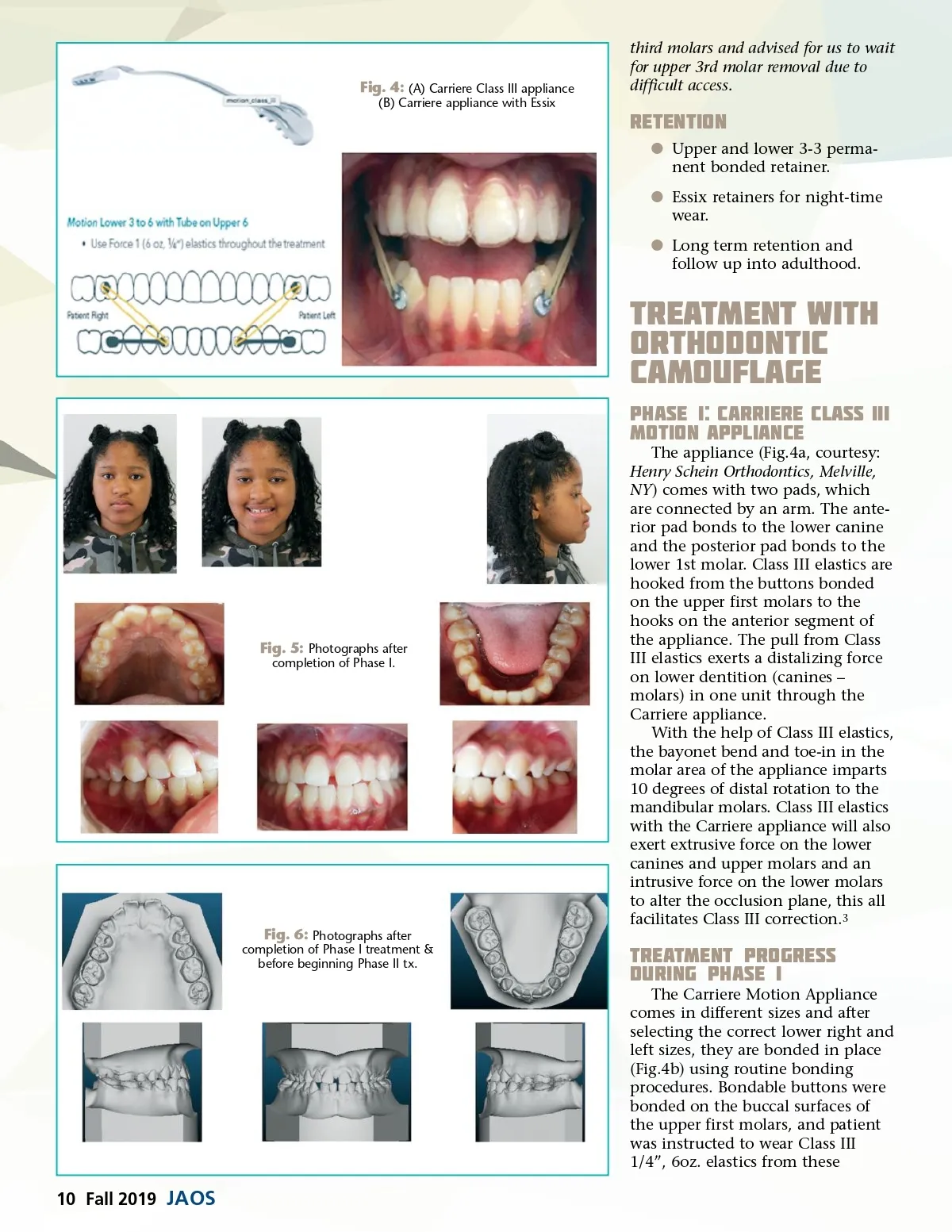
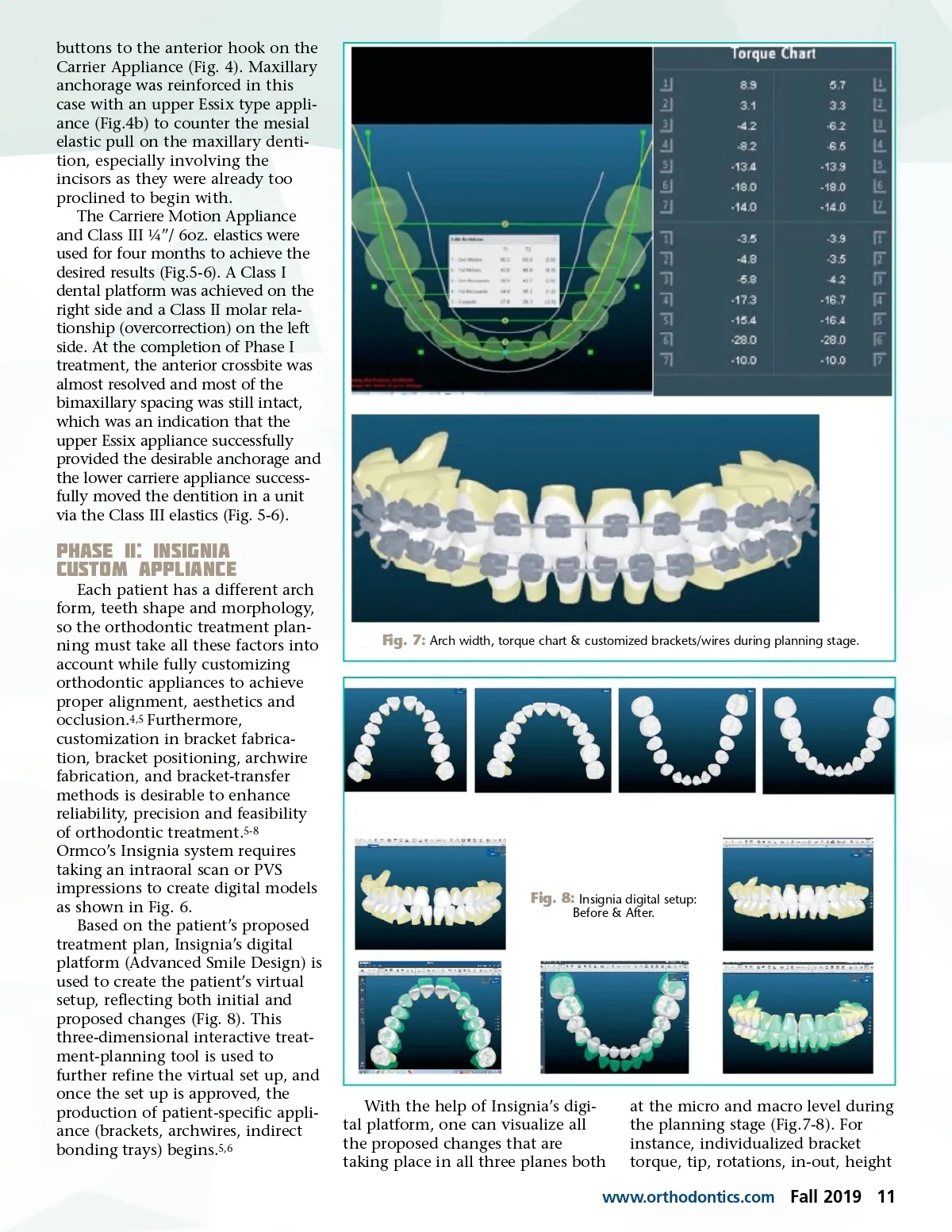
buttons to the anterior hook on the Carrier Appliance (Fig. 4). Maxillary anchorage was reinforced in this case with an upper Essix type appli-ance (Fig.4b) to counter the mesial elastic pull on the maxillary denti-tion, especially involving the incisors as they were already too proclined to begin with. The Carriere Motion Appliance and Class III ¼”/ 6oz. elastics were used for four months to achieve the desired results (Fig.5-6). A Class I dental platform was achieved on the right side and a Class II molar rela-tionship (overcorrection) on the left side. At the completion of Phase I treatment, the anterior crossbite was almost resolved and most of the bimaxillary spacing was still intact, which was an indication that the upper Essix appliance successfully provided the desirable anchorage and the lower carriere appliance success-fully moved the dentition in a unit via the Class III elastics (Fig. 5-6). Phase II: Insignia Custom Appliance Each patient has a different arch form, teeth shape and morphology, so the orthodontic treatment plan-ning must take all these factors into account while fully customizing orthodontic appliances to achieve proper alignment, aesthetics and occlusion. 4,5 Furthermore, customization in bracket fabrica-tion, bracket positioning, archwire fabrication, and bracket-transfer methods is desirable to enhance reliability, precision and feasibility of orthodontic treatment. 5-8 Ormco’s Insignia system requires taking an intraoral scan or PVS impressions to create digital models as shown in Fig. 6. Based on the patient’s proposed treatment plan, Insignia’s digital platform (Advanced Smile Design) is used to create the patient’s virtual setup, reflecting both initial and proposed changes (Fig. 8). This three-dimensional interactive treat-ment-planning tool is used to further refine the virtual set up, and once the set up is approved, the production of patient-specific appli-ance (brackets, archwires, indirect bonding trays) begins. 5,6 Fig. 7: Arch width, torque chart & customized brackets/wires during planning stage. Fig. 8: Insignia digital setup: Before & After. With the help of Insignia’s digi-tal platform, one can visualize all the proposed changes that are taking place in all three planes both at the micro and macro level during the planning stage (Fig.7-8). For instance, individualized bracket torque, tip, rotations, in-out, height www.orthodontics.com Fall 2019 11
Journal of the American Orthodontic Society Fall 2019: Page 11